
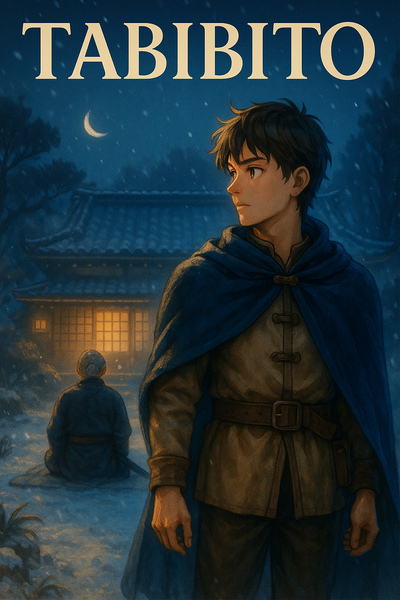
With a gasp he jolted upright—no snow, no tatami, no night; only mid-morning sun and the familiar scratch of meadow grass against his palms. A field-lark shot skyward, startled by his sudden lurch, while two copper-blue dragonflies fussed beside the garden fence. At fourteen and three-quarter summers—not quite fifteen yet, though he rounded the number in his head—Akio brushed clinging blades from his tunic. He lay just outside his family’s cottage, deep in the sprawling hinterlands of Rathvale. A leather-bound book lolled open at his side: The Epics of the Western Rim—legends from Continent Three. A ribbon bookmark fluttered in the breeze, pointing to a chapter on “City-States Beyond the Red Dunes.” He had read until the singing of crickets blurred into lullaby, then drifted into that sword-haunted dream yet again. He flexed his left arm. A vine-like mark—inky blue, almost luminous—curved from wrist to elbow: relic of a reckless experiment with crushed nightmoth wings and solvent oils. Not a burn, not quite a tattoo; a thing that simply was, stubbornly permanent, as though the substance had decided his skin would make an agreeable home.
I keep dying different ways in places I’ve never been, he mused, but the pain always feels perfectly remembered.
He closed the volume and pushed to his feet, joints clicking from the awkward nap angle. Somewhere inside the cottage, iron rang rhythmically; his father must already be at the forge. The scent of baking rye drifted from a clay oven near the bazar square where his mother worked. Everything was just as it should be. Calm, ordinary, safe. The dream’s chill lingered like a hand on his spine, but the meadow’s warmth pressed back. Peace. Calm. Ordinary. At least on the surface.
Rathvale counted one-hundred-fifty souls, give or take a newborn lamb and two traveling tinkers who refused to be tallied. Cottages wore thatched roofs patched with river reeds; window shutters sported sun-faded paint in blues and reds no dyer could replicate twice. The single watchtower, leaning just enough to unsettle outsiders, hadn’t rung alarm in a dozen years. Paths of hard-packed earth crisscrossed barley fields, converging at the bazar square. Six permanent stalls formed a crooked horseshoe around a moss-splotched fountain. Farmers traded barley and plums, fishers hawked silver-scaled zander still flicking water, and the occasional bard swapped news for a mug of ale. Magic glimmered only at the periphery of daily life—rarer than emeralds, half-feared, half-revered. Rathvale fostered precisely two families with any knack at all:
- The Van Halens, merchant lords of the river trade. Matriarch Celania bent space with pocket-sigils so cargo barrels seemed to slide through invisible doors. Townsfolk insisted her family wagons could glide uphill.
- The Morrows, modest carpenters whose patriarch coaxed saplings to grow fence posts overnight. Useful, unassuming sorcery that kept goats in and wolves out.
No academies, no guild halls, no shimmering towers of robed savants—only the odd bloodline trick passed down like an heirloom tool. Even identical intentions birthed different miracles; no two fireballs ever flew alike. Everyone else lived by muscle, barter, and a conviction that steady routine held chaos at bay.
Inside the cottage, the forge room crackled with heat. Arthurs, bare-armed and sweat-sheened, drew a length of orange steel from the coals. Sparks burst like day-fireflies as he hammered rhythm into iron. Akio pushed open the forge’s plank door. Heat slapped his cheeks; sparks pirouetted in air thick with pine resin. His father, Arthur, stood over the anvil: tall as a mid-summer scarecrow yet twice as broad, shoulders knotted like cedar roots. At forty-four, Arthur wore age lightly—only twin crescents of gray kissed the bristled beard framing a smile the color of sunrise iron. Today he worked in shabby trousers and a scorched linen tunic. Hammer rose and fell with metronomic grace, each strike ringing a promise of strength into the glowing sword blank. Yet outside the forge, Arthur favored crisp waistcoats, polished boots, and wool coats cut to flatter his form—a smith who became a gentleman the moment soot no longer touched him.
“Morning, cub,” he rumbled, deep-blue eyes glinting through the haze. “Dreaming in daylight again?”
Akio grabbed bellows to steady the heat. “Just a nap.”
Later, Freyr waited at the bazar bakery stall, arranging rye loaves in pleasing spirals. She stood barely to Arthur’s collarbone, yet commanded any space with effortless poise. Long brown hair cascaded past her waist, catching sun in auburn ribbons. Her dark-brown eyes held both mirth and secrets; point-tipped ears, subtle but unmistakable, lent her an almost elven grace. Freyr’s figure turned heads—young traders often stumbled mid-sentence—but her smiles deflected questions about herself, steering talk toward their hopes, their miseries. She was kindness woven with caution. And she loved her children fiercely—though love, Akio sensed, could wear masks. Hovering nearby like a hungry jackal, Ekkehard—the Van Halen caravan guard—flashed his usual wolfish grin. Muscles strained beneath leather brigandine; mid-length hair fell messily into eyes too fond of mischief. Freyr laughed at something he whispered, fingers brushing his forearm in a gesture casual to everyone except her eldest child. When the guard leaned to whisper, her laughter tilted one shade too fond. The boy marked it—the fractional lean of her hips, the swift tuck of loose hair behind her ear—and stored the observation without comment. Across the square, Vesta twirled through puddles, a blur of sky-blue eyes and mid-length blonde hair. A daisy—tucked behind her ear by Freyr at dawn—now drooped sideways, petals muddied from play. Her favorite lavender dress bore fresh grass stains, and one shin sported a purple bruise shaped suspiciously like a goat hoof.
She dashed up to Akio, thrusting a fistful of ladybugs onto his palm as though bestowing a royal offering. “Look! They’re all friends. I counted."
He crouched, ruffled her tangled hair. “You know insects don’t stay still long enough to be friends.”
“They do if you ask nicely,” she insisted with solemn conviction.
Peace lived in that small exchange—pure, bright, fragile.
Love permeated the family like hearth-warmth, yet to his eyes it bore fissures: micro-cracks invisible until hindsight or pressure. Perhaps every structure did.





Comments (0)
See all