
The second harvest after the festival came in heavy, bending barley stalks until they whispered like tired men exchanging secrets. Cart‐loads rattled across the foot-bridge morning to dusk, and its planks—extra thin, because village coffers had balked at Oak-Master Garrick’s thicker invoice—held without groan or warp. Each time a wagon rolled clear, folk in the tavern lifted mugs to “good Rathvale craftsmanship” or to “old Jeb’s saw,” but no one toasted the diagram Akio once unfurled explaining buoyancy coefficients, cyclic strain, or why iron collars—the very ones Arthur still kept in a burlap sack—would double the bridge’s lifespan. Akio heard the praise anyway, each omission striking like a tiny invisible nail driven beneath fingernails.
On long twilights he sat on the river wall, feet dangling above dark water that smelled of peat and distant rain. He would drop a reed, watch it swirl, imagine the barge system he’d sketched—flat-bottom hulls with sealed barrel banks, hoof-ramps hinged at bow and stern so carts could roll on, float across, roll off. He saw it so vividly that sometimes the water appeared to part, revealing a ghost vessel sliding beneath the shiny skin of the current. But when he blinked, it was only moonlight and an idea no one wanted. He plucked pebbles, skipping them until conscience pricked that he should be pumping the forge bellows or compiling rainfall tables. Yet even his diligence soured when matched against the village’s settled inertia. Eventually he began carving thin wooden feathers from driftwood; each stood for an uncredited notion. By year’s end the window-sill in his attic room bristled like a captured swan—dozens of pale reminders that cleverness without adoption grows brittle.
One fog-drenched dawn he woke to find every wooden feather realigned into a spiral. No wind could have done it. No footstep crossed the stair. He smiled in spite of himself—splinters still hurt, but mystery, at least, remembered his name.
At eleven Vesta’s legs outgrew her dresses twice in a single summer, leaving Freyr sighing over hem-extensions and hand-me-down repairs. The child’s imagination, however, outpaced even her limbs. She invented cloud taxonomies beyond Akio’s star charts—“whisper-sheep,” “thunder-stallions,” and a rare pink “sunset-foal” she claimed predicted double-rainbows. Villagers indulged her; laughter was a currency they could still afford.
One hectic froggy morning she staged a duckling coronation on the riverbank, complete with reed thrones and a diadem woven from marsh marigolds. Arthur took a break from shoeing the reeve’s gelding to watch, wiping sweat while his deep-blue eyes softened. When a duckling escaped and toppled the reed dais, Vesta merely bowed, declaring the accident a “festival of surprises.” She salvaged the scene by presenting each quacking vassal with a pebble she pronounced an “oath-stone.” Akio served as reluctant court historian, sketching the ceremony while calculating how long before ducklings swallowed ribbon tassels. He wondered if childhood audacity could be bottled—an elixir for later years when courage wanes. That evening, during supper, Vesta asked whether clouds felt lonely drifting so high. Akio nearly choked on stew, startled by the question’s gentle profundity. He answered with a thought he’d never voiced: maybe clouds drift so they can carry stories from one town to the next.
Freyr watched the siblings, pride mingling with melancholy. She saw how Akio’s responses had slowed lately, as though each word passed through heavier doors. Catching her gaze, he managed a crooked grin—assurance, or attempt at it. Vesta, oblivious, leaned close to whisper that tomorrow she would teach beetles to joust astride blades of grass. The plan sounded impossible; therefore it excited her. Akio envied that metric.
At forge, star-iron sang a note no earthly ore could match: a keening undertone like wineglass rims stroked by storm-winds. Arthur heard it first when he pried open the courier’s casket. Akio heard it when the first hammer-ring met heated billet—tone layered atop vibration, reverberating through ribs and sternum. They worked nights so the glow would not draw gossip or envy; inside the forge, blue sparks sparked crimson, as though the metal’s own night sky had begun shedding constellations. The saber’s specification—“no fuller broader than a smile”—proved maddening. Arthur quenched, reheated, folded, ground; Akio timed heats, logged temperatures, fetched charcoal from pits he mixed to a secret ratio. Together they argued the metaphysics of edges, the philosophical difference between ceremonial steel meant to dazzle and steel meant to kill. Arthur rarely spoke of his youth, but one predawn lull he admitted he once forged pikes for a border garrison: “I watched wagons carry them away. Never saw a single pike return.” Then silence, and the hiss of star-iron cooling. It dawned on Akio that his father feared the saber might journey to battle regardless of pedigreed pomp.
When final polish came, the blade mirrored firelight in threads like trapped galaxies. Arthur wrapped it in wool, sealing unknown fates between layers. The courier retrieved it at sunrise, galloping north. Akio stood watching dust settle on the road, realizing some creations are exiles—born to depart the hands that nurtured them. Inside, the forge felt suddenly bigger, as if the empty space where the star-iron had rested was now its own silent apprentice.
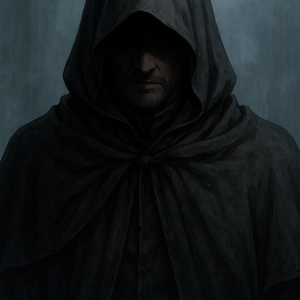
The hooded silhouette that had haunted festival edges never reappeared; still, Akio discovered spirals in uncanny places. One winter dawn he woke to frost-etched lines on his windowpane, looping in perfect whorls that resisted melting until the sun topped treetops. Another afternoon he reached for a barley sheaf and found the stalks braided into a helix—impossible handiwork, for barley snaps before bending so.
Moved by equal parts trepidation and curiosity, he began cataloging each finding: date, hour, weather, location, material. A pattern eluded him—except frequency spiked whenever he lingered in deep dissatisfaction or when his mind knotted over a difficult theorem. It felt as if some watcher liked to prod him precisely when stagnation threatened, leaving tokens that said, Move. Think. Become.
One moonless night Akio opened the cedar box, arranged every spiral on the hearth-stones by size, and studied them as one studies star charts. Lines appeared—constellations, knots, or letters—he did not know. Vesta wandered in sleepily, saw the shapes, and whispered, “They look like paths curling into forever.” Then she padded away, leaving the observation ringing.
He considered tossing the tokens into the forge—challenge the mystery to manifest in person. But he feared such finality might close a door leading somewhere he was meant to walk. Instead he locked the lid, muttered, “I’m listening,” and banked the fire, uneasy soul soothed only by the embers’ glow.



Comments (0)
See all