
Night in Solara was never truly dark.
The city’s veins of crystal glowed faintly, tracing its streets like molten rivers. Towers gleamed with captured starlight, their wards flickering softly against the cool air of the high mountains. Yet for all the beauty, shadows were never absent. They gathered beneath the arches, lingered behind statues, crept along colonnades where whispers carried better than wind.
And in those shadows, Calithra moved.
Her steps made no sound on the marble. A half-dozen figures trailed her — not openly, but woven into the gloom, cloaked in glyphs of silence. They were her acolytes, men and women drawn not by loyalty but by threads of fear, favors, and forbidden knowledge.
Tonight they convened not in the great hall, but in a side chamber older than the palace itself — a vault carved into the mountain long before Solara’s crown gleamed.
The chamber smelled of dust and old fire. Runes scarred the walls, ancient sigils of warding meant to keep intruders out. But where others saw barriers, Calithra saw tools. She brushed her hand across the glyphs, and they pulsed faintly, then bent to her will.
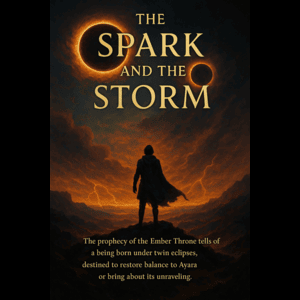
A crystal sphere floated above the central table, glowing with the reflection of the twin eclipses.
“Everything bends toward this,” she said, her voice low, smooth. “The prophecy. The fire-born heir. The throne that may burn or save. And yet the king blinds himself, calling flame only a blessing.”
One of the acolytes, a gaunt man with silver-threaded eyes, asked, “And the Rite? He is bound now. To her.”
Calithra’s lips curved, not quite into a smile. “Yes. Bound to the earth-girl. She strengthens him. She anchors him. But anchors can drown ships as easily as steady them. The Verdant Core sleeps in her blood — and when the Shadowspire stirs, it will wake. Then let us see how strong their bond remains.”
Her hand hovered over the sphere. The eclipses shimmered, then twisted into the image of Ravyn’s citadel — black towers clawing against the void, ten spectral forms circling like vultures.
“Already he moves,” she whispered. “Already the first threads are pulled.”
Elsewhere, in the golden halls, Rael slept poorly.
Dreams of fire plagued him — not gentle warmth, but roaring, consuming blaze. He saw armies of ash rising from molten plains, heard the Phoenix’s cry splinter into a thousand screams. Again and again he reached for his sword, but flame devoured steel, and when he turned, Sira was gone.
He woke with a start, breath sharp, sweat dampening his tunic.
“Another dream?” Lakvenor’s voice was thick with sleep. He sat up on the nearby couch, rubbing his eyes. His storm-staff leaned against the wall, faint arcs of lightning twitching along its runes as though responding to Rael’s unease.
Rael nodded. “The same. Fire without end. Loss I cannot stop.”
Lakvenor scowled. “Prophecy again. Always prophecy. I swear these dreams are less from gods and more from that snake Calithra whispering doubt into the air.”
Despite himself, Rael chuckled softly. “You give her more credit than she deserves.”
“Do I?” Lakvenor shot back. “I’ve watched her. She coils words like chains. One day Father listens too closely, and—” He broke off, shaking his head. “Just promise me you won’t let her snare you.”
Rael looked toward the window. The twin eclipses still glowed faintly on the horizon, their light washing the mountains in pale fire. “I promise nothing,” he murmured. “Except that I will not let Solara fall. No matter the path.”
At dawn, the court reconvened.
This time the air was heavier, the murmurs sharper. Rumors had spread overnight — whispers of omens misread, of visions suppressed, of Calithra’s warnings ignored at peril.
When Rael entered with Sira and Lakvenor, silence rippled through the chamber.
King Aranthor rose to speak, but Calithra’s voice cut in first, like silk across steel.
“My king,” she said, bowing low. “Forgive my boldness. But I bring grave tidings.”
She gestured, and one of her acolytes stepped forward, carrying a shard of crystal etched with runes. He held it high. The shard pulsed, releasing an image into the air: a battlefield, cities aflame, skies torn open with storms. At the center — a figure of fire, crowned, blade raised.
Rael.
Gasps echoed.
Calithra’s voice softened, almost mournful. “This is no invention. It is vision. The throne will not save us. It will burn us. And the fire-born prince will be the spark.”
The chamber erupted. Cries of denial, shouts of agreement, demands for proof, for silence, for order.
Rael’s hand clenched on the Flame-Edge at his side. He felt every eye like a weight, every word like a lash. He looked to his father — but the king’s face was unreadable, his gaze locked not on Rael, but on the shifting image above the crystal shard.
And in the far corner of the hall, Calithra’s eyes met Rael’s.
For the briefest instant, he thought he saw not triumph, not malice, but inevitability.
As though exile were not choice nor punishment, but the turning of a wheel long set in motion.







Comments (0)
See all