
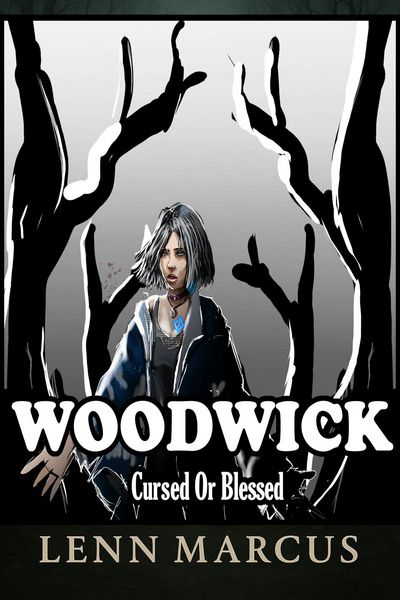
WOODWICK
Chapter 1: The House by the Woods
By Lenn Marcus
---
Autumn bled quietly into the early morning.
The trees had already given up their leaves, scattering color across the roadside like forgotten confetti. The red SUV hummed down the winding road leading to Woodwick — a town that didn’t exist on most maps.
I sat in the backseat, head pressed to the cold glass, watching trees blur into one another.
Strands of silver hair — shoulder-length and fine — slipped into my face. I didn’t brush them away. I didn’t move much at all.
I wore what I always did —
A faded blue jean jacket, sleeves too long.
A simple black dress, just above the knee.
Worn boots that creaked when I shifted.
And a black velvet choker, the only thing that made me feel remotely grounded.
Six months.
That’s how long it had been.
Since my father died. A birthday vacation to the snowy mountains that turned into my nightmare.
The day everything cracked.
The day I stopped sleeping right.
The day the voices started.
Each day since then, worse than the one before.
His absence settled in my bones like frost — the kind that doesn’t melt, even when the sun tries.
A therapist — my fifth — suggested a change of scenery. Said it would “do me good.”
But what she meant was: Forget about him.
Move on. Start over.
Like he was a book I finished reading.
Close it. Shelf it. Pretend the story didn’t end halfway through.
The worst part? I didn’t choose this.
Mom did.
New house. New town. New everything.
She said it would help me heal. But I knew better. I saw it in her face — every time she looked at me like I was a cracked vase she didn’t know how to glue back together.
She didn’t say it, but I felt it: I was too much. Too broken.
The twenty-two-hour drive was mostly quiet.
And occasionally, her blue eyes — the same as mine — would flick to the rearview mirror.
We share the same eyes. But that’s where the similarities end.
“Almost there,” she said softly. Like the wrong word might break me. “You might actually like it, you know.”
I didn’t answer.
Just watched the Welcome to Woodwick sign flicker by — warped wood, peeling paint, the kind that felt more warning than welcome.
The town looked... paused.
Like it exhaled one day and forgot how to breathe in again.
Small shops with chipped signs. A single traffic light blinking endlessly on a loop.
People in coats, heads down, eyes half-alive.
It felt like everyone here had been walking the same loop forever.
I let out a sigh — soft, but sharp — as I imagined what was coming: fake smiles, forced conversations, pretending to be okay.
That was the part I dreaded most.
That, and a million other things.
We slowed at the red light.
A woman sat on a milk crate near the crosswalk, her coat patched in places. Beside her, a rusted cart. She was carefully arranging cracked jars and bits of string into neat rows.
I kept watching.
Gaze drifting from jar to jar — the colors, the patterns.
My eyes lingered on one just as her hand hovered above it.
Then she froze.
She didn’t look up. Not until I did.
Her eyes met mine. Wide — recognition, maybe. Or fear.
Her hand jerked back from the jar and plunged into the cart. Frantic. Rushed. Almost panicked.
She pulled out a piece of cardboard. Then, with a trembling hand, scribbled something quickly in marker.
Then she lifted it.
TURN BACK.
Her other hand rose, slow and deliberate. A crooked finger pointed straight at me.
My spine stiffened as I leaned away from the glass. Slow. Uncertain.
I didn’t breathe.
“Everything okay back there?”
Mom’s voice snapped the moment. I turned, startled. She hadn’t seen it.
She was just watching me in the rearview mirror, fingers tapping softly on the steering wheel.
When I looked again, the woman was mumbling to herself, scribbling nonsense now — like the message had never been there.
“Yeah,” I said, a soft breath escaping. “Fine.”
The light turned green.
We drove on. Leaving the woman behind.
I leaned back in my seat, careful not to look out the window again.
Didn’t want to.
We turned off the main road onto a narrow path strangled by trees.
And then — there it was.
The house.
At the far edge of Woodwick, tucked behind crooked oaks, sat a house that looked... tired.
The kind of tired that seeps into walls. Into memories. Into you.
Peeling gray paint, strips of worn wood beneath.
Shutters barely hanging on, like they’d stopped resisting the wind.
A slouching porch with a rusted wind chime that clinked gently in the breeze.
It didn’t look haunted.
It looked hollow.
Mom pulled into the gravel drive and turned off the engine. Her fingers gripped the wheel for a moment longer than they needed to.
“That was one long drive. Had no idea Dandelion Valley was this far. God, I’m exhausted,” she said, turning to look at me with a worn-out kind of relief.
I tried to force a half-smile.
But it didn’t feel right.
Guilt settled heavy in my chest, so I looked away.
“Hey, Winter... I love you,” she said quietly, brushing a thumb against my cheek.
“I…”
My voice failed. Dried up into silence.
Those words.
They meant something once.
I just didn’t know how they felt anymore.
The glow in her face dimmed — like she'd been hoping I’d say it back.
It hurt watching that hope fade.
It hurt more knowing I was the reason.
I dropped my gaze and shut my eyes, fighting the sting in my throat.
She pulled me into a hug. Kissed my cheek.
Then leaned back, sighing as her fingers tapped the steering wheel. Her gaze dropped to the floor.
We didn’t speak again.
Just reached for the doors.
Cracked them open like breaking into a new life.
I opened the back door and unzipped the carrier.
Neptune blinked up at me — my gray-and-white cat with elegant poise and yellow eyes that glowed like candlelight.
His fur bristled slightly as he stepped into my arms.
“Come on, Neptune,” I whispered. “We’re in this together.”
Mom started unloading the trunk, pretending all this was normal. Like we were just moving, not grieving.
I didn’t move. Not until she said:
“Don’t forget to take your meds later.”
The words sank like a stone.
Meds.
Antidepressants. Anxiety stabilizers. A whole rainbow of numb.
I stepped out and closed the door — harder than necessary.
“I’m not broken,” I muttered, low.
“Winter—”
My jaw clenched.
The words flew faster than I could stop them.
“I’m not a problem,” I snapped. “Stop… treating me like one.”
I hated how sharp it came out.
I hated the bitterness beneath it.
Her mouth opened like she wanted to say something. But I was already walking to the porch.
Fast.
Tight shoulders. Quiet rage.
The wood creaked under my boots.
The door groaned open like even it didn’t want us here.
Inside… wasn’t what I expected.
Not dusty. Not derelict.
Just... sterile.
Too clean.
Minimalist furniture. Pale beige walls. A fake lavender plant in a pristine vase.
It felt like someone had scrubbed the house raw — like they were trying to erase something.
But some houses remember.
No matter how much bleach you throw at them.
I climbed the stairs. The floorboards sighed under each step.
At the end of the hallway, I found my room.
It was small.
White walls. A single bed. A dresser. A desk.
A wide window facing the woods.
No neighbors. Just trees.
Neptune hopped onto the bed, curled up, and stared out at the tree line — eyes unblinking.
I sat at the desk and pulled out a worn pill bottle from my jacket.
The label smudged. My name faded.
I stared at it.
Then opened the drawer.
Shoved it in.
I’m not crazy.
Just… splintered.
From my other pocket, I took out the golden locket.
A gift from Dad on my sixteenth birthday.
The last thing he ever gave me.
It was oval-shaped, warm from my touch — with delicate carvings that traced the edges like curling vines.
At its center sat a small diamond, surrounded by three deep red rubies.
On the back, etched in fading script:
W & W — forever.
I held it for a moment.
Then opened it slowly.
Inside: a photo of the three of us.
Mom, Dad, and me.
Smiling in a way I can barely remember how to do.
Guilt bit hard behind my ribs.
I hadn’t meant to lash out.
But the words always came first — too loud, too fast.
I traced the tiny photo with my thumb.
“I just want us back…” I whispered.
But the picture stayed still.
Frozen.
Untouchable.
I closed the locket and breathed deep.
Then stood.
Neptune followed as I headed back downstairs.
---
In the hallway, Mom was quietly unpacking boxes near the kitchen.
She looked… smaller somehow.
Tired in a way that changes your posture.
I paused in the doorway.
Throat tight.
I wanted to say I’m sorry.
But I couldn’t.
“I’m stepping outside for a bit,” I muttered, already turning.
She didn’t say anything.
Just gave me a small, broken smile — the kind that cracks without sound.
And somehow, that hurt more than yelling.
I stepped onto the back porch.
The railing was crooked.
The lawn faded into thick woods, fog spilling through the trees. A rusted fence split the yard — the gate barely hanging on.
Neptune settled into my lap.
I stroked his fur slowly, my fingers dragging through the soft gray. His purring was low and steady — a calm in the silent void. Soothing.
The porch groaned softly beneath us.
Above, the wind chime stirred once, then fell still.
We sat like that for a while.
Just breathing.
A few leaves swept across the yard, whispering over the boards before the wind faded again.
Stillness settled. Not peaceful — just full.
Pressing.
Then Neptune’s body tensed.
The purring stopped.
His ears twitched sharply, his head lifting — eyes fixed on the fog-draped woods beyond the rusted fence.
I followed his gaze.
Nothing moved.
Just crooked trees and layered shadows.
But something about them felt... aware.
Like they were looking back.
I squinted, suddenly too still.
My fingers curled slightly into Neptune’s fur.
It’s nothing, I told myself. Just trees. Just fog.
Then came the question I always hated —
Was it real?
Or was this the part the pills were supposed to help with?
The longer I stared, the more it felt like the woods were holding still for me.
Not quiet by chance, but because something behind them was watching.
The fog at the forest floor began to shift.
Just a ripple at first.
Then it slid forward — slow, steady, white against the grass.
Like something had drawn a breath and was exhaling it toward the house.
My jaw locked tight.
Creeeak.
The porch gave beneath me as I slowly stood, careful not to jolt Neptune.
He jumped down without being told — stiff, alert, tail low.
My eyes stayed fixed on the fog as I rose to my full height.
It kept coming.
Inch by inch.
Soundless.
Then—
Tink.
The wind chime above me rang once. Hollow. Crooked.
I didn’t breathe.
The fog curled at the base of the steps now.
Climbing them. Slowly. Like fingers reaching over the edge of a table.
“Neptune,” I said, barely a whisper. “Inside.”
He didn’t need another word.
He darted to the door, not running — but fast. Uncertain.
I backed up. One slow step.
Creak.
The fog touched the first porch plank.
That was enough.
I stepped inside after him and shut the door — soft but final.
Click.
Not because of the cold.
But because I needed something — anything —
between me…
and whatever was out there.
Watching.
Waiting.
END OF EPISODE
---
Author’s Note:
Hi there! Thanks so much for reading the first episode of Woodwick!
This story is part mystery, part emotion, and a little bit eerie — with quiet forests, emotion, and secrets waiting in the fog. If you're into slow-burn suspense with heart, you’re in the right place.
I’m just someone who loves stories and finally decided to write one of my own. I’d love to hear what you think, so feel free to leave a comment, drop a theory, or just say hi!
💬 Like what you read? Tap that ❤️ and hit follow — more is on the way. Every Wednesday!!!
Thanks again for being here. Really. :)
Pen Drop.
— Lenn Marcus









Comments (0)
See all