
Deep in the ravine, Thanatos’s venom beckoned Oleander into the gentle repose of slumber, but he did not go quite yet.
Years under the influence of the god husk's magic had built up a resistance in his body and sleep no longer came instantaneously. It would come eventually, but slowly. Slow enough to give him time to feign sleep and fool his watchful keeper. Once Thanatos receded to whatever business occupied him in the farthest depths, Oleander sprang up. Drowsiness weighed heavy on his limbs, urging him toward the comfort of stillness. Even with his accumulated resistance, it took all his will to resist the magical toxin’s insistence. He knew he would not be able to resist for much longer. The butterflies circled above him, frustrated, showering more glittering blue powder down.
He spent his last moments of clarity frantically running his fingers over the seams of the mattress. He did not remember where exactly he had stashed it, years ago when he first arrived here. It occurred to him that Thanatos might have found it, or replaced the old mattress while he had sleep, but then his fingers caught on a small tear in the fabric. From within that tear where he’d hidden it years ago, Oleander withdrew a small glass vial stuffed with desiccated gray-brown leaves, half disintegrated into powder. It was a rare herb, part of his mother’s extensive regime of medicines. In her final days, when her condition put her in a constant state of exhaustion, she had used it to spend precious fleeting moments of wakefulness with her sons.
The only other use for it that Oleander knew was military. In days of the war, soldiers would use it to march for days without rest through the most dangerous depths of the Evergrowth, where sleep invited fatal ambush. It was for that reason he’d taken some with him when Rowan had rescued them from the kingdom, and again when he’d left Aster, Cedar, and Fern behind after that. Though he’d initially gone willingly into Thanatos’s captivity of sleep, he’d hidden the herb as an emergency measure. Now, with years of accumulated guilt weighing on his conscience, it seemed the time to use it.
His enchanted eyelids drooped and his fingers fumbled sluggishly to uncork the vial. His mother had used only a pinch of the stuff at a time, but he dumped the entire contents of the vial into his hand and palmed it into his face, breathing the powder deep into his nostrils and throat. In the coughing fit that followed, the building drowsiness did not dissipate and he feared the herb had lost its potency in the gap of time since its harvest. But then his heartbeat surged and his eyelids flung open and a jittery buzz banished the heaviness from his body. The remaining butterflies, their toxins scales spent, returned to their posts on the stalagmites above.
For several minutes after that, Oleander sat on the mattress, stunned at his unexpected success and not quite sure what to do next. It was the thought of his brothers, their fate unknown, that finally moved him.
It took several more minutes for his legs to retrieve the ability to walk, having lay in disuse for fifteen years. But eventually, Oleander slid from his bed and wobbled once again on solid ground. The stone beneath his feet, like the world beyond sleep, was cold and hard and uncomfortable. Oleander did not know where he intended to go nor even precisely why he was going, but the further away he crept from the underground bed, the more the urgency of escape tugged at him.
Sleep is like death, a removal of the self from the world. But unlike death, it is not complete. In sleep an anchor remains, and most of the time one pulls oneself back from the brink and wakes up. That was how Oleander felt now, reeling himself back into what he’d left behind. That’s the problem with sleep, just as its removal is not complete, neither is its rest. It leaves the lingering possibility of life, the desire to know, the compulsion to walk again among awoken. That compulsion gripped Oleander now, urging his stumbling through the blue-tinted dark. Perhaps that compulsion was only his desire to know the fate of his brothers. He paid no thought to how he would find them, explain his long absence, or if he would return to Thanatos after.
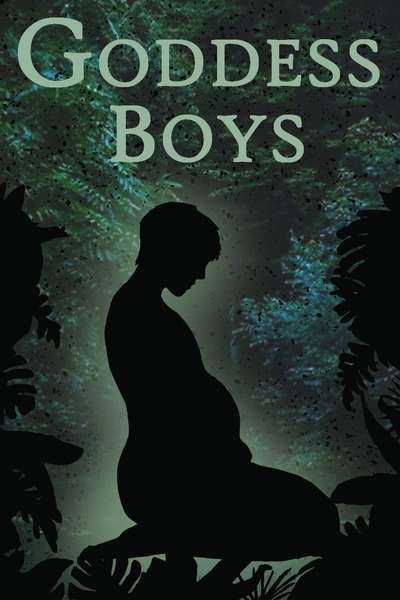
He had no idea how to escape the ravine even. The steep sloping sides possessed few ledges, and fewer wide enough to be walked. Where Oleander stepped was choked with stalagmites, some small tripping hazards reaching only his knees, others taller than him. Occasionally a dense crop of them blocked the path and Oleander had to squeeze through them like an insect slipping through gaps in a row of sharp teeth. It was slow-going travel, not just for the terrain but also because of Oleander's current state. His body, heavily pregnant and aching from years of disuse, was ill-fit for travel of any kind. He could inch along on the edge of the ravine for a whole day and barely have traveled a few miles, and at his current rate he would be halted by exhaustion long before then. It was unclear what path would even lead him to the surface, if any. At times the ledge he tread graded slowly upward, then it would dip down again. Sometimes he could see the dim glow of the forest far above and then he would pass under a disorienting overhang of stalactites. The only way to go anywhere with any expediency would be to throw himself to the depths that lurked a mere footstep to his left and let gravity whisk him further down to the bottom of this deep wound in the earth. If there was a bottom, that is. Maybe he would fall forever deeper. There could be no telling what was possible this deep in the alien terrain of the Evergrowth.
The further he traveled and the more his bare soles and aching thighs protested for the return to his mattress, the more impossible any kind of escape seemed. But even if he had reversed course, he was unsure if he would even be able to find his way back to his bed, now vanished into the darkness behind him. If Thanatos emerged from his depths and found him now, there could be no pretending this was anything other than an escape attempt. So, senselessly, he continued on.
The only sliver of hope came when the natural ledge along which he crept broadened onto a pathway sloping consistently upward. Not well-maintained by any means, but a definite path of cleared stone carved crudely out of the ravine’s side. It seemed, at least once, this place had been traversed by something intelligent besides himself and his captor. Travel along this path went slightly faster. It zigzagged across the uneven ravine side, but consistently led upward. Soon the blue glow of the butterflies that clung to the stone everywhere was supplemented by the dimmest traces of sunlight. Oleander began to indulge a small hope that he might actually see the surface again, even as he simultaneously expected Thanatos to emerge from the dark below at any moment.
He was forced to rest at a wide level point along the path when his haggard body refused to push on any further. Even though he had now spent more of his life pregnant than not, he was not at all used to carrying the weight. The dregs of sleep now fully cleared, he considered for the first time whatever infant life he carried within himself. He knew from Thanatos that his sleeping body had completed the cycle of gestation and birth myriad times before, but never had he been awake to see whatever offspring he produced. That line of inquiry, like that of his brother’s fate or the state of the kingdom, produced an unbearable number of unknowns. What exactly did Thanatos have him birthing in this hidden place? And where did the newborns go? For what purpose had his body been instrumentalized? These mysteries were hard to put out of his mind with the constant bulk and weight of his belly, caked in sweat and dust, there to remind him. He missed the oblivion of sleep.
It was there in the ominous blue-tinted dark of the ravine that Oleander heard voices. A slight sound, barely audible over his own labored breathing, whispered by the vastness ahead on the path. He could not be certain, but after several minutes of intent listening, it seemed to be multiple voices, and none of them the husky whisper of Thanatos. Curiosity urged him forward, fear pulled him back the way he came. It was the desperation to know, something, anything, that won the tug of war. When he had recovered enough breath, he inched onward, eyes peeled for the source of the sound.
He found it where the path broadened to a platform overlooking a particular wide point of the ravine, where the black depth appeared especially voracious. Thanatos, still inhabiting the centipede husk, rose up from it. His papery translucent body arched over a group of ten individuals on the platform arranged in a semicircle around a body. The body, prone, was that of one of the humanlike bugs of Gol. A beetle, it appeared, reminiscent of Aster’s prince that Oleander had met once long ago. If it was alive, it did not move. The figures surrounding it approximated the size of humans, but wore feathery cloaks of intricate orange patterning that obscured their bodies. One among them wore a simpler leather cloak. It was their voices that Oleander had heard, chanting together something in the primal sound of some chirping, buzzing language. Whatever ritual they performed engaged their full attention and that of Thanatos, so Oleander went unnoticed where he watched behind a cluster of stalagmites about a hundred paces away.
There was no way forward on the path except across the platform where they gathered, so Oleander had no options beside staying hidden or turning back. He stayed to watch, eager for any information to fill the vast gaps of his knowledge. Whatever ritual he watched, however, raised more mysteries than it answered. The cloaked figures chanted for a long while before they closed in on the prone body. Then they withdrew knives and began to cut into the body, each opening up a hole in the exoskeleton. When this was finished, they each reached into the hole they had cut, sinking their hands into the guts of the body. The beetle body offered no resistance to any of this. If it had not been dead before, it surely was now, penetrated by the arms of ten. Oleander, always squeamish, was grateful that at least the ritual body was the rigid shell of a bug and not the squishier, messier container of a vertebrate. They remained in that morbid stage of the ritual for a long time, maybe the better portion of an hour by Oleander’s guess. All figures kneeling, hands plunged into beetle innards while Thanatos watched, all motionless.
Finally, on some unseen signal, they withdrew their arms. The ritual apparently over, they moved and spoke among each other freely, without the eerie unison from before. In the new movement Oleander realized that the nine richly decorated cloaks were not cloaks at all, but folded wings. And the arms that reached out from within them numbered not two, but four. Other insectoid denizens of Gol, he assumed. The tenth figure with his plain cloak, single pair of arms, and slightly smaller stature, appeared human. It was this human that spoke directly with Thanatos the most. They possessed an androgynous voice, distinct from the buzzing quality of the others. It was mostly the human that spoke, reporting information to Thanatos it seemed. Whatever they shared, devoid of context and littered with unknown names, meant little to Oleander. He considered turning back. Maybe eavesdropping on this ritual would only worsen Thanatos’s anger when he was discovered awake. But then the cloaked human said something that dismissed any notion of leaving.
“Those idiot half breeds of the kingdom have been tramping around the edge of the city’s territory lately. Enough to arouse the Queen’s attention.”
Thanatos, as intrigued by this as Oleander, curled in close, thrusting his hollow mandibles into the human’s face. “The princes, have they been seen?”
"My leige, you know that I find it hard to believe they could possibly have lasted this long without being captured by something… or worse.”
“If they were in the possession of someone, we would know. A prize like that is not kept secret easily.”
“You keep yours hidden,” the human countered.
“I am a level above most of the Goddess’s children, am I not, Styx?” Oleander recognized the controlled raise in his voice, the intentional naming, a sign of practice in the art of wielding authority.
The human, Styx apparently, bowed low. “Of course. There are always stories of the princes is all. I try to be discerning.”
“And what do you discern from this? Do the half breeds know something?”
“The source is less than reliable, but… there is a rumor in Gol that a pair of young humans were spotted in the edge territory. We have looked, of course, but found nothing.”
Oleander’s heart beat faster. His brothers, potentially alive and nearby.
“If the princes are hiding here within antennae reach then we cannot allow them to be snatched by those kingdom brutes.”
“Of course, we will continue to search, but it is difficult to spend much more time prowling the border territory without drawing Gol’s attention to our activities.”
“You have the one,” one of the Golians insects offered, “Is that not sufficient, given enough time?”
This seemed to draw the ire of both Thanatos and the human named Styx.
“My power is not infinite.” Thanatos said, “Our time is limited, especially yours. These rituals are a precious expenditure of what remains of me. You would prefer that they continue, wouldn’t you?”
The Golian acolyte gave a gesture somewhere between a nod and a bow.
“Then we may not have enough time with just one.”
“We will search as much as we can.” Styx said.
Listening to their plans, Oleander was struck with an idea, a possible route to see his brothers. If the ritual had occupied Thanatos enough to allow him to leave his bed, it was over now. He would not escape the ravine in his current encumbered and exhausted state. He could still bargain though, just as he had done when he’d first stumbled onto the god husk in the ravine. If he played his cards carefully, his tongue would shape his fate better than his legs could.
He gathered his nerves and stepped out from his hiding place.




Comments (0)
See all