Please note that Tapas no longer supports Internet Explorer.
We recommend upgrading to the latest Microsoft Edge, Google Chrome, or Firefox.
Home
Comics
Novels
Community
Mature
More
Help Discord Forums Newsfeed Contact Merch Shop
Publish
Home
Comics
Novels
Community
Mature
More
Help Discord Forums Newsfeed Contact Merch Shop
__anonymous__
__anonymous__
0
  • Publish
  • Ink shop
  • Redeem code
  • Settings
  • Log out

The New Animals

Chapter 13

Chapter 13

Jul 25, 2023

This content is intended for mature audiences for the following reasons.

  • •  Physical violence
Cancel Continue
2215, and the zoans are twelve-or-seventeen years old.  No longer tucked away in group homes and scurrying in shadowed alleys, they are out, they are present in everyone's lives, they are emerging as citizens.  Where they had previously been heard, they now have the chance to be listened to. 
The Brightlove House has been independent for years.  It has no human staff, its teenage occupants are all emancipated and have so far successfully provided for themselves.  Their agreement with the city's government holds, and they are rarely hassled.  They are infamous in their community, as a curiosity and a fluke, an example of the strangeness of the times.
In winning independence, Samuel had agreed not to instigate similar rebellion outside his new fiefdom.  At the time, that had seemed a fair sacrifice; the other terms were more than satisfactory, and there was so much work to be done in the years immediately following emancipation. There was paperwork to complete, there were contracts to negotiate.  Detractors of zoan independence protested; and opportunists, thinking the house would be affluent and vulnerable, tried to get in: for many months, much of Samuel's attention was on repelling them, with Geir's help.  But soon, their needs were met, lines of communication were in place and stable, and their assailants ceased to be allured by the novelty of the independent zoan house.  The challenge Samuel faces now is that of administration.
Geir can see right away that Samuel is struggling.  The chrysocyon is often on edge, antsy, irritable.  When they sit together at nights, he complains about petty disagreements among the Brightloves that he has to mediate, and about the pressure he feels to have answers for everyone who brings him a problem.  Like the rest of them he is only seventeen, he knows no more about governance than they do.  Geir makes suggestions, but in addition to his age, Geir completely lacks the propensity that has made Samuel successful so far.
Toward the start, Samuel appreciates Geir's suggestions, the care that they represent, even if they are inactionable.  Less, as the months progress.  Geir perceives over time that Samuel wishes badly to ask him to stop, so he does.  They often do not talk, now, but they are not unhappy in each other's company.
House meetings are frequent.  Calls for Samuel to appoint some kind of government are frequent, but he refuses.  The Brightlove House is a small community, he says, every member should be able to know every other's needs, negotiate in a friendly manner and avoid harming or undercutting.  He may reluctantly accept his role as mentor, but he will not put any zoan above any other.  Some insist that those who most directly helped overthrow the caretakers should be given authority, and this Samuel especially denounces.
The Brightlove House's first trial is held in the summer.
Cameron 55-D4XR comes to Samuel with a complaint about Jeremy DC8-089.  Jeremy has been verbally abusive to many of his housemates and zoan neighbors: Cameron has noted a pattern.  A rabbit model, Jeremy targets zoans modeled after non-mammalian animals.  He scoffed when Cameron, a piscine model, raised the accusation.  Then, in the night, the plaintiff was woken by an unseen assailant forcing his door and holding a pillow over his face–not to suffocate him, but to frighten and distract him as the intruder stole the rations from his cooler.  In the morning Jeremy made sure his victim saw him casually eating a candy bar in the garden, which should have been a rare commodity.
There have been similar disputes in the House's independent years, but the accused buckled quickly and it took only brief talks to repair damage and restore harmony.  When Samuel and Geir approach Jeremy, the rabbit only laughs off the accusation.  Cameron insists, and he denies it again, smugly and barely hiding his derision.  Geir breaks into Jeremy's room and finds twice the rabbit's rations in his cooler.
So what? Jeremy says.  Are you gonna call the cops?  Humans?
The trial is as informal as Samuel can make it.  He asks everyone in the house for insight or testimony, invites those who offer it to sit around the dining tables pushed into a square and share.  Geir has to drag Jeremy in, and Cameron is too scared to attend.  When everyone has spoken, the picture is clear: Jeremy's attitude has been an affront to everyone, and none believe he will stop if unpunished.
Samuel asks them all to decide on a punishment.  In turn, they all ask him to decide.
Jeremy says that Samuel won't mete any out.  Everyone is indebted to the maned wolf, but he has no authority. His attitude is enough that Samuel asks Geir to lock him in his room until there is consensus.
There is none, for several days. Samuel and the others propose and reject numerous modes of punishment. It is proposed that Jeremy’s rations should be halved: Samuel insists that hunger should never be wielded as a weapon. That Jeremy should be forced to do unwanted work, cleaning the bathrooms and maintaining the yard: Samuel will not permit anyone to exercise the power required to force him.
Cameron and several others come to Geir in the night, when he is sitting guard at the rabbit’s door. They say that Samuel cannot make this decision, that he will waffle and deny any justice indefinitely. They ask that Geir let them in to punish Jeremy in kind for his assault, plus extra to account for his violent words. Allow it, and they will ask no more of Samuel.
Geir knows Samuel would disapprove, but he also knows that Cameron is right. His friend will make no move to deter actions like Jeremy’s, and while he doubts their community would crumble, he also knows that distrust in Samuel would be disastrous. He refuses to let the group in. He does it himself.
After the beating, Jeremy does not wake in the morning. Geir admits to Samuel what he has done, and the rabbit is rushed to the hospital, bones broken and bleeding internally.
Samuel doesn’t say a word to Geir for the rest of the day. It isn’t that he’s angry—not at the bird, anyway. He understands Geir’s reasons, and to some extent even agrees with them. But every aspect of the crisis fills him with frustration and distress. He feels useless, and hopeless, and clueless, he feels like he dove into shallow water but just kept sinking and sinking beyond where the bottom should be, and that is the first thing he says when he speaks again.
In the next months, the commune seems to be functioning again, but there is a difference in the air. No one has the words to express it, but the handling of Jeremy has opened up a vault of uncertainty that had been undiscovered before. Even those who had come with cameron to request the action sense the danger in it. To Geir, it feels as though his fists are not his own: someone will direct them at a target again soon, and he does not even know who will do it, or whether he will resist.
A new specter is spreading across the world, as the zoans approach their eighteenth birthday. The matter is hotly debated: will they be granted the status of adulthood? Some authorities insist it should be withheld until their twenty-third, when they have been alive for eighteen years. Others say they should be considered minors forever. Adulthood is a matter of reliability, they say; we can’t know what maturity this first generation will have at that age. Especially since there has not yet been a successful zoan pregnancy—those will come in the next few years—so their mettle has not been properly tested.
What would they do with the freedom?
For the Brightloves the question is abstract. There is a pall as the UN deliberates, as the youths worry that their emancipation will be rescinded. But the pall is background noise, one of many anxieties the zoans all share. Another reason for them to be on edge.
Sentiments like Jeremy’s are becoming commonplace. In childhood, zoans had been unified by their otherness from humans, but now most of the commune’s population scarcely deals with them, and hasn’t in years. Their animal faces look more different from one another than they had realized, and they don’t know what to think.
Mammals are more sophisticated and others are dumb and simple—or else mammals are more like humans, and shouldn’t be trusted. Mice eat cheese, dogs are gross, reptiles are cold-blooded, therefore unfeeling and scheming. Cops are pigs, so porcine zoans are in league with oppressors. Predator animals should lord it over prey animals—or should be subjugated so they can’t give in to their killer instincts.
Geir hears them all every day. They are widespread ideas, spoken casually, rarely meant but also scarcely questioned. He asks Samuel to let him form a clandestine police force, himself and a few trusted compatriots, to root out and quash this thinking, even if it takes violence to do so. Later he will recognize the dangers in such a force and think himself stupid for having wanted it, but in the moment he is deeply frustrated that Samuel will not let him. He doesn’t understand the wolf’s reasons, he only knows the threats. But he also knows that Samuel spends hours every day trying to concoct a response. Nothing he does is offhand.
Eventually Samuel accepts a title. President, Administrator, something like that. He starts to allow the Brightloves to choose officials for acquisitions, fundraising, communications, security, and such—though he loathes it. Geir is the first Officer of Internal Security, and his chief supporters are the ones who came with Cameron. He holds the office for a few weeks before resigning.
Geir doesn’t know when he realizes he wants to leave the Brightlove House, or what specifically drives the feeling. He can wax romantic about the pain of watching Samuel feel like a failure, or about the good he could do elsewhere, but he suspects all along that his reasons are much more banal. The revolutionary life is hard, and he feels no drive to continue in it. He is also weary of the squabbles between his housemates, and truth be told, he has spent so long directly at Samuel’s side that he feels distant from the rest. Besides, he will soon be eighteen, and when he is, he wants to break with his childhood.
That he thinks of those reasons before he thinks of Samuel, he also takes as a sign.
He doesn’t let the malaise draw out. The conversation with his boyfriend is brief and to-the-point. With beak and mouth they talk about his need to be elsewhere. With their eyes they express that their love for one another is not reduced by an ounce, but their lives are filled with other feelings they could never have anticipated, a rolling ocean of them, whose tides all the love in the world couldn’t hold back. They embrace, but then they back up and shake hands. Geir is only the third to leave Brightlove House.
While the vulture seeks a new niche for himself in whatever of Terrace’s strata will take him, he hears word now and then about how the House fares. It enjoys a brief burst of economic growth when the UN rules that zoans must be granted adulthood at eighteen. Holds firm when Terrace begins to sell its neighborhoods off to pay its civic debts. It seems much smaller when spoken of thirdhand; not the roaring piconation Geir had helped to build, but an isolated little building surrounded by miles of dark city. After a couple years, Geir hears that Samuel has dissolved it as an entity and sold the property to one of its tenants, while the rest have scattered. The maned wolf gets word to him, inviting him to meet, catch up or at least talk. Geir thinks of reasons not to: he has obligations now, his crowd is dangerous. The message he sends back, though, is more honest: I’m not ready. And before that has had a chance to change, his friend has vanished into the underworld. Rumors circulate that Samuel has returned to his roots as a revolutionary, that he has founded a new rebel group at a global scale, but Geir puts it out of his mind. He is busy, and he is poor—and, moreover, that was another life, and it’s behind him.
elgruderino
Groods

Creator

Comments (0)

See all
Add a comment

Recommendation for you

  • What Makes a Monster

    Recommendation

    What Makes a Monster

    BL 75.2k likes

  • Silence | book 2

    Recommendation

    Silence | book 2

    LGBTQ+ 32.3k likes

  • Secunda

    Recommendation

    Secunda

    Romance Fantasy 43.2k likes

  • Mariposas

    Recommendation

    Mariposas

    Slice of life 231 likes

  • Blood Moon

    Recommendation

    Blood Moon

    BL 47.5k likes

  • Silence | book 1

    Recommendation

    Silence | book 1

    LGBTQ+ 27.2k likes

  • feeling lucky

    Feeling lucky

    Random series you may like

The New Animals
The New Animals

621 views0 subscribers

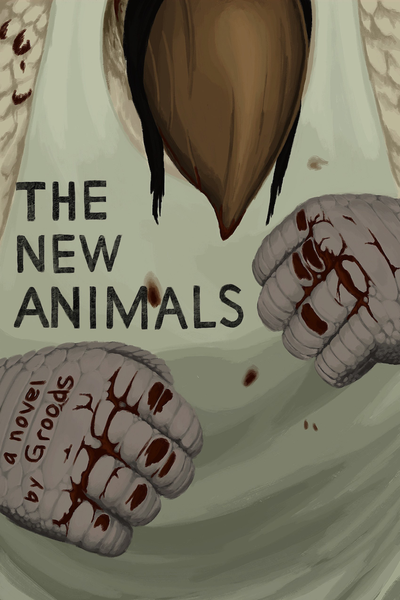
Set in the same world as The Two Fangs, several centuries earlier. The earth is a world of population crunch, technological breakdown, and gargantuan machines that create wonders for the wealthy at everyone else's expense. Zoans were created thirty-five years ago to be the earth's new workforce and Geir, of the bearded vulture ("barbatus") model, is of the first generation. He has been working in isolation in the arctic for years, but his past is about to catch up with him.
Subscribe

41 episodes

Chapter 13

Chapter 13

2 views 0 likes 0 comments


Style
More
Like
List
Comment

Prev
Next

Full
Exit
0
0
Prev
Next