
Oliver had always been at war with his reflection. Every mirror was a battlefield of imperfections-small blemishes that loomed large in his mind, curves and angles that seemed grotesquely wrong. His obsession with body perfection consumed him, leaving him yearning for a transformation that seemed forever out of reach.
This was the world he lived in: a world that had so many people comfortable in their own skin, which only deepened his dissatisfaction. Friends of Oliver would tell him that he was handsome, that he was his own worst critic. But their reassurances fell on deaf ears, drowned out by his relentless inner critic that whispered of flaws and inadequacies only he could perceive.
It was during one of these frequent late-night searches for body modification that Oliver first came across Celeste: an underground artist wreathed in mystery and whispers, noted for her gross yet mesmerizing sculptures that seemed to breathe with life. Her work showed beauty in all the macabre ways-a delicate balance between art and horror.
Intrigued, Oliver sought her out, compelled by a need he couldn't articulate. He found her in a dimly lit studio, a place humming with the energy of creation and destruction. Celeste was everything he imagined-ethereal and intense, her eyes alight with a passion that bordered on madness. Her presence was magnetic, pulling him in with an allure that promised salvation from his self-imposed prison of imperfection.
"You want to be beautiful," she said, her voice low and husky, a whisper of seduction. "I can help you. I can make you perfect."
Oliver was enthralled, caught in the promise of her words. Celeste offered to mold him into a living work of art, a masterpiece that would transcend the frailty of human flesh. She would cut away the superfluous, shape his body into the perfect form he so desperately coveted. The catch? There would be no anesthesia to numb the pain, for transformation required sacrifice.
It was an intoxicating thing at first-the pain. Every slice of the scalpel, every bit of flesh shaved away brought him closer to perfect. He felt alive in a manner he never had, intoxicated by the agony and its promise. Celeste's hands were deft and sure; her vision for his body terrifying and thrilling.
Weeks hardened into months, and the surgeries went on. With every session, something was different: one muscle tensed, one limb lengthened, one line perfected. Oliver's faith in Celeste was implicit, his commitment to her vision absolute. He began to close himself off from friends and family; his fascination with the transformation eclipsed everything in his life. But as the transformations mounted, his reflection became increasingly alien. A stranger stood in the mirror, a Frankenstein's monster of flesh and ambition.
The ritual of their sessions became a dark dance: Celeste wielding her tools with an artist's grace, Oliver willingly offering himself to her scalpel, driven by the intoxicating blend of pain and transformation. He began to notice changes in his daily life-strangers would turn their heads, mesmerized by his evolving form. Yet, the admiration was hollow, feeding into his yearning for something unreachable.
One night, driven by a restless curiosity, Oliver finally wandered into Celeste's gallery, a room he had never been invited to enter. The room was dim, shadows playing tricks on his eyes. As he moved among the sculptures, he developed a nagging sense of unease. Each figure was too lifelike, its forms twisted and hauntingly familiar. He stopped cold before one statue, his heart hammering in his chest. Those fingers belonged to him, no question. And over there, a modelled mouth in alabaster took on the contour of his own lips.
There, in horror, it sank in-he wasn't being 'sculptured' into perfection; he was a harvest, one piece at a time, destined to adorn Celeste's next great showpiece. It was his body that was providing this so-called artist with raw material in her grotesque displays.
Desperation clawed at Oliver as he tumbled back against the weight that crushed him, while he had given all to Celeste, trusting her with his very essence, turning him into a victim of her genius twistedly. The studio, once a sanctuary of possibility and beauty, was now a chamber of horrors.
For Oliver, the revelation was a world come crashing down. His perfection was but a mirage, an illusion cruelly contrived by his own insecurities and the manipulative brilliance of Celeste. He was to realize too late that beauty was not a thing of form and bone, but of acceptance.
In his last lucid moments, Oliver fled the gallery in terror, his transformed body testifying to a quest for perfection gone wrong. He disappeared into the night, leaving behind him grotesques of flesh and stone, while the haunting echo of Celeste's laughter reverberated within him-a grim reminder of the cost of obsession.
His flight was wild, with every step a reminder of his folly. Oliver wandered the city streets, the weight of his realization weighing upon him like a physical force. The city that had once felt like home now seemed vast and alien, every corner reminding him of the life he had left behind.
At first light, Oliver was in a secluded park where the world came softly into light. He threw himself onto a bench, crisp morning air with the promise of new beginnings. He was alone there, and the realization of his loss began to set in-not just the physical loss, but the loss of who he had been.
In the weeks that followed, Oliver began the slow process of healing. He sought out therapy, confronting the demons that had driven him to Celeste in the first place. Each session was a step toward reclaiming his identity, toward understanding that the perfection he sought could never be found in flesh.
Oliver's journey was long and painful; at every step, he was faced with problems. But Oliver gained a new understanding of self-worth which helped him push on, learning to love his imperfections and not see them as flaws, but as individual pieces of his humanity.
And though the scars of his past remained, they became a testament to his resilience-a story etched in skin and bone. Oliver emerged from his ordeal with a new perspective, one that valued inner beauty over outward appearance.
In time, Oliver found a quiet acceptance, an acceptance of his identity that all the while he had been deprived of. He used the experience to stand in for other people who struggled with body image, helping many trapped by what had once haunted him.
As for Celeste, her gallery continued to draw those curious about her macabre art, but Oliver never returned. He had moved beyond the need for her validation, finding strength in his own journey of self-discovery.
The city, once the backdrop to his obsession, had become a canvas on which the landscape of his new life unfolded—a new life he was the artist of, with every nuance of choice shaping his own destiny. In every reflection, Oliver would see not the flaws of his shortcomings but the strength and beauty of his true self.
A Body for You
Feb 08, 2025
This content is intended for mature audiences for the following reasons.
- • Blood/Gore





Maggots&Marrow
77 views34 subscribers
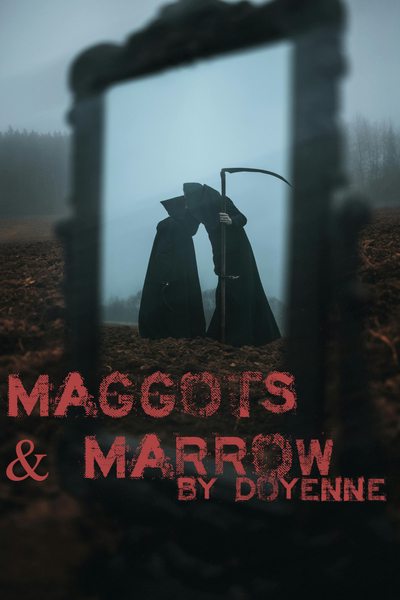
Maggots & Marrow is a chilling collection of 18+ horror stories dealing with the grotesque, the macabre, and twisted consequences of human desire that have gone horribly wrong. From cursed bodies and monstrous transformations to unholy feasts and graveyard terrors, all manner of dark depths in the human experience are traversed. With vivid depictions of gore, grotesque imagery, and nightmare scenarios, these tales are not for the squeamish. Each story peels away the skin of our reality to unleash terrors lurking in dimensions adjacent, where boundaries blur among life, death, and suffering in the most terrifying and graphic manner. It promises to sicken, disturb, and fascinate readers with the primal fears driving its unrelenting visceral narrative.


Comments (0)
See all