
The crackling fire shattered the silence of the night. The wind rustled the treetops, casting restless shadows across the earth. In the heart of the clearing, a makeshift bonfire bathed two weary travelers in flickering light.
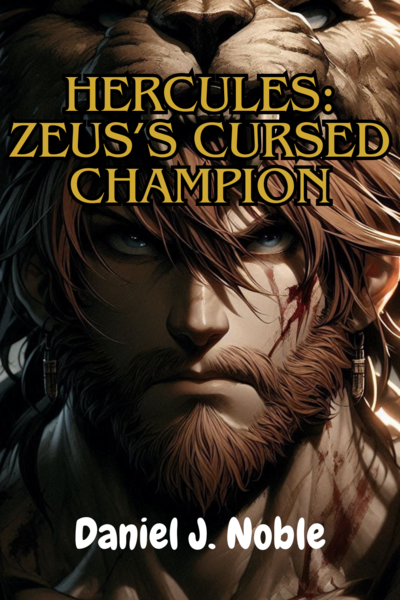
Hercules leaned against the trunk of a tree, his massive frame covered in cuts and bruises. Blood still trickled from his wounds, staining his tattered exomis. The garment, designed for freedom of movement, had been shredded along one side where the lion's claws had torn through it. His single leather shoulder guard—once a warrior's badge of resilience—now hung uselessly, a mere remnant of the brutal battle he had endured. His bracers were scuffed, his sandals coated in soot and ash from the scorched earth.
Across the fire, Iolaus watched him with open concern.
"You shouldn't be so reckless," he finally said. "You could get an infection. I have linen bandages—"
Hercules didn't look away from the flames.
"I've had worse. By morning, they'll heal."
"That so?"
His nephew's tone was dry, unconvinced. Hercules turned his head with an irritated scowl.
"Why in Hades did you interfere?"
Iolaus hesitated before answering.
"Because I couldn't just stand there. I kept hearing the ground shake and blows landing from outside—I had no idea what was happening."
"I was about to win."
Iolaus let out a sharp, incredulous laugh. He gestured toward the open wounds on his uncle's body.
"Right. That was obvious. You had the lion right where you wanted him."
Hercules growled, looking away.
"It's not the first lion I've fought."
"Oh?"
"I killed the Lion of Cithaeron when I was younger. It was the same."
Iolaus narrowed his eyes.
"You really think this was the same?"
He didn't argue further. There was no point. His uncle saw every battle as a test of willpower, something to be crushed beneath his strength. But this time was different.
Iolaus inhaled deeply, searching for the right words. If he wanted to help, he had to tread carefully.
"Uncle—" he started.
"Sleep, Iolaus."
The finality in his voice ended the conversation.
Iolaus pressed his lips together in frustration. He glanced at the fire, then at Hercules. His uncle had already shut his eyes. His chest rose and fell with heavy, deliberate breaths—but not the breaths of someone at peace.
Muttering a curse under his breath, Iolaus lay back against the earth and forced his eyes shut.
Hercules, however, did not sleep.
The firelight flickered against his closed eyelids, and his mind began to drag him into the past.
To the Temple of Delphi. To the Pythia. To the judgment of the gods.
The wind stirred the dust along the rocky path, clinging to the travelers' clothes. Alcides walked with heavy steps, his shoulders slumped, his gaze hollow. Beside him, his brother Iphicles struggled to keep pace, watching him with concern.
Before them, the Temple of Delphi rose from a fissure in the earth, built on a surface where no structure should have stood. Marble columns, perfectly aligned, upheld a ceiling of divine craftsmanship. At the entrance, a statue of Apollo gleamed as if cast from the very light of the sun. A low murmur filled the air—pilgrims and kings from distant lands, all gathered in hopes of receiving the Oracle's prophecy.
"The priestess must have the answer," Iphicles murmured.
Alcides did not respond. He had no words. No thoughts.
Megara was dead. His children were dead. Their blood still stained his hands.
The temple had yet to open its doors, but a crowd already swelled before the entrance. Nobles in flowing robes and golden diadems quarreled over who would be granted an audience first.
No one paid Alcides any mind. Just another pilgrim, head bowed, lost in his own sins.
But he did not stop. Ignoring the line, he walked forward.
"Hey! Wait your turn!" A broad-shouldered man in a purple cloak stepped forward, his voice thick with authority. A minor king—a Thessalian noble. He moved to block Alcides, but the moment their eyes met, his expression faltered.
The fire in Alcides' gaze hollowed the man from within. The color drained from his face.
"It's… the son of Zeus. The great hero, Alcides…"
Murmurs spread like wildfire. Alcides ignored them and kept walking.
The temple guards did not attempt to stop him. They could not. The half-brother of Apollo could not be denied entry to his sacred house. But when Iphicles tried to follow, a sentinel barred his way with a spear.
"He may enter. You may not."
Iphicles swallowed hard, then nodded in resignation.
Alcides did not look back.
The temple's interior was bathed in dim light, torches flickering against ancient stone. He moved forward without hesitation, toward the chambers of the Oracle.
When he pushed the door open, a wave of incense met him.
Before him, a woman emerged from a sacred bath, droplets of water trailing down her sun-kissed skin. Her long black hair clung to her back, heavy and damp.
She gasped softly and reached for a delicate cloth, draping it across herself. Her dark eyes never left his, unreadable yet knowing.
"If a man enters this chamber unbidden, he is usually put to death to protect the Oracle's sanctity," she said calmly. "But somehow, I doubt that applies to you, son of Zeus."
He said nothing.
She sighed, wrapping herself in a flowing white toga before gesturing for him to follow.
"Tell me—what do you seek here?"
For the first time in days, Alcides raised his head. And he spoke.
"I killed my family."
The Oracle's expression did not waver, but for the briefest moment, her breath caught.
"Very well," she said. "Come with me."
She led him into the adyton, the temple's holiest chamber. A stone altar stood at its heart, encircled by pillars engraved with hymns to Apollo. A priest led a goat to the altar and, with a swift, practiced motion, slit its throat. Blood poured over the sacred rock as a servant doused the lifeless body in cold water.
A heavy silence fell over the chamber.
The Oracle watched the animal's final moments. If the creature convulsed before death, the gods had accepted the offering.
The goat shuddered. Its glassy eyes dimmed.
"Apollo has granted you an audience," the Oracle whispered.
Servants offered Alcides a cup of sacred wine and a plate of fruit. He drank without thought.
The Oracle closed her eyes. Her body trembled, then collapsed to her knees. Her pupils dilated until her irises turned a luminous, unnatural white.
The world around them disappeared.
Darkness.
Nothing but Alcides and the Oracle, suspended in the void.
She arched as if her body was too fragile to contain the weight of divinity. A tremor passed through her lips before she spoke—not in a single voice, but in many. A chorus of past, present, and future.
"The sun does not cleanse the shadow of those who stain their flesh with the blood of their kin. There is no redemption without burden. No rest without debt."
Alcides did not breathe.
"Your lineage is of kings, yet your throne is built of bones. You are no prince. No ruler. You are an executioner. Your steps echo in the path of fallen titans, and wherever you walk, the earth shall quake."
The Oracle's white eyes turned upward, as if gazing beyond time itself.
"Ten are the labors. Twelve are the years of servitude you will bear upon your shoulders. To the throne that was stolen, and only when the tally is paid shall guilt dissolve like mist at dawn."
Silence descended like a hammer.
Alcides did not fully understand, but the weight of the prophecy settled deep within him. Ten trials. Twelve years. Servitude and… Eurystheus.
The priests of Apollo approached to decipher the message, their voices solemn.
"To atone for your sins, Alcides, you must serve as a slave to your cousin, Eurystheus. He will dictate the trials that will cleanse your soul."
It was his only path forward.
He rose to his feet and turned to the Oracle.
Still dazed, she gave him the faintest smile.
"Now, if you'll excuse me," she murmured, brushing a strand of damp hair from her cheek. "I must dress. I cannot receive those arrogant nobles in this state."
Alcides inclined his head and left.
Iphicles waited outside.
"Well?" he asked.
Alcides gazed at the horizon. Mycenae awaited.
"We go to Eurystheus."







Comments (0)
See all