
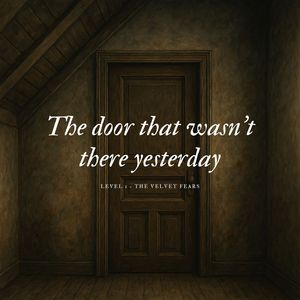
I noticed the door on a Tuesday morning.
It wasn’t there the day before. I would’ve seen it—same hallway, same faded light from the ceiling bulb, same creaky floorboards. But now, in the narrow stretch of wall between the coat closet and the kitchen, a small wooden door stood half open. Just wide enough for me to see the edge of a rug and the corner of a lamp.
It shouldn’t have been possible. My apartment was too small for hidden rooms.
Still, I stared at it for a long time before stepping closer. The wood looked old, darker than the rest of the apartment, with a brass knob that felt faintly warm when I touched it. I expected resistance when I pushed—locked hinges, maybe a trick.
Instead, the door opened easily. Silently.
Inside was a small, quiet room—soft yellow wallpaper, shelves of books, a window I didn’t recognize. There was a chair in the corner with a folded blanket across it. A faint scent of lavender hung in the air. It looked warm. Safe.
There was nothing obviously strange about it, and yet… it felt like it had been waiting for me.
I stepped inside.
The door stayed open behind me.
I wandered closer to the window. It overlooked my neighborhood—the street, the trees, even the red mailbox across from the building. I recognized it immediately. But from this angle… it didn’t make sense.
I live in an attic flat. There shouldn’t be a window. Not here. Not in this direction.
I stepped back and sat down in the chair. The blanket was soft—worn in the way things are after years of use. The cushions hugged my body perfectly. Too perfectly. The way it shaped around me made it feel like I’d sat here before, often. Like the chair remembered me.
There was a photo on the little side table. A child sitting in a swing.
It was me.
I stayed for a while, longer than I meant to. Just sat, watching dust move in the sunbeams. It was the most at peace I’d felt in months.
Eventually, I stood and left.
I thought I’d only been there a few minutes.
But when I stepped out of the room and glanced at the clock in the hallway, it was nearly evening.
The next day, I checked again.
The room had changed.
Still cozy, but different. The chair had been replaced with a small couch. The scent was stronger—this time rosewood, like my grandmother’s house. There was music playing softly from a small radio on the shelf. A tune I hadn’t heard since I was a child.
There was a painting above the couch—something soft and faded, a countryside at sunset. At first glance, it looked peaceful. But the colors were just slightly… wrong. The sky was too orange. The grass too dark. I couldn’t explain it, but the longer I looked at it, the more my skin prickled. Every time I blinked, it felt like the details shifted—the clouds moved, the shadows lengthened, the trees leaned in slightly farther.
I tried to fix my eyes on it, to study it without blinking, and that was somehow worse. The longer I stared, the more wrong it felt. My stomach turned. Something about it pushed back.
I looked away, but a shiver ran down my spine anyway. Like I’d just stepped into a memory I wasn’t supposed to remember.
On the table, I noticed there was a book, open to the first page.
A handwritten note inside read: “I knew you’d come back.”
As I quickly closed the book, the radio skipped.
Just once.
But in that brief, stuttering gap, I heard something—faint, like a voice whispering from the static. I couldn’t make out the words, but it sounded like someone trying to speak from underwater.
I didn’t wait around to hear it again.
I left.
On the third day, I stood in the hallway, staring at the door.
I didn’t want to go in. That note—“I knew you’d come back”—lingered in my mind like an echo I couldn’t shake.
I told myself it would be the last time. Just one more look. Just to understand.
I opened the door.
The air felt heavier than before. The wallpaper had faded. The light bulb above flickered.
The couch was gone—replaced by a low bed, its sheets tucked too perfectly. The radio was missing. The photo on the side table had vanished.
So had the painting.
I hadn’t realized how much space it had taken up, how it seemed to anchor the room. Its absence made the wall feel… blank. Exposed.
My skin crawled. The hairs on my arms stood up.
Something was wrong. I couldn’t hear the soft music anymore. I couldn’t smell the lavender from the first day, nor the rosewood from yesterday. The silence felt like it was pressing in from all sides.
I felt observed.
My body screamed at me to leave—to turn around, to run, to not look any closer.
That’s when I saw the box.
It was sitting neatly on the bed. Wrapped in grey paper. Tied with black string.
I stepped forward slowly, as if my limbs didn’t belong to me.
I opened the box. Inside was a watch.
It was my father’s watch. The one we buried with him.
I backed away, heart thudding.
Then came a sound—sharp, sudden. A crack from somewhere behind me, like a floorboard splitting under pressure.
I spun around, pulse racing.
Nothing moved. The room was still.
But something in the corner of the desk caught my eye—a folded newspaper that hadn’t been there when I entered the room.
I stepped closer, hesitant, each footstep feeling heavier than the last.
The headline read:
“Local Resident Still Missing – Disappearance Leaves Few Clues”
My name was in the subheading. My photo—staring back at me—sat just below the date: Tuesday. The same day I found the door.
I laughed, but it didn’t feel like mine.
I turned toward the hallway.
There was no doorway.
Just solid wall. Smooth. Pale. Seamless.
I ran my hands across it, then my fists. My breath hitched. I screamed. I begged.
The room did nothing.
The light bulb buzzed gently overhead.
Panicking, I turned and ran to the window.
Outside, I saw the street—my street. The trees swayed gently. A breeze I couldn’t feel rustled the leaves.
Down below, people were gathered. My friends. My family. I saw my mother clutching a photo, my sister taping a missing poster to a streetlamp. Someone called my name—it echoed faintly, like it was being pulled away by the wind.
I pounded on the glass.
“I’m here! Look up! I’m right here!”
Then I blinked.
The world outside had changed.
The sky had turned a bruised yellow-gray, like an old photograph left in water too long. The buildings had faded to warped silhouettes, sagging and stretched like melting wax.
The people were gone.
Only one figure stood at the edge of the sidewalk, directly beneath the window.
It was tall. Still. Wrapped in something dark and heavy. I couldn’t see a face—only the faint glint of eyes, too far apart, shining up through the murk.
It didn’t move.
It just watched me.
Behind me, I heard the soft creak of the bed—as if someone had just sat down.
A shiver ran down my spine.
If you find a door that wasn’t there the day before, ignore it.
Or better yet, find another apartment.
And move. Quickly.









Comments (0)
See all