
And the Senate held its breath.
Chaos did not arrive gradually.
It breached the chamber like a pressure shock—instantaneous, deafening, complete. Delegates were already on their feet, voices crashing over one another, arms raised, banners flickering in glyphlight. The ambient light panels spasmed in response, their programmed hues jittering between amber and violet as if struggling to recalibrate. Console glyphs blinked warning runes. Drones flitted nervously overhead, untethered from routine.
None of it helped.
The Senate Rotunda, built for dignity and ceremony, had become a panicked chorus of uncertainty. Old rivalries flared into accusations. Calm masks cracked. Someone demanded visual telemetry; another shouted for emergency fleet uplinks. The Gravari delegate was already murmuring into their loom, but even the translation glyphs staggered and glitched. A burst of scent from the Silvarian seats filled the dome—sour, frantic. The Virellan delegations pulsed in warning-light scent, the spore-glow on their skin dimming in chemical unease.
And then—
“Enough!”
The word detonated.
It wasn’t the Chancellor’s usual voice—not the measured resonance of Illenar’s highest office, not the refined modulation woven into years of civic decorum. It was louder. Harsher. Human.
A silence rippled outward. Abrupt. Total.
He stood in the center of the rotunda, spine straight, face taut, robes shimmering with residual crimson pulse from the emergency lockdown. One of his aides had already moved into position behind him, unmoving, eyes scanning the room.
“The Circumlunar Senate,” the Chancellor declared, each word deliberate, “is hereby placed under full lockdown until further notice.”
His voice echoed against the dome—amplified by the rotunda’s ancient acoustic filaments. It landed heavy.
“No delegate, aide, or envoy shall exit these walls until the source, trajectory, and full implications of what we’ve just witnessed are confirmed.”
Gasps. Whispers. One or two made motions to speak. One delegate—a Nethari—rose halfway from their seat, beginning a protest. But another voice was already rising from the southern tier.
Measured. Cool. Entirely unsurprised.
“If I may,” came the voice—clean, dustless, and irritatingly correct.
All eyes turned toward a figure in monochrome formalwear—mid-length tunic lined in vein-glass script, copper-red hair tied in a high knot. One eye covered with a translucent lens, the other glowing faintly in the low crimson light.
A Rheunarian.
“By Lexicon Protocol 17.8.1,” he said, hands folded precisely behind him, “subsection three, ratified Session 12,342, reaffirmed during the Gravari Tidequake proceedings—under conditions of anomalous celestial emergence constituting a threat to intermoon integrity, the acting Chancellor is empowered to invoke autonomous containment for up to one full Commonwealth Standard Year. Said measure requires no prior vote, provided the threat is acknowledged as exo-dynamic and observed by quorum.”
He sat again without flourish, adding—almost as an afterthought—“We are quorum.”
The Chancellor did not nod. He simply turned slightly, acknowledging the words with silence. His voice, when it returned, was calm again—but edged with iron.
“There are sufficient habitable wings in the sub-spire chambers for all present. Nutrient recyclers and water reclamation systems are stocked and calibrated for a full-cycle confinement scenario. There will be discomfort, yes—but you are safe. I give you my word.”
His eyes swept the room—familiar faces, old rivals, uneasy allies.
“This chamber will not fracture into rumor and panic,” he said. “Not while I remain Chancellor.”
He turned toward the private entrance—pressure-sealed, glyph-locked, its arch traced in gold-threaded script. His aides flanked him now. One handed him a secure datapiece. The other activated the exit’s cipher band.
He paused once at the threshold.
“Remain calm. Remain orderly. We will know more soon.”
Then the doors hissed open—and he was gone.
The Chancellor stood motionless as the lift descended, its walls sealed in matte alloy, light pulsing softly in concentric rings along the ceiling. The sound was near silent — no cables, no friction, only the faint hum of magnetic isolation as they fell beneath the Council Spire. His two Illenari aides stood behind him, unmoving, mirrored in composure and stillness.
The lower chamber was not ceremonial. It was not symmetrical, or serene, or spare.
It was alive.
The elevator doors parted into a cavern of motion — the Emergency Coordination Wing, a web of subsurface corridors and open command bays hidden deep beneath Illenar’s polished façades. If the Rotunda was the system’s conscience, this was its nerve. Operators moved in rippling formations — engineers, analysts, tactical scribes, projection translators — most of them Illenari, though a few bore the markings of other moons. Glyphscreens flickered. Transit beacons pulsed. Emergency stabilizers thrummed beneath the floor like the low breath of a buried engine.
To the uninitiated, it was chaos. To the Chancellor, it was architecture.
He strode forward, eyes scanning for the status interface. “Report,” he said, his voice low — not a request, but a call to alignment.
A cluster of aides parted. Two stepped forward.
The first was unmistakably Gravari — tall by their standards, their segmented torso shifting subtly to adjust for the stabilized gravity of the chamber. Their name translated imperfectly into spoken script, but in Commonwealth Standard, they had chosen:
“Tem-Korrin”, Senior Gravimetric Astrophysicist, Gravath.
Tem-Korrin inclined their body, lower segments folding slightly in a sign of respect. “Chancellor. We have verified all external vectors. What we observed was not a flare, nor a malfunction. All sensor arrays were intact before, during, and after the event.”
They gestured with one compact limb toward the rotating model projected above the central table — the Typharion system, rendered in perfect orbital fidelity. A new marker blinked in quiet white past the oribital ring of the eighth moon Rheunon
“It did not arrive,” Tem-Korrin continued. “It appeared. With no velocity trace. No gravitational wake. No orbital drift. It seems to be... natural.”
Beside them, the second aide raised their head — a Netharian, suspended in a glistening exosuit of gravitic balance and hydrated mist. Their six limbs moved with fluid grace, each motion mirrored by faint chromatophore flickers along their arms and mantle.
Their name, announced in smooth chemical intonation and translated in glyphscript, was:
“Irothein”, Planetary Systems Analyst, Nethara.
“Surface data from the anomaly indicates structural presence,” Irothein said, voice soft and resonant, like sound echoing through a tidepool. “Mass is consistent with a small moon, but its density profile is... curated. It holds equilibrium too precisely. No tectonic drift. No atmospheric erosion.”
The Chancellor’s eyes narrowed. “Has it moved?”
Tem-Korrin shook once, spine tightening. “Not artificially. It is stable. Synchronous with Typharion if it had a ninth orbital band. Precisely where the system’s natural gap would allow… if it were ever meant to hold a ninth.”
Irothein’s limbs folded. “We recommend limited dissemination. The delegates are probably already agitated. The longer they remain uninformed, the more they will imagine.”
Tem-Korrin tilted toward the Chancellor, speaking again in that precise Gravari cadence.
“This is not drift. Not decay. This is placement. And someone — or something — placed it there.”
The Chancellor’s brow furrowed — not in anger, but in the subtle crease that meant his mind had already moved three steps ahead.
“Has there been any ground deployment?”
“They are... deliberating,” Tem-Korrin said, with a gentle contraction of their lower thoracic segments — the Gravari equivalent of a sigh. “The Rheunarian Outer Archive Council is currently voting on whether to deploy a planetary skiff for orbital inspection.”
“They cannot help themselves,” muttered the Chancellor, half to himself. “They think caution means recitation.”
Irothein, ever composed, added, “Their message was—eloquent. They cited precedent from Session Twelve-Thousand-One-Hundred-Five. Something about 'precedent of first pursuit under anomalous visual infringement.' It was footnoted... extensively.”
The Chancellor turned sharply toward his nearest aide. “Draft a directive to Rheunon. Inform them: no deployment, no orbital approach. Not until we've finished passive analysis and environmental profiling.”
The aide bowed slightly. “Understood. Tone?”
“Civility, not ambiguity,” the Chancellor said. “Make it read like procedural alignment, not restraint. No suggestions. No room for reinterpretation. They respect clarity more than command.”
He paused — then added with a faint curl of lip, “And quote them something obscure. Something they’ll have to look up.”
The aide’s expression didn’t shift — but a faint glimmer of humor pulsed across his projection band as he turned to transmit the message.
Irothein adjusted the flow of mist in their exosuit, their limbs folding inward with deliberate grace. “If they request justification, Chancellor — shall we cite containment precedent, or invoke the Chancellor’s discretionary seal?”
The Chancellor gave a slight nod, already pacing slowly toward the central map table. His voice came low, but iron-edged.
“Both,” he said. “Containment under Clause Forty-One-Gamma. And the precedent from the Gravari tidequake response. Make it clear: this is not a matter of paranoia — it's protocol.”
He stopped at the edge of the holoprojection, watching as the ninth orbital ring pulsed faintly with live telemetry.
“I won’t have Rheunon scrambling ships toward a mystery moon like children reaching for a spark.”
He folded his hands behind his back.
“Not until we know whether that light was reflected…”
A beat.
“…or emitted.”
For three standard cycles, the object remained suspended in perfect equilibrium — unmoving, undemanding, yet impossible to ignore.
It occupied the ninth orbital path with a kind of seamless inevitability. Not hovering. Not intruding. Just... fitting — with a precision that became more disquieting the longer it was observed.
Dozens of sensor arrays, orbital scopes, and deep-rotation telescopes trained themselves on it from every angle, every frequency. It emitted nothing unusual. No erratic radiation. No EM distortion. No synthetic heat or propulsion. Its surface reflected light diffusely — soft, almost gentle — yet comfortably within natural variance. Its thermal output registered at a steady 288 kelvins, warm enough to permit temperate weather, should any system exist to allow it.
The atmosphere was thin, but breathable: oxygen-nitrogen dominant, with trace gases in stable ratios. No toxins. No anomalies. No signal.
Its mass was... ideal. Too ideal. It sat in gravitational counterbalance with Typharion, requiring no corrections, no stabilization. It caused no tug on the orbital tides, no wobble in the planetary harmonics. The system did not react to its presence because the system — somehow — had already accounted for it.
Surface scans revealed more confusion than clarity. There were formations — long ridgelines shaped with unnatural symmetry, voids arranged in repeating intervals, angles that suggested function but not purpose. They bore no signs of recent disruption, no burn-scars or scouring. And yet they were not pristine. The terrain was worn. Settled. Weathered by time.
Not artificial. Not ruin. Just... aged.
The analysts disagreed quietly, cautiously. Some argued that it must have arrived with great stealth, inserted gently to avoid detection — though no known technology could accomplish such a thing. Others suggested that perhaps it hadn’t arrived at all.
Perhaps it had simply always been meant to be there.
No alerts had triggered. No defenses had activated. The system — gravitational, chemical, orbital — accepted its presence with perfect silence.
And slowly, language began to shift.
What had been called an anomaly on the first day was called an object by the second.
By the third, no one was using either word.
Because by then, they had all seen what the data refused to contradict:
This was a moon.
A new moon.
With no birth.
And no arrival.
Just... presence.
The Chancellor had not slept. Not truly.
He had rested, yes — reclined in the meditation alcove of his quarters, eyes closed, breath stilled — but the silence of the ninth orbit had pressed against his thoughts like static. It wasn’t dread. Dread had a shape. This had none. It pressed inward like pressure from a seal that should not have been broken.
When the call came from the Emergency Coordination Wing, he felt no urgency, only inevitability.
He descended alone, as he always did.
The Wing had changed. It no longer hummed with the anxious energy of the first day, nor with the fevered uncertainty of the second. By the fourth day, the noise had become a rhythm — not calm, exactly, but focused. Even the operators moved differently now. Their gestures were quieter, their speech more clipped, as if acknowledging that their tools had been outpaced by the thing they were trying to measure.
Tem-Korrin and Irothein stood together at the center of the command floor, not facing him, but the projection — that ever-spinning, ever-silent sphere at the heart of it all.
They did not bow when he approached. They did not need to. This was not a ceremony.
Tem-Korrin’s mass reoriented as the Chancellor arrived, vertebral bands tightening slightly under their skin — the Gravari signal for structural readiness.
“We’ve completed the deep modeling,” they said, voice low and flat, as if even emphasis felt excessive now. “Every analysis we’ve run confirms the same truth.”
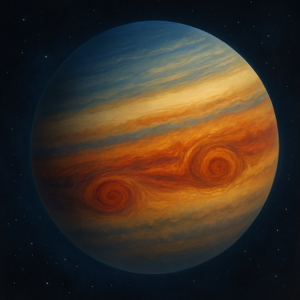
Irothein raised one limb and adjusted the projection above the command table. The moon bloomed into detail — not as an unknown object, but as a planetary body rendered in full systemic context. Atmospheric currents. Seismic flex-points. Core heat gradients. All clean. All healthy.
It was, by every metric available, a functioning moon.
“It rotates,” Irothein said softly, as if still surprised by the simplicity of the observation. “Its axial tilt is stable. Its orbit is locked. It catches and reflects solar radiation at precisely the expected angles. There is no gravitational interference. No course correction needed. The system flows better with it in place.”
Tem-Korrin’s voice followed. “Its mantle is warm, but not volatile. Tectonic systems appear intact, though long dormant. There are sediment traces of erosion and wind activity — recent wind activity — but the current pressure gradients are still. We believe atmospheric weather systems were active until very shortly before it appeared.”
The Chancellor’s eyes narrowed. “And the surface?”





Comments (0)
See all