
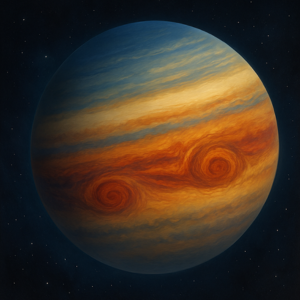
Tem-Korrin shifted. “Geometrically structured. Not uniformly — it’s not artificial — but layered in the way long-inhabited moons are. Ridges, landbreaks, depressions. Water channels. Geological age consistent with the inner moons, possibly older. And yet… no signs of population. None.”
Irothein folded their limbs inward. “No life. No heat. No signal. No infrastructure still in use. No decay, either. As though everything that was once there… simply stopped.”
Tem-Korrin leaned forward slightly, the movement accompanied by a soft creak of internal mass shifting through fluid suspension. “And still, it functions. It has re-entered the system as though it never left. Tides across Gravath and Illenar are more stable. Interference bands across Cindaros’ forge lattices have less turbulence. Orbital harmonics have improved. Not subtly. Significantly.”
The Chancellor said nothing. He watched the projection turn, again and again, with quiet mechanical grace. The data scrolled in light beside it — steady, uninterrupted, as though this moon had always been part of the system’s ledger.
“This is not a foreign object,” Tem-Korrin said, finally. “It is behaving exactly like a natural satellite. A real moon. Not something inserted. Something restored.”
Irothein added, “It is no longer out of phase, Chancellor. It’s here. Fully. Reacting to the system as if nothing happened. As if it never left.”
The Chancellor’s voice was low. “And yet it did.”
“Yes,” said Tem-Korrin. “It did.”
The projection continued to spin. The winds that no longer moved. The waters that had no inhabitants. The systems that remained, pristine and alone. The silence of it all.
A moon, alive in function.
And utterly empty.
The Chancellor drew a slow breath, then released it. He did not speak for a long while, not because he lacked words, but because the words he had — none of them fit.
One of the aides stepped forward — not hurriedly, but with the kind of gravity that signaled something unscheduled had arrived.
“There’s more,” they said quietly. “Just before your arrival, Chancellor, we received a coded transmission from Rheunon. High priority. Authenticated by voice and symbol.”
The Chancellor did not turn, but his presence sharpened, his spine aligning slightly straighter as he spoke.
“From whom?”
The aide hesitated, then answered with the care of someone invoking a name not lightly.
“Akliam of Lioren. Keeper of the House of Threads. She speaks with full authority of Rheunon’s Continuance Council.”
That earned the Chancellor’s attention. He turned at last, expression unreadable.
“Speak.”
The aide gestured, and a new projection thread unfolded over the table — not orbital telemetry, but an archival transmission, encoded in Rheunon’s distinct visual dialect. The first image was of an ancient ceiling panel — a fragment of carved geostone, veined with blue ore and etched with concentric star-maps. Amid the rings of constellations and known planetary paths, one symbol repeated again and again: a bright-marked glyph just outside Rheunon’s orbital curve. Always near. Always in step. Never crossing. Never gone — until it was.
“Akliam consulted one of their elder memory-keepers,” the aide explained, “a hereditary oral reciter from their deepstone archive line. This elder recalled stories passed down from long before the founding of the Commonwealth — before even formal legal codex. According to these records, Rheunon’s astronomers once tracked what they called a wandering star — not a poetic term, but a designation.”
The Chancellor studied the glyph’s position on the chart. It hovered behind the symbol for Rheunon’s own orbit like a shadow that had learned to pace its source.“It was not erratic,” the aide continued. “It followed their path with precision — always just beyond, always stable. Their records show it was plotted for over three centuries. Not daily, but seasonally, in sky-cycles and drift charts. They described it as steady, temperate, bright enough to mark, but never close enough to name.”
Another projection unfolded — fragments of navigational texts etched into mineral tablets, their grooves highlighted with vein-glass pigment. There were no legends attached. No myths. Just positional data and celestial coordinates, drawn by hand across eras.
“And then,” the aide said, “the records show a flash. Not described symbolically — described physically. A disruption of the night horizon. A skyburst. After which the star ceased to appear. No orbital shift. No decay. It simply vanished. And the charts that followed its disappearance redrew the night sky without it.”
The projection dimmed, leaving only the hollow orbit of the ninth path. Empty once again — until four days ago.
“Rheunon had always assumed it was a misclassification,” the aide added. “A background planet. Or a binary reflection. But their elders kept the record alive — not as prophecy, just... unresolved data.”
The Chancellor stood motionless. Then: “And Akliam believes it is the same?”
“She doesn’t speculate,” the aide replied. “She sent us the charts, the stonework, the coordinates, and a single line from the House of Threads ledger.”
They adjusted the projection. A single phrase unfolded in formal Rheunarian script, then translated automatically into Common Standard beneath it:
“The star that kept pace has returned to its orbit.”
Tem-Korrin shifted slightly, mass bracing. “They were observing a moon,” they said. “But didn’t know it.”
Irothein’s voice followed, quieter. “Its orbital rhythm matched theirs so precisely that they never saw it as separate. Just part of their sky.”
The Chancellor’s gaze lingered on the translation. His expression didn’t change, but his voice did — slow, low, and deliberate.
“And they forgot it.”
“They didn’t forget,” said the aide. “They stopped seeing it. And eventually assumed it was never there.”
“And now?”
“Now they remember.”
A long silence held in the Coordination Wing. Even the machines quieted, as if the revelation had reached something older than systems and sensors.
The Chancellor looked once more at the map — a new moon, in a perfect orbit, as if it had never left.
And now, across the system, the moons were beginning to remember.
The Chancellor’s gaze remained fixed on the projection — the ancient carving, the orbit it marked, the phrase etched into the House of Threads ledger. But after a moment, his voice cut through the silence, even and cool.
“Has any other moon confirmed this?”
Tem-Korrin and Irothein exchanged a brief glance — not hesitation, but coordination. It was Irothein who answered first.
“We’ve begun searching the historical catalogs — not just scientific records, but cultural archives, untranslated folktales, ethnographic strata from before the Commonwealth consolidation.”
Tem-Korrin folded their limbs slightly, shifting the projection to a new layer. This one wasn’t clean or well-indexed. It showed grainy reconstructions, fragments of ceremonial sky-maps carved into driftwood, etched into temple clay, or painted on fabric faded long beyond utility.
“There are mentions,” they said. “Not logged as astronomical data, but scattered through oral histories and local myths. Gravath records an old calibration song used by early engineers — it references a ‘sky-stone’ that moved with the pull tides, described as a second moon that watched from a distance. Thassalor has a harvest chant that speaks of a ‘quiet twin of night,’ always present during years of abundance, always missing in times of drought. Cindaros... well. They don’t preserve myth the same way. But their oldest mine-cycle logs contain references to ‘light echoes’ during seismic stillness — one of which matches the orbital alignment pattern within a one-degree variance.”Irothein’s voice softened. “None of it was considered credible. These entries were filed under ‘unverified cultural references’ — kept for linguistic study, not planetary science.”
“Until now,” the Chancellor said.
Tem-Korrin nodded once. “Now they all describe the same phenomenon. A light. Constant. Companion. Gone.”
“And,” Irothein added, “like Rheunon, nearly every reference ends the same way — with a flash. A rupture. Not a loss, but a severance. As though something... left.”
The Chancellor did not respond at first. He simply stood in the middle of the coordination floor, beneath ancient symbols and orbital mechanics, beneath maps drawn in memory and dust and mineral pigment. The room felt heavy with things once discarded — with whispers that had waited generations to be taken seriously.
“So it was seen,” he said at last. “By many. But remembered by none.”
“Not remembered,” Irothein corrected gently. “Misfiled.”
And somehow, that distinction made it worse.The Chancellor stood at the edge of the command floor, arms folded behind his back, eyes fixed on the projections still spinning in layered silence. Ancient sky-maps flickered alongside orbital renderings, the ghost of a memory now reintroduced into physics. Around him, aides waited — still, expectant. He didn’t need more analysis. He needed a decision.
He turned toward the central console. “Open a direct channel to Rheunon. Private band. Continuance Council seal. Priority two.”
The command was carried out without hesitation. But even priority channels from Rheunon came slow. Their encryption layers were deliberately complex, a relic of their cultural ethos — nothing was allowed to arrive quickly if it had not been properly considered. The silence that followed was not empty. It was weighted, coiling behind the screens like the air before a shift in gravity.
At last, the projection stabilized. The grain was faint, the relay imperfect, but the figure that emerged was unmistakable. Akliam of Lioren stood beneath the arched glow of vein-glass memory panels, her slate-gray robe falling in layered tiers, each hem inked with the thin lines of historical threading. Her face, as ever, was unreadable — not cold, but structured. The angle of her brow said calculation. The line of her mouth said restraint.
“Chancellor,” she said evenly, her voice clean and echoing slightly against stone. “I assume this is not a matter of ceremony.”
“It’s not,” he replied. His own tone matched hers — neutral, clipped, with just enough weight to suggest mutual inconvenience. “I’m requesting a favor. From Rheunon.”
There was a pause — one beat longer than required. Her eyes didn’t move, but her silence spoke clearly: she already knew the difference between a favor and a move on the board.
“Then speak it plainly.”
“I want you to send a probe,” the Chancellor said. “Not ours. Yours.”
Her head tilted slightly — not quite curiosity, not quite suspicion. She said nothing, waiting for the rest.
“High-pass flyby,” he continued. “Passive sensors only. No contact. No beacon. No broadcast. I need it launched under your authority — with one condition.”
She let that statement hang before responding, the words slow, deliberate. “And what’s the condition?”
“The transmission,” he said. “Every frame, every particle of incoming data — I want it sent directly to the Emergency Coordination Wing. No Senate relays. No Council archive. A closed feed. Live.”
The silence on her end thickened. It wasn’t hesitation. It was assessment — the kind Rheunari were known for. She was weighing not just the request, but what it implied.
“You’re asking us to collect data we cannot see,” she said.
“I’m asking you to help verify what none of us yet understand,” the Chancellor answered, his voice even. “And to do it before politics devours the science.”
Her brow arched ever so slightly. “Rhetoric.”
“Strategy,” he corrected.
Akliam’s hands remained clasped before her, unmoving. “You’re not asking. You’re directing.”
“If I were directing,” the Chancellor replied quietly, “I would have used our own probe. And I still may.”
Her mouth flattened — not in anger, but in recognition. Leverage, acknowledged and named. “And if we refuse?”
“Then I deploy ours,” he said. “But you lose the window. And the advantage. And whatever trust you’ve quietly built with the inner moons.”
The projection glitched for half a second as the distant signal pulsed — a wash of digital tension, followed by stillness. Then she drew in a breath, slow and composed.
“Fine,” she said. “We’ll deploy. One probe. Passive. No contact.”
“You’ll transmit directly to this chamber,” the Chancellor said. “We’ll know if anyone attempts to redirect or duplicate the stream.”
Akliam’s voice chilled by a few degrees. “That almost sounded like a warning.”
“It was.”
Another pause. Not as long this time, but no less intentional.
Then, as the Chancellor’s hand hovered over the panel to close the link, Akliam spoke again — and her voice changed.
“I want one thing in return.”
He looked up.
“Name it.”
There was the smallest tightening at the corner of her eyes — the only indicator that what followed cost her anything.
“I want to know if my son is safe.”
He blinked. “Who is your son?”
“Ax,” she said. “Of Lioren.”
The Chancellor exhaled slowly. “He is well. Still within the rotunda. Uninjured. Sharp as ever.”
Something flickered across her face. Not softness — she was Rheunari — but something close to its echo. A controlled breath. The barest blink. A pause held just long enough to make it personal.
“Then you’ll have your probe,” she said.
The projection cut off.
No formal closure. No seal. No parting gesture of diplomacy.
Just the dull, sudden absence of signal.
And far above them, the quiet, perfectly orbiting body continued its passage through the sky — waiting.The hours that followed moved like sediment through still water — slow, fine-grained, heavy in ways that could not be measured by clocks alone.
The Emergency Coordination Wing remained sealed. No fresh directives. No Senate briefings. The Chancellor had not left. He stood in quiet orbit of the central projection table, surrounded by aides and senior analysts, all of them waiting for a sound that had not yet come.
The Rheunarianan probe had launched hours earlier — a narrow, double-winged body built for atmosphere grazing and low-silhouette imaging. Its flight path had been approved, plotted, and uploaded in meticulous intervals, every adjustment cleared with more ritual than urgency. The Chancellor hadn’t watched the launch. He had simply nodded when confirmation arrived and resumed his silence. He didn’t need to see the liftoff. Only what came next.
Now, the probe was en route — somewhere between the cold curve of Rheunon’s orbital edge and the silent presence of the ninth body.
The waiting was the hardest part.
No one in the chamber spoke unless required. The usual hum of sub-vocal coordination, so common in high-intensity command floors, had gone still. The data streams, waiting to populate, hung open and unfilled. The air held an unusual stillness — as if even the circulation systems had slowed to listen.







Comments (0)
See all