
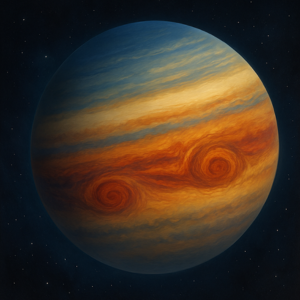
“It is a moon. Fully formed. Orbitally stable. Its mass, its atmospheric composition, its gravitational influence — all consistent with our system’s natural satellites. No anomalies. No inconsistencies. It behaves as if it has always been there. And yet…”
He allowed the silence to hang — heavy, unchallenged.
“Until five cycles ago, it was not.”
Above him, the chamber lights dimmed further as the first public transmission from the Rheunarian probe bloomed into view — high-altitude scans rendered in layered clarity. Cratered ridgelines softened by overgrowth. Towers folded into cliffs like fossilized memory. Valleys cradling tangled forests too uniform to be wild, too quiet to be new. The architecture of something ancient, but not broken — not entirely.
The projections shifted in silent procession, and still the chamber said nothing. The visuals spoke louder than speculation. They were real.
And they had waited a long time to be seen.
“These images from a Rheunarian probe,” the Chancellor said, gesturing without raising his hand, “are not a simulation.”
A rustle moved through the chamber — subtle, organic, the shared exhale of hundreds who had been holding something in. Not disbelief. Not even fear. Just breath. The kind one takes before a descent, or a decision.
“This moon’s surface shows signs of age. Of civilization. Of abandonment.”
His voice did not rise. It didn’t need to. The images spoke — towers without collapse, roads overtaken not by entropy, but by time. Nothing eroded. Nothing scorched.
“The structures you see were not buried. They endured. Not hidden beneath sediment, not fractured by tectonic collapse or orbital stress. They stand, in form and function, much as they once did — preserved not by artifice, but by absence.”
He let the silence draw out, letting the gravity of his words settle into the stone of the chamber. Then he continued.
“We have detected no active energy sources. No beacon pulses. No atmospheric disturbances outside natural variance. No life signatures, not from the air, nor the soil, nor the bioscans. Only silence. A silence... so complete, it echoes.”
A Silvarian delegate raised a slender, multi-pronged hand, crystalline tips glinting faintly in the lowered light. A motion of protocol. A signal of query. But the Chancellor did not yield the floor.
“No expeditions have been sent,” he said, his voice cutting gently through the pause. “No landers. No scouts. No analysis teams. What you are seeing — these projections, these scans — are the first and only pass. High-orbit visuals. Non-intrusive. Observational. This chamber is the first to witness them in full.”
Now he stepped forward, away from the central axis of the dais. His gaze swept upward across the tiers of the spiral forum — not searching for a reaction, but weighing the room itself.
“There are moons among us — Rheunon most notably — whose ancestral records speak of a ‘wandering star’ that once traced their orbit. Not erratically, not like a comet. A regular, deliberate path. Their early astronomers recorded it in orbital glyphs as a fixture. Then, according to carved timelines preserved in glacial sanctuaries, it vanished in an instant. A flash so intense it reportedly turned surface frost to vapor and left the skies altered, empty.”A shift in the chamber followed — small but collective. The kind of silence that comes not from disbelief, but from the unsettling friction of memory trying to reconcile with proof.
“Other moons — Cindaros, Sylvaan, even Thassalor — possess fragments. Partial myths, scattered references in oral traditions, side notes in archived surveys no longer considered canonical. All describing something similar: a light in the sky that moved in rhythm, then disappeared. Too patterned to dismiss as fantasy. Too incomplete to confirm as fact.”
He stepped forward, slowly, deliberately, letting the words settle before continuing.
“These were never treated as history. Nor as science. They occupied the space in between — the forgotten edge where memory blurs into silence. Where something may have once been known… and then wasn’t.”
Now he let his gaze pass over the chamber — not challenging, not defensive, but steady.
“Until now.”
The silence that followed was not empty. It had form, and weight.
“We are not yet ready to declare what this means. But we are no longer asking whether it is real.”“I come to you not with answers, but with a proposition. We must act — not react. We must investigate — but with unity, not ambition.”
A secondary image formed — a multi-moon crest, the diplomatic sigils of each member world surrounding a shared center.
“I propose a joint reconnaissance mission. One representative from each moon. Civilian-trained, interdisciplinary, cooperative. Not military. Not political. This is a discovery — not a conquest.”
Now the chamber stirred in earnest. Soft murmurs rose. Ambition. Skepticism. A few audible agreements.
The Chancellor’s voice cut through again — firm, calm.
“Let us not reduce this moment to competition. We have been given something rare — a question born in the silence of space. Let us answer it together.”
And then he stepped back, allowing the images to loop, the chamber to breathe again, and the murmurs to grow into the storm of politics once more.
But the silence he had carried with him still lingered — a reminder that, above them all, a moon long gone had returned. And it was waiting.
From the ascending tier of Thassalor’s delegation, a figure stood — tall, angular, draped in a mantle of black-threaded indigo. Councilor Sen Talar of the Outer Trident did not speak often, but when he did, it was with the precision of someone used to shaping policy by tone alone.
“Chancellor,” he said, voice measured, “you’ve just described a miracle — a celestial body re-entering our system, fully intact, unannounced, unaccounted for. You call it a moon. You say it belongs here.”
A slow pivot of his head, eyes scanning the tiers as if inviting them to witness not just the moment, but the silence it produced.
“Then I must ask — as a representative of Thassalor and a sworn protector of intermoon sovereignty — what gives you, or the Emergency Wing, the authority to treat it as yours to study… before any declaration was made to this chamber?”
He descended a step, hands clasped behind his back, tone tightening.
“Five cycles have passed since this object — this moon — inserted itself into the ninth orbital path. In that time, a probe was launched. Not from this council’s joint fleet. Not through a multilateral resolution. But from Rheunon — at your request. Without vote. Without consultation. Without so much as an emergency quorum.”
Now the air changed. Not dramatic. But taut.
“You’ve shown us terrain. Atmosphere. Ruins. And in doing so, you have already framed the narrative. That it is a place to be explored. An opportunity to be studied. But what you have not told us is who will decide its fate.”
A ripple moved through the chamber — not outrage, but the prelude to it.
Talar’s voice dropped just slightly, enough to make the room lean forward.
“We’ve witnessed too many times how 'first to arrive' becomes 'first to claim.' How the moon closest to discovery becomes the one entitled to define it. And how science becomes policy before diplomacy catches its breath.”
He let the words hang. Then delivered the final blow:
“Is this moon to be declared a shared artifact of our system? Or will it become yet another frontier to be divided, negotiated, and quietly owned?”
Before the room could tip further into speculation, another figure rose — not with drama, but with exactitude. Ax of Lioren stood without hesitation, voice carrying with the crisp cadence of one who knew the letter of the law better than the tone of the room.
“Commonwealth Directive 7.3, Subclause E,” he began, “ratified during the Thassarist Chancellorship in Session 21,774 — in response to the sudden emergence of an uncharted sub-satellite in the outer Cindari belt.”
The air in the chamber recalibrated, ever so slightly.
“It provides that in the event of a previously unobserved celestial body entering established orbital lanes — with unknown origin, trajectory, or potential impact — the sitting Chancellor may authorize a singular, passive reconnaissance action without prior Senate approval, so long as the data is disclosed to the Council before any physical engagement or policy recommendation is made.”
He let the clause breathe, then continued.
“It is a provision not of secrecy, but of speed. Designed for precisely this kind of uncertainty — where hesitation could lead to chaos, but premature action could provoke worse.”
Ax’s eyes met Sen Talar’s now — firm, but not combative.
“The Chancellor did not deploy forces. He did not conceal the data. He acted within the scope of established law to prevent misinformation, not to suppress deliberation.”
Then, shifting his gaze briefly across the room:
“And if this body believes that discovery is the same as possession, then perhaps it is not law that must be questioned, but memory.”He returned to his seat, the weight of his words still hanging in the chamber’s echo.
Before the chamber could fully absorb Ax’s words, Sen Talar rose with deliberate precision, voice slicing through the tension like polished glass.
“How convenient,” he said, eyes narrowing slightly, “that a legal defense materializes the moment scrutiny is applied — and from Rheunon, no less. The very moon whose probe was granted the honor of first passage. One might call it impressive coordination. Others might call it orchestration.”
The air shifted. The implication had teeth.
“Shall we pretend,” Talar continued, voice gaining sharpness with each word, “that proximity alone earns privilege? That Rheunon’s involvement was incidental — not chosen, not invited, not designed? We’ve been locked in this chamber for five cycles, Chancellor, and only now are we being shown these images. Are we to believe the Emergency Wing consulted no one else? That this was not a quietly negotiated advantage?”
He turned, gaze fixed on the Chancellor.
“If the moon had surfaced near Thassalor, or Sylvaan, would their probes have been granted the same autonomous path? Or would they have faced obstacles, delays — oversight masked as caution?”
Low murmurs rippled through the tiers — not debate yet, but friction.
The Chancellor did not move at first. He let the charge hang in the air, allowed its weight to settle across the rotunda like unsettled dust. When he finally spoke, it was not in defense, but in declaration — calm, measured, and without apology.
“Rheunon’s proximity made it the most apt candidate,” he said evenly. “Not because of politics. Because of physics. Their orbital path aligned most efficiently with the object. Their launch time would be shortest. Their risk of telemetry distortion lowest. Any moon in that position would have been asked — and yes, delegate Talar, if the ninth orbit had brought the anomaly nearer to Thassalor or Sylvaan, I would have extended the same request to your fleets. Without hesitation.”
He turned slightly now, eyes sweeping the rows not with challenge, but with authority.
“The data received from the probe was encrypted at the point of origin. Its stream was routed directly to the Emergency Coordination Wing and nowhere else. This chamber may review the logs. The relay path is unbroken. There has been no tampering. No early access. Not even Rheunon itself retained the feed. The information was protected — because the knowledge it contains belongs not to one moon, but to the Commonwealth.”
Now, his voice shifted — just slightly. Not louder, but fuller.“And let us not pretend that this has been a solitary Illenari decision. My senior aides, Tem-Korrin of Gravath and Irothein of Nethara, are not only trusted members of this administration — they are distinguished scholars in their fields. One, a leading astrophysicist. The other, a planetary systems analyst whose models are studied across our academies. Their counsel shaped every stage of this response. Their allegiance is not to me — but to the truth.”
A quiet settled again. It was not submission. It was recognition.
“I have held this office for the last 1,200 sessions,” the Chancellor continued. “Through collapses, crises, and peace accords. I have served with three generations of Silvarian delegates, four of Thassalor, and six from the outer moons. I have not always been right. But I have never once acted in concealment. If my judgment no longer warrants your trust, say so. Say it plainly. But do not confuse urgency with advantage. Do not turn gravity into suspicion.”
His gaze returned to Sen Talar, not hostile, but unyielding.“And if this chamber still values discernment over disorder, then let us proceed.”
Senator Talar did not reply. His jaw tightened, mandibles flexing once, but no words followed. Whether out of calculation, caution, or the dawning realization that the chamber was no longer leaning in his direction, he remained seated.
The Chancellor turned slightly toward the center of the spiral. He let the silence sit just long enough to settle the tension, then spoke with a voice that left no room for ambiguity.
“In light of the concerns raised — and to prevent this discovery from fracturing the unity it may yet require — I propose the following course.”
The projections shifted behind him. The image of the ninth moon remained, but a thin ring of light now encircled it — symbolic, yet unmistakable.
“A full orbital interdiction will be established. A blockade, sanctioned by this body and enforced by automated drones bearing the seal of the Circumlunar Commonwealth. No vessels — military, research, or civilian — shall land upon the surface of the ninth moon or enter its atmosphere without the unanimous consent of this Senate.”
A few murmurs began, but he did not slow.
“Let it be clear: any craft that breaches the blockade will be neutralized. Immediately. This is not a punitive measure. It is a stabilizing one. We do not know what lies beneath those ruins. And we cannot afford to let ambition outrun understanding.”
He stepped forward once more, gaze sharpened, but not cold.
“Furthermore, should any moon of this Commonwealth act unilaterally — violating the interdiction, falsifying flight paths, or aiding unauthorized descent — their moon will fall under Article 9: Interstellar Containment Protocol.”
The words hit hard. Article 9 was rarely invoked — a diplomatic sanction short of war, yet economically and politically suffocating.
“No trade. No data exchange. No representation within this chamber until full review by the High Council of Accordancy. And if necessary, military observation will follow.”
His hands remained folded before him. No dramatics. Just law, spoken aloud.






Comments (0)
See all