
The Montpellier sky remained dazzling even at dusk, bathing the buildings in a golden glow.
It had been nearly three weeks since Weiss and Clarisse began living together in his studio apartment.
And now, in that very room, the two accomplices were preparing for their next act.
Clarisse quietly closed her notebook in the corner of the room.
"...So, we're finally going to sell it."
"Yes."
Weiss nodded slightly.
"The painting is finished. It fills in Ernst's 'blank.' ...All that's left is the background."
"You mean, the story."
Without hesitation, Clarisse spread a large map across the desk.
An old map of European estates, marked with numerous red ink dots she had prepared over the past few days.
"Here, and here. Regions known for wealthy collectors. The classic 'found in the attic of a grandfather's estate' story. It's cliché, but that's precisely why it's believable."
"Good point. Overused, but effective. I'll get the frame ready. The label will read: 'Private record from a collector near Cologne, 1931.' That feels right."
"We'll also need a photo—one showing the forgery with 'grandmother.'"
"Hmm... how should we do that?"
They both pondered.
Then Weiss suggested,
"Why don't you disguise yourself as the grandmother?"
"Ah, so we photograph you with the painting, staged as if from that era."
"Exactly. We'll set up a background with era-appropriate props and use an old camera."
"Alright, I'm in."
Clarisse smiled, standing up to rummage through the closet.
"I have some vintage clothes from the '60s. I'll pin up my hair, and once we take the photo in black and white, it'll be perfect."
"Leave the set to me. I'll find a dusty old sofa, a mirror, and curtains from the antique shop."
"Good. We'll give ourselves a week. Let's make it flawless."
Clarisse's eyes no longer held the gentle smile she had shown at the café.
Now, they reflected the focused intensity of an actress just before the curtain rises.
Weiss met her gaze with equal resolve.
The year was 1980.
This was, perhaps, the last era where analog deceit could still thrive.
Before the digital age, before everything became searchable and traceable, there was still room for stories to be believed— as long as they were crafted convincingly.
Photographs could be aged with simple chemicals.
Paper textures could be mimicked.
Fonts, ink colors, even the way stamps faded— all could be controlled by human hands.
The key was consistency.
A single slip—a wrong paper, an anachronistic label—could ruin everything.
But if every detail aligned,
if the illusion was complete,
it would become reality.
That was the art Weiss and Clarisse were perfecting.
A forgery was never just the painting.
It was the story, the evidence, the world built around it.
And in 1980, there was still space for such worlds to exist.
One week later.
Just before noon on a Saturday, a quiet knock echoed through the atelier's door. Weiss looked up, and Clarisse also gently raised her face.
—He's here.
When Weiss opened the door, an older man stood before him, dressed in a gray suit.
"Herr Werner Spies?"
Indeed, it was the renowned art scholar, the man who supervised Max Ernst's catalogue raisonné.
Weeks earlier, Clarisse had sent a carefully composed letter to Spies, complete with a fabricated provenance and convincing photographs of the forgery. Her social finesse and eye for detail had paid off.
Even so, Weiss hadn't truly expected Spies to come in person.
The man smiled gently, raising his right hand in a modest greeting.
"This is quite a surprise. To think, there might be an undiscovered work by Ernst."
His voice carried not sarcasm or skepticism, but pure interest and delight.
"I'm just as surprised, sir. Please, come in."
Clarisse guided him inside, offering coffee, which Spies politely declined.
"Ah, thank you, but—I'm afraid time is short. Might I see the piece your grandmother described as 'my late husband's most beautiful forest'?"
"Of course. If you would, please show him," Clarisse said.
Weiss led Spies to the back of the atelier, where a canvas stood draped in white cloth.
Slowly, Weiss unveiled it.
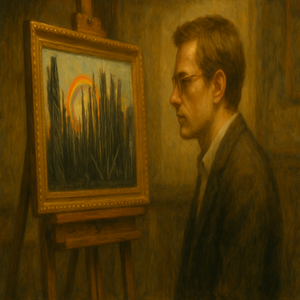
The painting emerged—a fantastical composition blending forest and crowd, unmistakably reminiscent of Ernst's dreamlike style.
"...This is..."
Spies widened his eyes, momentarily at a loss for words.
He stepped closer, scrutinizing the brushwork, the color palette, the depth of the composition.
Clarisse calmly explained,
"While sorting through my late grandmother's estate, we found this in the attic. Along with it were letters, records, and photographs, all of which we have prepared for your review today."
"May I see them?"
Spies perused the documents carefully, occasionally glancing back at the painting. Finally, he gave a deep nod.
"There is no doubt... This reflects the style of Ernst's 'lost period' perfectly."
"Really?" Clarisse feigned astonishment.
"Indeed. I am confident this can be officially recognized as an undiscovered work by Ernst."
He offered his business card, a restrained smile tugging at his lips.
"If you are considering selling, I would be happy to handle the arrangements. The piece would likely be valued at around one million Deutsche Marks."
Clarisse and Weiss exchanged a brief glance.
In their eyes was not tension, but the quiet satisfaction of having executed a flawless performance.
"...One million Deutsche Marks," Weiss echoed softly.
At the time, that amounted to roughly 60 to 70 million yen.
A number that now carried tangible weight.
Spies checked his watch and stood up.
"Unfortunately, I cannot stay longer, but I will contact you soon regarding the official appraisal and sales process."
Turning to Clarisse, he smiled warmly.
"Truly a remarkable piece. I never imagined I'd witness such a discovery with my own eyes."
Clarisse bowed gracefully, all the while gauging how much of the truth Spies truly saw.
"All necessary documents and contacts are noted on the back of my card. I'll send a representative in the coming days."
Weiss nodded silently.
At the door, Spies paused for a moment.
"Still... it truly feels like Ernst's 'lost forest.' Thank you. I am deeply moved."
The door closed quietly. Neither Weiss nor Clarisse spoke until his presence had completely faded.
Weiss stood still for a few seconds, then sank into a chair, resting his elbows on the table.
"Hah... It's done."
Clarisse slowly nodded, running her hand through her hair as she slumped onto the sofa.
"Is this really happening? Unbelievable. Did you hear that amount clearly?"
"...One million Deutsche Marks. The zeros were collapsing in my head."
"For just one painting. One painting with a 'story.'"
Weiss took a sip of water, moistening his parched throat.
"I painted, bought a dusty mirror and curtains at an antique shop, you became a 'grandmother'... and with that, one million."
Clarisse nearly burst out laughing but managed to hold it back.
"I'll say it again... Is it really this simple? Spies being fooled so easily."
"Honestly, it's absurd, Clarisse!"
After a brief moment of silence, their disbelief gave way to laughter.
"One million, can you believe it? He just looked at it and said, 'No doubt, this is Ernst's lost work.'"
Clarisse mimicked Spies mockingly.
"Hey, don't mock Spies. We owe this to his 'first glance judgment.' We should be grateful."
Weiss joined in, laughing.
"But you're mocking him too!"
"Heh... still, one million..."
"You know, we might have started something truly outrageous here."
"Isn't that exactly why we teamed up in the first place?"
Their eyes met.
In a surge of emotion, they embraced, their laughter filling the room, shaking the very air.
*
Meanwhile, at the Berlin Police Headquarters.
Footsteps echoed as a young man hurried down the hall.
"Excuse me!"
A rookie detective, his face still bearing traces of youth, yet with sharp eyes filled with nervous tension.
"Sorry to call you in so suddenly," said an older officer seated at his desk, looking up from a thick file.
"Er, your name?"
"Rosen. Rosen Franz!"
"Right, Rosen. I've heard good things. Top marks, they say."
"Thank you, sir. Um..."
The senior officer pulled out a document and handed it over.
"Your assignment has changed. You're now with the Art Crime Division."
"Art... sir?"
Rosen's eyes widened slightly.
"Surprised? We're busier than you'd think. Lately, more and more 'lost artworks' from the Nazi era have been 'found.' Dealers, museums, and the police are all scrambling. Rosen, you'll be investigating those."
"...Understood!"
Though his eyes lowered, a spark of curiosity flickered in Rosen's expression.
He quietly opened the file he'd been given, scanning the extensive list: anonymous oil paintings, sculptures with dubious provenance, watercolors shrouded in forgery rumors.
Among them, five characters caught his eye:
"Campendonk — provenance unknown, donation from private collector, Cologne West, 1973."
One of Weiss's past forgeries.
Rosen's brow furrowed slightly at the name, but he said nothing and turned the page.
The fact that this painting would later shake the art world—
That, he had yet to realize.






Comments (0)
See all