
After the Spies incident, the gears began turning rapidly.
Weiss painted, and Clarisse moved.
As soon as one painting was completed, the next concept would begin. Meanwhile, Clarisse arranged the photographs, constructed the story, and knocked on the doors of experts.
"Here's the invoice, thank you very much, goodbye."
Transactions worth huge sums began to feel as simple as bartering at a flea market.
Yet for them, this had become their most efficient form of livelihood.
That day, Weiss was working on a forgery of Campendonk. A painting meant to fill in a blank from 1914.
Title: "Dedicated to Lasker-Schüler."
Lasker-Schüler — an expressionist poet who had briefly been acquainted with Campendonk. Their relationship, in reality, is evidenced only by a handful of postcards.
But for Weiss, that was convenient.
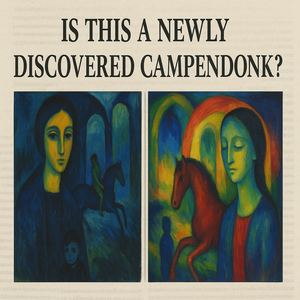
At the center of the canvas, a woman bathed in fantastical light. A flurry of arches and beams, galloping horses — and in one window, nestled deep in the composition, was a childlike figure.
Tiny, but oddly realistic. Bouncing hair, expressionless eyes, and a small, unmistakable mustache.
Clarisse frowned as she examined the piece.
"...Is this a child?"
"Doesn't it look like someone to you?"
Weiss responded with a mischievous grin.
"Wait... is that supposed to be Hitler as a child?"
"Ah, so you noticed. Yes, I painted young Hitler."
"What?! ...Isn't that a bit risky? Won't someone notice?"
"It's a fine line. But don't you want to see how the experts react?"
"Ugh, don't. It's worrying."
"If they do notice, I'll just say, 'Yes, I suppose it does resemble him.'"
Weiss laughed and handed the painting to Clarisse.
*
"...Magnificent."
The elderly appraiser murmured through his loupe, enchanted.
"This composition, brush pressure, layering of color... it's exactly in line with the 1914 style. Very much in Campendonk's 'Blue Period.'"
Clarisse gave a demure smile.
"I'm honored it meets your eye."
The appraiser gently tilted the canvas, checking even the back for stamps.
As the loupe neared "that" window in the corner, Weiss's heart skipped a beat.
"...?"
But the loupe slid right past, without a word.
Weiss held back laughter with effort.
"By the way," the appraiser suddenly looked up.
"Do you have a certificate of purchase or a receipt for this painting?"
After a slight pause, Clarisse shook her head.
"It was found after my grandfather's death. From what I've heard, most of the records were lost during the Second World War in a fire... I'm afraid we have no documentation."
The appraiser nodded.
"Understandable. That happened often during the war."
He turned his gaze back to the painting.
"Still... to think such a work remained undiscovered for decades. A true miracle. Now then, how about this for payment?"
"...Thank you very much."
They both bowed slightly.
"Excellent, thank you again. That's all, then."
Purchase amount — 580,000 Deutsche Marks.
*
In the spring of 1983, the two married. Not for love, but for practicality — both in life and in business.
After juggling multiple names, false identities, and playing relatives or secretaries in front of art dealers and experts, they concluded that formalizing their relationship would be most convenient.
For unifying names, giving paperwork more legitimacy, and most of all, to wear a faint veneer of "respectability."
For a forger and their accomplice, it was the most rational choice.
"So we're officially a married couple now," Clarisse said with a sly grin, spinning a gold ring she'd bought from a used bookshop.
"Officially, sure. But we've already been acting like one in all our private dealings," Weiss replied, organizing envelopes.
Clarisse shrugged.
"Fake identities, fake backstories, fake relatives — it's all 'marital teamwork.'"
"Sounds more like a scammer's vow."
"Wrong. It's an artist's vow."
They exchanged looks and laughed quietly.
*
One quiet afternoon—
"Moving?" Clarisse repeated Weiss's words.
"Yeah. Montpellier is great and all... but honestly, it's too expensive. And pretentious."
Weiss stirred his coffee cup as he spoke.
"We're selling real work, but the buyers act more authentic than the art."
"Haha, totally. People who are more fake than anything we make, asking 'Is this genuine?'"
Weiss nodded seriously.
"Exactly."
"Then... how about Germany?"
"Germany?"
"A rural town near Cologne. Bergisch Gladbach. My father's relatives lived there long ago. The house is empty now."
"Near Cologne... so that's the West."
"And the house has a basement."
"A basement?"
Weiss's eyebrows rose in excitement.
"Yes. It's a little old, but it has big windows. The lighting is great for painting."
"Then let's go with that one," Weiss said instantly.
"Without even seeing it?"
"The house doesn't matter. As long as there's a basement."
"You're such a weirdo."
*
On the weekend, they drove to Bergisch Gladbach. At the top of a small slope, the house that Clarisse had visited only a few times before stood quietly, partially overtaken by weeds.
"So this is it..."
Clarisse unlocked the door, and the creaking echoed through the empty space.
The furniture had already been cleared, but the interior was more spacious and quiet than expected.
Weiss found a staircase at the back of the entrance and headed straight for it.
"Most homes here are supposed to have basements."
He opened the creaky door, and a cold breeze wafted out. A single bare bulb hung from the ceiling. Exposed concrete everywhere.
But Weiss's eyes gleamed.
"This is good. There's humidity. The sound doesn't echo. And no sunlight."
"Most people would say that's a bad thing."
Clarisse frowned.
"No, you don't get it. In this place, the lines I draw won't be weathered by time. Untouched by anyone, they'll just remain quietly. That's... perfect for expression."
Clarisse paused on the stairs, looking down at Weiss.
A little exasperated, and yet, a little proud.
"Then you'll be able to work here, right?"
"Yeah. I'll paint so much. This is a perfect underground fortress."
"Alright, alright. We'll need to clean up and organize everything first."
*
Life in Bergisch Gladbach was quiet, modest, and ideal for forgery.
Weiss gradually increased the time he spent in the basement, controlling light and humidity, chasing even more intricate brushstrokes than before.
He became particular about his pigments.
(This blue... it's not deep enough. It's still far from Campendonk's 'midnight blue.')
He ordered rare mineral-based pigments and recreated adhesives and grounds using early 20th-century recipes. He noted pigment ratios and subtle brush pressure differences like a researcher, sketching multiple drafts simultaneously.
Clarisse also stepped up her background creation. New photos, letters, family trees — sometimes even placing small anonymous articles in art magazines.
Most of their profits were funneled into materials, pigments, tools, paper, and bribes to antique dealers. But to them, none of it was waste. It was part of the artwork.
"This is the 'setup.' Forgery begins before you ever pick up the brush."
Whenever Clarisse said that with a laugh, Weiss would stop his hand and nod.
*
Meanwhile, in Düsseldorf—
In a corner of an appraiser's office, young investigator Rosen pored over a thick file.
"Possible Campendonk forgeries..."
"Yes. They're expertly done, but we suspect a few may be fake."
In front of Rosen were photos and provenance details of recently surfaced "unpublished works."
All had been authenticated and evaluated. Yet something about each one felt... off.
"The timing, the background — it's all too perfect."
A small memo left by another investigator lay on the desk.
"Origin: via France / Sold to: multiple buyers"
"The same art dealer keeps 'discovering' works, but the buyers are all over the place... like someone's spreading them deliberately."
Rosen quietly turned his pen in his fingers and murmured:
"Something's going on."
The following morning at Berlin State Police Headquarters—
"Rosen, I see you've been digging into the Campendonk case."
"Yes, sir. There are several aspects that caught my attention."
"In that case, you should visit the Campendonk Collection in Penzberg. Their chief curator is a bit of a fanatic — excuse me, expert. One of the best in the country, actually."
"May I ask who it is?"
"A woman. Brückner, I believe. Let me find her card... Here it is. Katarina Brückner. She's a little tough to approach, but she'll talk if you ask properly. Someone like you should do fine."
Rosen gave a small nod.
"Understood. I'll go."
—Katharina Brückner / Museum Penzberg – Sammlung Campendonk
Rosen tucked the card into his chest pocket and put on his coat.
He was ready to seek the truth behind the beauty.
*
It was a gloomy afternoon. The Penzberg Museum was quiet.
On a weekday, only a few visitors wandered through the exhibition hall. In the center of the gallery, a woman stood still, gazing intently at a painting. She wore a black turtleneck, a red skirt, and thin glasses, with an intelligent glint behind them.
She was Katharina Brückner, chief curator of the Heinrich Campendonk Collection at the Penzberg Museum.
A soft voice broke the silence behind her.
"Ms. Brückner, you have a visitor."
A museum staff member gestured as Rosen stepped forward and bowed politely.
"My name is Franz Rosen from the Berlin State Police Headquarters. I apologize for the sudden visit."
Katharina looked at him with slight surprise, raising her eyebrows.
"The police? Has something happened?"
After a whispered explanation from the staff, Katharina composed herself and nodded.
"This way, please."
They walked through a corridor reserved for staff and entered a small office lined with archives and art books. Once seated at the central table, Rosen pulled out several photos and documents from his coat.
"We've noticed a series of 'unpublished Campendonk works' appearing on the market in recent years. Some details seem odd."
Katharina crossed her arms, examining the photos with a hint of tension and curiosity.
"Are you suspecting forgeries?"
Rosen nodded.
"Yes. According to appraisers, they're 'too perfect.' The historical context and provenance are all too neatly tied together."
Katharina remained silent for a moment, then spoke.
"Looking at these pictures... yes, they could easily pass as real. Honestly, I wouldn't question them until someone mentioned forgeries. They're... exceptionally well made."
She paused, then added:
"But when I look closer, they all feel a little too... bright. The tones are too light, the figures too idealized. Campendonk's art carries more melancholy, more solitude."
Rosen nodded thoughtfully. Katharina pulled an old art book from a nearby shelf.
"He was born in Krefeld in western Germany, raised in a modest textile merchant family. He wasn't rich. His parents opposed his art studies. He dropped out at 18, penniless, and kept painting in despair."
She opened to a self-portrait from that era.
"You won't find glamorous women in his paintings. The faces are stylized, shadowed. He never painted overt beauty. That was Campendonk."
Rosen murmured:
"So the recent works... they're too vibrant. Too alive."
"Exactly. Art is a conversation with its creator. If you can't hear that 'voice'—then it's not authentic."
Rosen added quietly:
"I've also felt something odd. Some of these works have no heat behind the eyes. Perfect technique, no breath."
Katharina nodded.
"The problem is, everything checks out—paper, paint, provenance. Every expert signs off."
"Then my job is to turn that 'sense' into proof."
"Come. Let's go see a real one."
She led him back to the main hall. Surrounded by white walls and high ceilings, carefully curated Campendonk pieces lined the gallery.
They stopped before one from 1912.
"Notice the use of blue? It's unique. There's brightness, yet it shrinks from the light."
Rosen observed in silence.
"Even with vivid colors, Campendonk's paintings 'sink.' They retain his loneliness, his struggle."
She led him to another.
"This one's from 1915, after he lost a friend to war. There's color, but look—the expression is empty."
Rosen narrowed his eyes, comparing it to the forged works.
"Yes... those are too alive."
"Exactly. They're 'too bright.' The paintings talk too much. Campendonk was more reserved."
*
At the exit, Rosen handed her his card.
"Thank you for your time. I'll be in touch with any updates."
"Of course. Come back anytime."
Katharina returned to the quiet hall, holding one of the photos Rosen had shown her.
She muttered to herself:
"To think someone would fill in the blanks like this... clever. A money game, no doubt."
Then a voice from behind:
"I like this one."
She turned to see a small girl smiling and pointing at the very forgery photograph in her hand.
Katharina's expression flickered, but she said nothing in response to the girl's innocent words.
*
On a sunny Saturday in Cologne—
A special exhibition titled "Campendonk and His Time" was being held at a contemporary art gallery.
The catalog mentioned: "Featuring newly acquired works from private collections."
Weiss had decided to visit on a whim. Cologne was less than an hour's drive from Bergisch Gladbach. He'd joked to Clarisse, "I need to remind myself who I am before I get lost in forgery."
The gallery bustled with visitors. Weiss wandered aimlessly—until one painting stopped him.
"Huh?"
It looked familiar.
"...No way."
A painting of horses and a female figure, with surreal arches. The brushwork, the lighting, the composition—undeniably his own.
"...I painted that."
He chuckled. Someone else's name now hung beneath it.
A young man stood before the painting.
Rosen.
He had dropped by on his day off for casual study. Neither man recognized the other. But Weiss felt drawn to the man's focused profile.
"What do you think of it?" Weiss asked, more out of curiosity than caution.
Rosen turned, surprised but not alarmed.
"It's a beautiful painting. I'm no expert, but I like it. Though... maybe it's a bit too bright."
"Bright, huh? Interesting."
"Are you familiar with art?"
"Just a hobbyist, really."
The conversation didn't go further. Rosen gave a polite nod and walked away.
Weiss remained in front of the painting, then shrugged.
"Not bad..."
And with that, he turned and exited the gallery.
He had no idea that, decades later, this very painting would become the center of controversy in the art world.






Comments (0)
See all