
"Laughing was easy. What was hard came after."
In the morning, Weiss was already holed up in the basement.
Clarisse, alone, brewed herself a cup of tea in the kitchen.
A slice of precisely cut lemon floated in her cup, and the scent of bergamot slowly filled the quiet room.
With the cup in hand, Clarisse sat by the living room window.
A cloudy sky. Endless layers of gray. Only the white flowers in a potted plant outside added a touch of color to the world.
Weiss had fallen in love with this house for one reason—the basement.
Humidity, temperature, and complete silence.
To him, it was the ideal studio. To Clarisse, it was a space that evoked a certain distance.
Her gaze drifted to a letter copy hanging on the wall.
A postcard written by Campendonk to someone. It was something she had found at an old paper market and carefully crafted to look authentic.
"To think this became 'evidence'..."
she murmured to no one in particular.
As if repeating a scene she'd performed many times before in her life.
Clarisse lowered her eyes and sank into her memories.
"Back then, I think I was also sipping tea to hide something..."
──Back when she lived in Lucerne, Switzerland.
Her father had died of illness when she was still very young—at least that's what her mother told her. As a result, her mother became obsessed with maintaining appearances.
She hated being seen as a "widow's daughter" and shielded the family with nothing but decorum and perfection.
Clarisse, in turn, tried her best to meet those expectations, always playing the role of the "proper daughter."
They lived in an old stone apartment. The exterior was grand, but inside it was modest, with her mother's vanity the only thing that stood out.
Her mother often said:
"Posture is dignity. Tableware is language. Clothing is proof of family."
"Yes, Mother," Clarisse would always reply, like a script.
Piano, French, social etiquette. Drilled into her. If she made a mistake, a cold voice would command, "Again."
If her posture slouched, she'd get a tap on the back. If she mishandled a knife, her hand was seized and repositioned.
"Posture is everything. Weakness in the heart shows in the back."
"Yes... Mother."
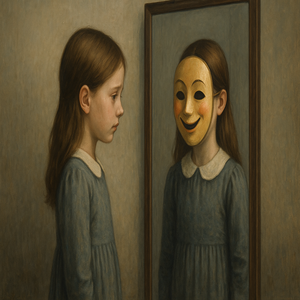
Clarisse was taught to smile. Smiling maintained order, or so she was told.
Crying, getting angry, even staying silent—none were permitted. It would make her look like a tutor's daughter, her mother said.
So Clarisse learned to smile.
Even when suffocating, she masked it with the scent of tea.
At school, among friends, she always played a role—model student, intelligent young lady, the one good at playing along. All of it was for survival.
But one day, when Clarisse returned home drenched from a sudden downpour, the moment she opened the door, her mother's voice thundered:
"What is that look?! Your clothes are ruined! Your hair's a mess—you look like a vagabond!"
Clarisse tried to speak, but more words came.
"Your umbrella? You had one, didn't you? Why didn't you use it? It's vulgar. Shameful!"
Softly, she answered, "The wind broke it."
Her mother grew more irritated.
"No excuses. So what if there's a reason? Looking disgraceful is still disgraceful! Your words won't change anyone's impression of you!"
That night, Clarisse stood in front of the mirror, towel in hand.
She tried to smile—but couldn't.
Yet by the next morning, in front of her mother, she smiled again as if nothing had happened.
──Performing had become her way of breathing.
*
By the time she graduated high school in Lucerne, Clarisse's smile had become an unquestioned mask.
She moved to Germany and studied languages and history at university in Freiburg, while working as a weekend magazine model.
On set, she smiled as directed, matched her expressions to the costumes.
"That gaze is perfect, Clarisse."
"You really have elegance."
The photographers' compliments filled her with fleeting warmth, but deep down, she remained distant.
"Once again, I'm becoming the Clarisse someone wants."
About a year into this lifestyle, Clarisse worked as a hostess at an architecture exhibition in Berlin. She wore a black dress, handing out glasses to guests, smiling mechanically.
That's when a young man approached.
Navy suit, modest glasses, and an oddly careful way of handing over his business card.
"Leonard Graf, from Graf Architecture. Sorry to trouble you."
His voice made Clarisse lower her guard.
His eyes looked at her not as a working woman—but as a person.
Later, when the event settled down, he asked:
"Would you join me for coffee, if you don't mind?"
They ended up at a small café nearby. They talked about architecture, work, music, travel.
Two hours passed in a flash.
Clarisse was surprised to feel at ease, unperformed.
He said, "You're quiet, but you really see people."
She liked that.
They began seeing each other—sharing meals, going to lakes, reading architecture magazines together.
But one day, Leonard asked:
"Clarisse... how much of you is real?"
Her heart skipped.
She smiled and said, "All of it."
But she knew that smile was false.
"Sorry, I'm not blaming you. It's just... sometimes you speak like someone else. It's unsettling."
After that, the messages faded. Meetings became less frequent, and only on his terms.
Eventually, he ended it.
"I think I fell in love with your 'surface.'"
That day, Clarisse stayed at the café alone, sipping her tea. The bitterness lingered.
Performance was a weapon for attraction.
But to live with someone—that wasn't enough.
She quietly laughed, then cried.
*
Clarisse gradually quit modeling and spent more time walking the city.
In a crowd, she felt anonymous. Herself.
One day, sitting on a station bench, she was drawn to a line in a literary magazine:
"The difference between real and fake lies in the heat."
She read it over and over.
Vague as it was, it struck a chord.
She closed the page and stood up.
Something within her had started to shift.
*
She sometimes remembers that café moment.
──Back then, he seemed a little shadowed. But direct, disliking vagueness. Behind his eyes, a quiet mask—as if, like her, he was hiding something he never showed anyone.
When Weiss called his work a "forgery," Clarisse gasped.
Not because the painting looked real.
But because, even knowing it was fake, it still resonated deeply.
"A lie, yet it speaks so directly."
She'd never felt that before.
──So that's it. He paints to perform.
Those works had heat. Though continuing someone else's story, they felt like his voice.
She didn't feel resistance to the word "forgery."
In that moment, Clarisse thought—this was someone she could show her unmasked self to. Something she hadn't done with Leonard.
Weiss accepted her lies as "roles."
"With him, maybe... I can finally stop performing."
"Clarisse!"
His voice echoed from the basement, pulling her back to the present.
The kitchen clock ticked faintly. Her tea had gone cold.
She stood slowly.
"Clarisse, I just finished a great one!"
His voice was childlike and bright.
She smiled and set her cup down.
"Then let me see it."
She stepped toward the stairs—toward him.









Comments (0)
See all