
──2010, Federal Criminal Police Office – Cultural Property Crime Division, Düsseldorf.
It was a morning when the phone wouldn't stop ringing.
"Yes, Rosen... Ah, that matter should be confirmed with the museum. Hm? No, that's already cross-checked — we should have it handled by the weekend."
Rosen hadn't even had time to remove his coat before taking calls.
More than 25 years had passed since his early days. Once a young investigator, Rosen had grown into a seasoned professional, someone regarded with quiet respect throughout the precinct.
On the other end of the line was a local culture desk journalist — known for his relentless inquiries and occasional jabs. Every few months, he poked at "unresolved shadows."
As Rosen gestured for coffee — two fingers meaning extra milk — a senior female clerk passed behind him with a knowing sigh.
Her name was Helga Friedrichs. Over seventy, she was the most knowledgeable record-keeper in the department. With gray permed hair, gold-rimmed glasses, beige sweaters, and long skirts, she moved slowly but missed nothing. Clumsy with mobile phones, yet flawlessly sharp with archives, she was the trusted "living archive" of the division.
Just as Rosen hung up the phone, a young officer arrived with a file.
"Chief Rosen, the Luxembourg transaction records have been verified."
"Thanks. Leave it there."
Another call rang through. Rosen took a breath and answered again.
"Rosen speaking..."
"Long time no speak, Mr. Rosen. This is Herbert Graf, the appraiser."
A familiar voice — low, calm, and somehow reminiscent of old parchment.
"Ah... Mr. Graf. What can I do for you?"
"I've come across something... peculiar. It concerns a piece once thought to be Fernand Léger. Or rather, what was attributed to him."
"A copy?"
"Quite a refined one. But the analysis... can I ask for a moment of your time?"
Rosen nodded instinctively.
"Understood. I'll be there in 30 minutes."
As he gathered his papers, he called over his shoulder.
"Frida! Sorry, that coffee—"
A hand extended behind him. Helga silently offered a paper cup of coffee, just the way he liked it.
"...Right. Thanks. Your... hair looks great today."
She left wordlessly, unimpressed.
*
"Mr. Rosen, welcome. Please, come in."
Herbert Graf's office was nestled inside what had once been part of a museum — stately, lined with reference books and replica works.
"Been a while," Rosen muttered.
The last time they'd worked together, Rosen had been in his mid-30s, investigating a questionable Chagall in a provincial museum. Graf had nailed the forgery through pigment analysis and spotting that every label used the same paper stock.
"Here's the piece in question — the 'so-called Léger'."
A high-resolution photograph and detailed scientific report lay on the table.
"Pigment analysis shows synthetic ultramarine that didn't exist before 1931. But this work is supposedly from 1912."
"The medium?"
"Modern glue instead of historical hide glue — too pristine to be old. Also, the scorch marks on the back were heat-induced, not natural UV wear. Deliberate aging."
"Where did it surface?"
"Auction in Munich last December. Seller — a woman in her early thirties. Digging deeper, we found links to a forgery ring."
Graf checked his notes.
"Name's... Isabelle Kleiner."
*
The interrogation room door shut quietly.
Rosen stepped inside. A young officer introduced the woman seated at the table.
"She's the leader of the group."
Mid-thirties, composed. Straight black hair, upright posture, eyes cool and distant.
Rosen sat and opened a file. She spoke evenly — the methods, materials, fabrication process. Everything was clear and calm.
Then Rosen asked casually:
"Why painting?"
She looked down briefly.
"My father loved art. I didn't care much at first. But when I was little, he took me to a museum..."
"Which museum?"
"...The museum in Penzberg. Campendonk."
Rosen's hand froze. Like a drawer creaking open, a memory returned after 25 years.
"That day... I saw a painting and thought, 'I like this one.' It was the first time I felt something about art."
She smiled faintly.
Rosen didn't respond. But inside, a file long shut slowly reopened.
*
Exiting the room, Rosen loosened his tie.
Cold sweat soaked his back, but his face remained cool.
Why Campendonk, now?
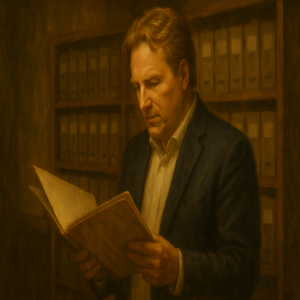
Back at his desk, Rosen opened a worn cabinet.
There it was: the "Unresolved Campendonk Forgeries" file.
Yellowed pages, ghost stories no one cared for anymore.
Too perfect to have been left unsolved.
He laid out photo after photo, tilting each under the light, reexamining the overly bright blues.
"Nothing's changed since then..."
He powered up his monitor and opened a new case file.
It was time — to reopen the forgotten blue.
To investigate what had been left untouched for 25 years.










Comments (0)
See all