
The 21st-century art market simmered quietly with intensity.
While digitization and online auctions surged, the shadowy underworld of untraceable masterpieces remained alive. Whispers began to circulate:
— Could this be the lost work of Max Ernst?
— Or perhaps part of Campendonk's vanished series?
These nameless "masterpieces" surfaced without provenance, yet radiated an eerie credibility that convinced collectors they could've — should've — existed in their time.
Truth was elusive. But in this market, uncertainty often birthed value that surpassed authenticity. In that ambiguous realm, Weiss's paintings quietly breathed.
──April 2010, Bergisch Gladbach──
In the same old stone house, spring sunlight filtered dully through the silence. In his study, Weiss stared at two unfinished canvases.
"...This will be the last."
He murmured it only to himself. He wouldn't tell Clarisse. She'd ask, "Are you sure you can really stop?"
Money was no longer a concern. Nor was there any clear reason left to paint. Yet he painted. Not for reason — but because it was breath.
"The spring air smells a bit different today."
Clarisse was out on the terrace, hanging laundry.
"Spring always smells different," Weiss replied vaguely — more to himself than to her.
Clarisse smiled faintly. Weiss quietly picked up his brush again.
*
Meanwhile, at the Penzberg Museum, Rosen had returned after 25 years, seeking clues on Campendonk.
"...You coming here, that's a surprise."
Director Katharina Endel smiled faintly. Once chief curator, she now led the museum — poised but still burning with quiet passion.
"...Do you remember the painting? The one they said 'might be a Campendonk,' 25 years ago?"
"Yes... Though I wish I didn't."
She turned and led Rosen deeper into the exhibition hall.
"So, what forgery have you brought this time?"
"None. Just... some questions."
He laid out photos — fragments of paintings attributed to Campendonk, Ernst, and other 'lost' works. There was something unsettlingly familiar about them.
"What do you make of these lines and colors?"
Katharina studied them, then said softly:
"Different subjects, different eras. But they're... too consistent."
"Too consistent?"
"Each artist usually leaves signs of doubt — variation. These show none. It's as if the same person calculated every stroke."
Rosen's breath caught. It echoed his unspoken suspicion.
"...So it's true."
"But remember," she said, voice lowering, "sometimes perfection looks more real than truth. That's when a forgery can surpass the original."
Rosen narrowed his eyes. Her words rang as both praise and warning.
"Thank you, Director. This helps. I can take the next step."
He left the museum behind.
*
That afternoon, Rosen entered a quiet street-side café in Penzberg. At a window seat, he opened his notebook and scribbled:
— A certain contour.
— A rhythm of lines.
The same mysterious commonality threaded through the works he'd reviewed — the forged Campendonk from 25 years ago, the recently surfaced Ernst. Different artists, different eras... yet something unmistakably familiar.
"...He's still doing it."
Just then, his mobile buzzed. Seeing the number, Rosen's relaxed face tensed.
"Rosen."
"Chief, we found further matches in the two forgeries."
"Go on."
"Not in brushwork. The ground layers, the pigment composition — both contain an identical chemical formula. And both used a rare solvent produced only in the 1980s."
Rosen was silent for a moment.
A clue he'd avoided 25 years ago had resurfaced.
"...I know who to talk to. I'm heading to London. Keep this discreet."
He hung up and headed for Munich Central Station.
The "blank space" was still being painted. And this time, he wouldn't look away.
*
London required planning.
An hour from Penzberg to Munich by local train.
Six more to Paris by TGV.
Then a Eurostar to London's St. Pancras. Over ten hours of travel.
Had he filed for official permission, this trip wouldn't have happened. Rosen simply told headquarters he was taking "personal leave," vanishing without alerting even his team.
It was all for one thing — the contour.
A name had lingered in his mind since the old Campendonk forgery case. A man whose analysis had been strikingly accurate. But his findings had been dismissed in favor of "convenient" consensus.
Maybe now, Rosen could finally hear the truth.
London. Fitzrovia.
A brass plaque hung on a red-brick building:
Edward Humble – Art Authentication & Research
Rosen rang the bell. The door creaked open.
Short silver hair. Neatly groomed mustache. Rounded cheeks and a slight belly. But the eyes — sharp as glass.
"A rare guest. Inspector Rosen — still digging up old wounds, I see."
"Well, that 'wound' just started bleeding again."
Rosen replied flatly.
He handed over photos and analysis reports: the old Campendonk forgery, the recent Ernst, and matching data from their ground layers.
"I need your eye. Are they connected?"
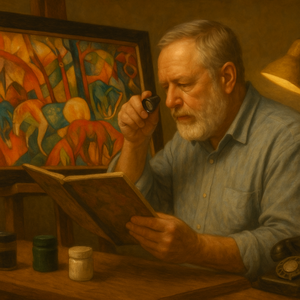
Humble peered through a microscope. After a moment, he spoke.
"Indeed. Not in strokes — in method. Same ground mixtures, pigment layering, and application. It's as if the same craftsman wore different faces."
"The same person?"
"I won't say definitively. But these habits are personal. A trained eye remembers."
"Call me if you find anything."
"Your obsession... I'll indulge it a little longer."
*
Days later, a new painting arrived at Humble's office.
A red background with a black horse and figure. Attributed to Campendonk.
"This is the one I called about."
The owner said he'd bought it at auction for 400 million yen.
"Nice piece."
"It is... but the provenance is fishy. I need confirmation."
The collector's tone was calm.
Humble placed it on a stand, took samples, and began testing.
──Titanium white.
──Detected in the underpainting.
"Well, well. Haven't seen this trick in a while."
He'd meant to think it — but it slipped out. The client looked uneasy.
"Sorry? You mean there've been fakes like this?"
"Too soon to say. I'll need time."
"Please. I paid 400 million."
"Understood. I'll contact you once results are in."
Once the collector left, Humble picked up the phone.
"Inspector Rosen... there's something you need to see."








Comments (0)
See all