
Federal Criminal Police Office, underground conference room.
As the thick door shut behind him, a heavy silence fell over the space, cutting it off from the outside world.
Rosen took his seat and placed a thick investigative file on the table. Seated across from him was Senior Inspector Brinkmann, chief of the Crime Prevention Division and Rosen's direct superior. His cold gaze and precise movements once earned Rosen's deepest respect.
"So, you went to London. Who authorized it?"
"I judged that cooperation with the local authorities was necessary. Any delay might have cost us—"
"Are you unaware that your judgment was unilateral?"
The words were spoken quietly, but they echoed with more weight than a shout. Rosen paused for a moment, then answered in a low voice.
"This case involves the distribution of forgeries spanning over forty years. The estimated damage—"
"Tens of billions of euros. I know. But do you also know whose money we're talking about?"
Brinkmann leaned forward slightly.
"Tycoons. Collectors. Museums. Are we truly responsible for the fact that 'the rich got duped' — to the point of diverting public funds?"
Rosen slowly straightened his back.
"No matter who they are, being deceived is a fact. The question of who painted the work, and what era's air it carried — rewriting that is a crime against history."
"...History isn't life," Brinkmann said, his voice edged with thorns.
"No one died. There are no armed terrorists involved. Our top priority is order — the stability of society as a whole. Questions of authenticity should be left to curators."
"If we do that, we create a world where the deceivers always win."
"Don't speak of investigations in terms of winning and losing. You're just intoxicated by your own sense of justice."
A few seconds of silence.
Their gazes clashed directly.
"The moment your obsession leaks to the media, upper management will be the ones cleaning up the mess. That's what I want to avoid. So I'm telling you now—any further rogue action, and I'll officially take you off the case. But—"
Brinkmann turned his back to Rosen and glanced at the material displayed on the monitor.
"...The French authorities have classified it as an international crime."
It was already clear that the trail of forgeries began in France.
Thus, France's declaration gave Germany the justification it had been waiting for to formally expand its investigation.
"We now have the pretext to act publicly. But unless we know the suspect's face or name, we can't hold a half-baked press conference. Gather the evidence immediately—images, sketches, anything persuasive."
"Understood."
Rosen quietly stood, turned his back, and began walking toward the door. As he reached for the handle, Brinkmann's voice followed him like a warning shot.
"You know what's at stake. If you go public, you'd better be damn sure... and do it now."
Without turning around, Rosen pressed his lips together and left the conference room.
Outside, he immediately pulled out his phone and headed toward the investigation office.
"This is Rosen. I need the name of the buyer of the Campendonk forgery."
His voice was sharp and low. He didn't make eye contact with anyone he passed in the hallway.
As soon as he hung up, Rosen forcefully pushed open the door to the investigation office. The detectives inside turned their heads in unison, momentarily holding their breath.
Without a word, Rosen marched straight to the center desk, his tense posture emanating frustration like a storm cloud.
"Everyone—take your positions."
Before anyone could respond, Rosen began slapping files onto the desk while turning toward the whiteboard.
"All known forgeries—Max Ernst, Paul Klee, Charmy—review them again. Check where each painting ended up, auction records, museums, collectors, acquisition channels."
One officer hesitantly raised a hand.
"Um... regarding domestic inquiries, to what extent should we investigate?"
Rosen's eyes flashed.
"...Domestic?"
He repeated the word quietly—then exploded.
"Switzerland, Germany, France—pull up 30 years of auction footage.
Any unknown origin, unsigned works, or abnormal bid prices—check every single one!"
The tension in the room snapped taut. One detective gulped visibly.
Everyone now understood—this wasn't just a case.
Rosen paused briefly, then lowered his tone.
"Especially that red painting with the horse. That's the key. If we've overlooked something, find it not with our eyes, but through their thinking. These people are professionals at fabricating the past. As long as we think we've figured them out, we'll always be one step behind."
Hours had passed.
Frustration mounted, yet they continued their desperate search through old footage and provenance records—grasping at nothing.
Even as the date turned over to the next day, there were no leads. The mood in the room was one of quiet resignation.
Then, one of the junior investigators broke the silence.
"Take a look at this."
On the monitor was security footage from an auction house in Basel, Switzerland.
A middle-aged man with calm eyes stood by the wall, gazing at a painting.
Beside him stood a woman with black hair.
"Zoom in."
The image was enlarged.
The woman's face came into clear focus.
"The man beside her also appeared in footage from a different auction.
We cross-checked it—he's connected to every single forgery we've identified."
"Zoom in on the man's face too."
"Y-yes..."
The next moment, Rosen's brow twitched slightly.
"...That man."
From deep within his memory, a single fragment surfaced.
—It had been at a gallery in Cologne, Germany.
A man had casually approached and spoken to him.
"What do you think of this painting?"
At the time, Rosen hadn't even turned around. He had simply replied,
"...It's too bright."
It had been over twenty years ago, but Rosen remembered it vividly.
"...It was you."
—Bergisch Gladbach
In the first-floor living room, the soft voice of a news anchor flowed from the television.
Morning light filtered gently through a gap in the curtains, bathing the room in a pale gray hue.
Weiss stood in the kitchen, making coffee.
The sound of beans being ground, the hiss of the kettle, and the calm, measured voice of the news anchor filled the space.
"...In the Bundestag, coalition leaders continue negotiations over immigration reform..."
He wasn't really listening—just letting the sounds wash over him as part of the morning routine.
He caught the aroma rising from the freshly poured coffee, then let his gaze drift toward the window.
In the garden, Clarisse was hanging up laundry.
When she looked up, she gave a small wave.
Weiss returned the gesture with a faint smile and raised his cup slightly in acknowledgment.
Then, holding the cup in one hand, he stepped out into the garden.
Moments later, the now-empty living room remained, and the television continued to play.
"...Our next story," the anchor's tone shifted slightly.
"A major announcement today from the Federal Criminal Police Office regarding an international art forgery case."
On the screen appeared an image of the forged painting—a piece now officially declared a fake.
It featured geometric structures floating against a deep crimson background, with a boldly rendered figure in striking brushwork.
"This work was auctioned at a high price in 2010, presented as a 'newly discovered early piece' by Max Ernst or Heinrich Campendonk.
However, recent analysis has confirmed it to be a forgery.
The individuals involved have yet to be identified, and the investigation is ongoing—"
Inside the quiet, empty room, unseen by anyone, the news played on, reporting the truth in a voice void of emotion.
Berlin Police Headquarters, press conference floor.
3:00 p.m.
Camera flashes blinked without pause, and every lens in the room turned toward the stage.
The man who stepped up was Inspector Rosen of the Federal Criminal Police Office.
He straightened his back, arranged his papers, and took a quiet breath before speaking into the microphone.
"We hereby announce that the long-standing series of art forgery cases has officially been designated as an 'international investigation,' and that we have begun coordinating with authorities across multiple nations."
A wave of tension swept through the press.
"In this case, works presented as 'newly discovered masterpieces' by renowned artists were sold at high prices in auctions throughout Europe and later acquired by legitimate museums and foundations.
However, recent analyses have determined—with extremely high probability—that many of these works are, in fact, forgeries."
The screen behind him changed.
Several images of artworks previously auctioned appeared.
"Among them, the turning point of this investigation was this piece—"
A black horse standing silently against a crimson background.
Geometric forms and bold colors.
The painting had been auctioned in 2010 as a lost work by Campendonk.
"This 'Red Painting with a Horse' drew global attention as a possible lost piece by Campendonk.
However, pigment analysis confirmed that the cinnabar and titanium white used do not match materials from the 1920s—they are modern."
Rosen's eyes rested on the horse's gaze on the slide—
a look that seemed almost to peer straight through him.
He sensed something in that expression.
"This analysis revealed patterns shared by multiple forged pieces, strongly indicating the work of a single individual—or a very small, coordinated group."
The flashbulbs intensified.
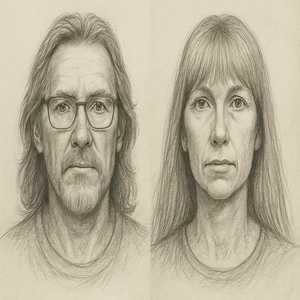
"Today, we are releasing composite sketches of the two primary suspects, along with still images extracted from surveillance footage."
The screen changed again.
Two sketches were displayed.
Weiss and Clarisse.
Rosen paused briefly before continuing.
"...This is not merely about 'fakes.'
Forgeries quietly rewrite the very history we believed in.
If anyone recognizes these individuals, please report to your local authorities or contact relevant museum personnel."
Rosen stepped slightly back from the microphone—
then leaned forward again, eyes focused dead ahead.
His voice grew firmer.
"And we have another powerful ally... the media.
Everyone watching on TV or social media right now—
I ask every citizen to look closely at these faces."
A faint stir spread across the press room.
"These two have insulted the legacy of art we have carefully preserved with reverence.
They have mocked the great artists who painted truth, and the world of art itself."
Then, Rosen spoke as if addressing Weiss directly.
"—The culprit may be watching this broadcast right now.
Or perhaps they'll learn about it soon.
And when they do, they may try to flee.
But the reality of being hunted—
That slowly eats away at the mind, distorts the spirit...
And we cannot predict what actions they might take.
They could endanger others.
Even themselves—"
With the flashes still going off, Rosen leaned once more toward the microphone and delivered his final words:
"That's why we need every citizen's eyes.
Please—do not forget these faces."
——Afternoon in Bergisch Gladbach.
Clarisse entered a small convenience store slightly off the main road near the station, as usual.
At the counter, a middle-aged clerk was laughing with a friend.
"Yeah, the engine stalled again. It's temperamental."
"Just like you—grumpy."
"Don't say that. If the machine starts sharing my personality, I'm doomed."
They laughed. Clarisse picked up bread and milk and approached the register.
"See you. I'll get it running next time, I swear." "Keep lying and even machines will stop trusting you."
As Clarisse approached, the clerk greeted her cheerfully.
"Hello. Just bread and milk today?"
Clarisse smiled faintly.
"And..."
She reached for a newspaper but froze at the headline:
—"Chain of Forgeries"
Front and center: the 'Red Painting with a Horse.' "Forgery Confirmed—Largest Ever" "Auction Price: €400 Million"
She hesitated, then returned the paper to the rack.
"No newspaper today?"
"Oh, um... right. My husband already bought one this morning."
A small addition to fill the pause. Her smile was tight, strained.
"I see."
But then a news report played from the TV behind the clerk:
"—This is footage from the press conference an hour ago regarding the international art forgery case."
Rosen appeared onscreen. Text below read: "Detective Rosen," with surveillance images of Weiss and Clarisse.
Sweat began to bead on her back. Wanting to drown out the sound, she spoke.
"Today..."
"Today?"
"...It's windy, isn't it? This morning was so calm."
"It is. A sign out front blew down, had to fix it. Wind like this means no customers."
Trying to keep calm, Clarisse glanced at the TV.
"—If you recognize these individuals, please contact the police or art institutions."
Her voice nearly cracked, but she forced herself to keep talking.
"I hung our laundry out early, just in case."
Despite her smile, she felt a cold drain through her.
Rosen's voice grew louder.
"—The suspect may be watching this now... or will soon."
Clarisse's face fell. Her eyes widened. Her lips twitched.
"Well then..."
She received her items and bowed slightly, trying to leave unnoticed.
As the door closed, she nearly vanished into the street—
"Wait!"
She froze.
"...You forgot your change!"
She turned slowly.
"Oh, thank you... I'm sorry."
Her smile was stiff. Her eyes seemed unfocused.
Taking the change, she left again. The clerk frowned slightly.
She looked smaller than usual. Weaker.
"...She seemed awfully nervous..."
He turned to the TV, but the news had switched to the weather.
"...And now the forecast. Strong winds expected in Cologne from afternoon into the night."
Putting away the change, he muttered:
"...Stormy, huh... Looks like a slow day."








Comments (0)
See all