
Penzberg Art Museum. In a dimly lit exhibition room, a painting in shades of blue and red lay quietly.
Katarina Brückner stood alone in the center of the gallery, her gaze fixed on a painting by Campendonk hanging on the wall.
At the center of the painting was a horse.
A background that ignored all rules of perspective.
Outlines that were vivid and strange, as if walking the line between dream and reality.
Her eyes traced the curve of the horse's neck.
—It was strikingly similar to the forged painting of the "Red Horse."
Remembering it made her throat tighten.
That painting, the one declared a forgery just days ago in the news.
The "red painting with a horse."
The composition looked familiar.
But the colors were different. The energy was different.
The brushstrokes were crying out.
As if the artist themselves was declaring, "I am here."
To her, it could not have been Campendonk's.
—And yet, someone had brazenly sold it under Campendonk's name.
"It's an insult... to him, and to art."
She murmured, not to anyone in particular.
But deep beneath her anger, a question began to form.
—Then, what exactly is "authentic"?
If a work moved the heart of the viewer, could it still be called a forgery?
No... no, that wasn't right.
There had to be something—something that allowed her to say definitively: "It's not real."
Katarina exhaled softly and stepped back from the painting.
The more the truth of this case unraveled,
the more it seemed that the very concept of "authenticity" she had believed in all her life was beginning to waver—
And with that, a chill ran down her spine.
Stepping out onto the street, Clarisse began walking briskly.
Each time the cold wind stirred the hem of her coat, her shoulders gave a little twitch.
(Calm down. No one is watching you.)
She repeated the thought in her mind over and over.
But her heartbeat only grew faster.
A man passing by seemed to glance at her out of the corner of his eye.
An elderly woman approaching from the other side of the street appeared to squint slightly.
Even the ringing of a bicycle bell felt like some sort of signal.
Her rational mind knew—it was all in her head.
But the voice on the television, those words, kept echoing deep inside.
—The perpetrator may be watching this broadcast somewhere right now.
Her face stiffened.
Still, stopping would only draw more attention, so she kept walking, eyes lowered.
She nearly kicked a potted flower on the sidewalk, having not noticed it by her feet.
Stumbling, she caught herself on a nearby wall.
She thought someone might ask, "Are you alright?"
But no one paid any attention.
It was as if she were completely invisible.
—No, not invisible.
They were only pretending not to notice.
Inside, they were all thinking: "There's something strange about that woman."
That paranoid thought kept circling through her mind.
By the time she reached the front of the house and took out her key, her hand was trembling slightly.
She glanced around the door more than usual, pretending to act natural as she slipped inside.
She was nearing her limit—of pretending to be "normal."
"The inspector! We've got a name!"
Amid the buzz of the investigation room, one of the detectives pointed at the monitor.
"We cross-referenced Germany's old municipal registration data with the list provided by the Swiss Artists Association. The man is Adalbert Weiss, and the woman is Clarisse Weiss, maiden name Auer. Both have past records tied to art schools and exhibition participation."
Rosen stared at the screen in silence for a moment.
Then he spoke in a calm but resolute voice:
"Good. At last, we've matched names to faces."
"The photo of Clarisse matches previously reported snapshots.
As for the man, he was captured on surveillance footage linked to one of the forged paintings. Location: Maria-Hilfer Street, Cologne."
"There have also been multiple tips from the local police in Bergisch Gladbach. A man resembling Weiss was seen recently—at a bakery, an art supply store, in front of the museum, and at the library. All the descriptions are consistent."
Rosen nodded, then issued orders without hesitation.
"Split into teams—one for Gladbach, one for southern Cologne. Reinvestigate all links to the 'Red Horse' painting and any works with uncertain provenance. Now that we have names and faces, there's no time to waste."
Just as his team jumped to their feet, gathering notes and files to leave the room—
"Wait. One more thing."
Rosen's voice cut through the room like a blade.
"There's a chance they've already gone on the move after that news report. Contact all airports, train stations, and highway checkpoints. We must prevent them from fleeing the country. Within the Eurozone, there are too many backdoors—list them all and share immediately."
"Understood!"
After exhaling deeply, Rosen walked silently out of the department office, through the corridor, and pushed open the entrance door.
The moment he did—
A storm of camera flashes exploded before him.
"Inspector Rosen! Have you identified the suspects?"
"Is this the work of a couple, rather than a criminal group?"
Amid the barrage of questions and microphones, Rosen did not flinch.
He stopped in place, then said just one thing:
"We won't let them escape. That's all."
Then he got into the car, shutting the door behind him.
The flashing lights and shouting voices were all that remained.
The ticking of the wall clock echoed faintly—tick... tick... tick.
Clarisse sat alone in the study, the only light coming from a small desk lamp.
Weiss was already asleep in the bedroom.
She pulled a pen and a notebook from the drawer.
Holding the pen upright against the paper, she tapped it lightly, over and over again—tap... tap... tap...
Like a nervous fidget made with her hands instead of her feet.
"...What should I do... what should I do..."
The words slipped from her lips in a whisper, barely audible even to herself.
Her gaze drifted sideways.
There, leaning against a shelf, was a photo frame.
A picture of the two of them, shoulder to shoulder, beneath the blue sky of Montpellier.
Weiss squinted under the strong sunlight.
Clarisse stood beside him, smiling.
As if blessing a future yet untouched by darkness.
Memories began to stir quietly.
Afternoons at the café terrace, laughing over idle talk.
Evenings spent walking hand in hand by the harbor.
But then, in the next instant—
That man's face from the television flashed in her mind.
—The perpetrator may be watching this broadcast somewhere right now.
Clarisse flinched.
The memories were pierced by an image from the press conference.
A police sketch displayed on-screen.
Beside it, the sharp-eyed investigator delivering a calm statement at the mic.
—Rosen.
Clarisse slowly reached for the laptop and opened it.
In the search bar, she typed:
"Rosen investigator background family past"
Her eyes scanned the articles that popped up, one after another.
"Federal Investigator Rosen cracks series of art forgery cases."
"Known for sharp insight and relentless pursuit."
"BKA agent Martina Rosen resigns following forgery case."
"Rosen and former agent Martina—once a married couple—divorced in 2012."
"Sources say his obsession with forgery cases strained the family."
Clarisse's eyes paused on one name:
"Martina Franz."
She rose from her seat, opened a drawer, and took out a leather business card case.
Then she printed part of the information she'd found, cut it out, and copied it along with her ID.
The next morning.
Clarisse stood in front of a house nestled in a quiet residential neighborhood on the outskirts of Leverkusen.
She knocked on the door, and after a few seconds, a woman with a gentle smile appeared.
"Are you Martina Franz?"
"Yes..."
"I'm Lisa Wagner from the BKA. I'd like to speak with you about your former husband."
Martina's expression stiffened slightly, suspicion flickering in her eyes.
"I don't understand—why come to me for a background check on Rosen?"
"It's standard protocol for agents considered for promotion. These checks are necessary."
"I know... I went through it during his last promotion. But we're divorced. We barely speak now, and I have no idea what he does at work anymore."
"I understand, but we need to finalize the report today. I promise it won't take long."
"I really don't want to spend more time on that man."
"I understand. Being a family member of a federal agent can be difficult. I've been through it myself—my ex-husband was an officer too."
Martina sighed and gave a small nod.
"Just don't tell him I talked to you, alright?"
"Of course. Everything will be kept confidential. Though... is there something you don't want him to know?"
"Honestly... I'm afraid of him."
Her voice was quiet now. Her expression darkened.
"Come in."
Martina led Clarisse into the living room and went to the kitchen to make coffee.
The house was tidy and warm, with soft light pouring in.
Potted plants sat peacefully beside wooden furniture.
Books lined the shelves, and children's picture books were stacked near the window.
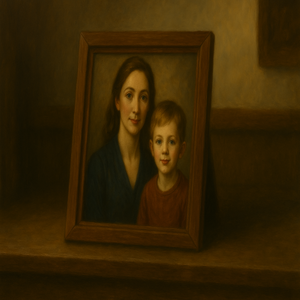
One thing caught Clarisse's eye: a photo frame beside the television.
It showed Martina and a young boy, perhaps around five years old, smiling together.
Clarisse paused for a moment, her gaze softening.
"Here you go."
Martina handed her a cup of coffee and took a seat.
"Thank you."
"The forgery case is what did it. Strange paintings started appearing on the market a few years ago... and he became obsessed. He fixated on one specific forgery."
"A specific forgery?"
"He kept repeating the same names—Campendonk, Max Ernst. After a while, he stopped coming home. He stopped smiling. Our son was only two or three then..."
Clarisse nodded in silence.
"At first I thought it was just work. But no... something had taken hold of him."
"You said you were afraid of him. Why?"
"His eyes changed. When I or our son spoke to him, it was like he was looking at strangers. He saw nothing outside of the investigation."
Clarisse felt a tightness in her chest.
This... this was our doing...
"I was a federal agent, but also a mother. That's why I left. The family... fell apart."
Clarisse was overcome by a deep pang of guilt.
Martina's eyes shimmered with tears.
"Excuse me for a moment," she said, stepping out of the room.
The moment Martina was gone, Clarisse stood.
She picked up Martina's smartphone from the table, opened the contacts, and searched for Rosen.
Once she found it, she slipped the phone into her coat pocket.
When Martina returned—
"The interview is complete. Thank you for your cooperation."
As Clarisse stood, Martina tilted her head.
"Wait... aren't you going to ask about my education or work history? Isn't that part of the background check?"
"It's fine. I just need to report the findings to the Strategic Intelligence Operations Center as soon as possible."
"...Strategic Intelligence Operations? That agency was reorganized years ago under new EU laws."
Clarisse's eyes flickered for a moment.
"Yes, but this is a special case. As you know, forgery investigations often go through separate channels."
Martina stared at her for a long moment, but said nothing more.
"The coffee was lovely. Thank you."
Clarisse bowed politely and left the house in silence.
Rosen was at his desk in the investigation unit.
Stacks of reports and analysis files from his subordinates were spread out before him.
Just then, his smartphone buzzed.
On the screen appeared a familiar name—Martina.
Rosen frowned slightly, then stood and walked into his private office.
He closed the door and pressed the call button.
"...Martina? Now's not a good time."
"She's doing fine."
A brief silence.
"...Who is this?"
"Clarisse Auer. You remember me, don't you?"
"If you lay a finger on my family, I swear—"
"That depends on you. I want to talk. Come to Café Friedrich—alone. It's a small place near the station."
"Hah... you think I have time for tea with you?"
"If you're not alone... your wife and son—he's five now, isn't he? ...I'll be waiting."
With that, Clarisse hung up.
Rosen stared at the phone for a long moment, then leaned back in his chair.
The past was knocking on his door once again.









Comments (0)
See all