
It was a quiet afternoon at Friedrich Café, just after a passing rain shower. A rare stillness hung in the air. By the window inside the café, a man sat on a wooden chair. It was Rosen.
He sat quietly with a cup of espresso in front of him, gazing out the window. His eyes followed the people walking along the wet cobblestone street, occasionally glancing down at his watch. Three minutes past the scheduled time, a woman wearing a long coat approached.
—Clarisse Weiss.
She walked quietly and took a seat across from Rosen.
“It’s just me. Like I promised, no one else is here. Is your family safe?”
“Yes. My family is fine.”
“What is it you want?”
“I just wanted to speak with you. One last time.”
There was a blend of exhaustion and a hint of relief in Clarisse’s voice.
“Why did you go to such lengths to construct those elaborate fake histories? Why all the theatrics?”
After Rosen asked calmly, Clarisse responded with a faint smile.
“Yes, we wove countless lies. But those paintings—they truly existed. They weren’t some imitation of another. They were original lines—drawn by him, by Adalbert. I simply gave them a story.”
“And still, the world calls them ‘forgeries.’”
Clarisse nodded slowly.
“Yes. But if no one had discovered them, those works would have vanished without ever being known. I… I just wanted someone to see his brushstrokes.”
“As forgeries?”
“A forgery is a forgery. And what we did, without question, was a crime. We stacked lie upon lie and deceived the eyes of many. But—”
She broke off, turning her gaze toward the window.
“Even so, I wanted to give those paintings a reason to exist. Even if just a little, if they moved someone’s heart, then they can no longer be considered as if they never were. And for that—I’ll take responsibility.”
After a short pause, she continued.
“If a painting holds its value not because of who painted it, but what it conveys—then maybe that's what really matters. That’s how I’ve come to see it. Through forgery, I kept asking myself what it means to be genuine. What is authenticity? A signature? A certificate of provenance? Or the power to move someone’s heart?”
“That kind of reasoning—‘that real and fake both have meaning’—doesn’t belong on a police desk.
But… I can’t dismiss your words so easily either.”
“I don’t think there’s an answer. But those paintings, at the very least, can no longer be erased. Even if they’re forgeries—if they conveyed something beyond the original, then… can we really deny them?”
A brief silence passed. Clarisse lowered her gaze.
“I just wanted to protect his paintings. Until the day he could sign his own name.”
Rosen exhaled quietly, his eyes still downcast.
“Please… don’t tell him. For me, this is the end.”
“You’re going to turn yourself in?”
“Yes. Everything—the staging, the story—was my doing. His brush… it was just ‘painting,’ nothing more.”
Rosen slowly closed his eyes. Clarisse quietly reached into her bag and placed a small envelope on the table.
“This is for you. Please don’t show it to anyone.”
Rosen took it, but didn’t open it right away.
“And… I have one more request.”
Choosing her words carefully, Clarisse continued:
“Your family… your wife, your son. Please—face them again. Give them your time.”
“…Is that your ‘condition’ for turning yourself in?”
“No. It’s not a deal. It’s just… a wish. If you can live as a father again, then… I believe that boy will find peace too.”
Clarisse stood from her chair and turned her back to Rosen.
“Because you were there… I was able to choose how this ends.”
At the door, she paused—then without looking back, said:
“If the police must uphold ‘the law,’ then I choose… ‘a feeling that goes beyond the original.’”
And with that, she walked out of the café.
Rosen remained still, watching her back as she disappeared.
After a while, he pulled a worn cardholder from his inner pocket. Inside it was a small photo—a candid shot of his son, smiling at the age of three.
Rosen looked down at it, quietly, and said nothing.
*
The morning light filtered faintly into the atelier.
Weiss, holding a freshly brewed cup of coffee from the kitchen, looked quietly around the room.
“…Clarisse?”
The bedroom was empty. Her bag and coat were gone.
Maybe she’d gone shopping—or out for a walk.
But even so… she was late. With that thought, he picked up the TV remote.
The screen changed.
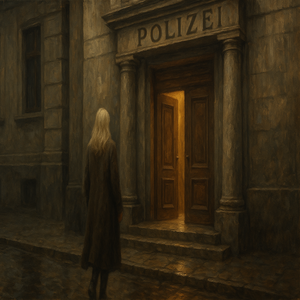
“New developments in the forgery case. A woman connected to the incident turned herself in last night at Cologne Central Police Station. Several dozen paintings…”
Weiss’s hand trembled. His coffee cup clinked faintly.
“…Clarisse.”
A tightening sensation clutched at his chest.
Without thinking, he stood up from the sofa.
—Just then.
Knock knock.
The sound echoed loudly through the too-quiet house.
“…No…”
Weiss hesitated, then slowly opened the door.
Standing there, in a coat, was Rosen.
“Can we talk?”
Weiss nodded silently and led him into the back of the atelier.
*
In front of the canvas, the two men stood facing each other.
Weiss was the first to speak.
“…I prepared everything to withstand scientific analysis. Paint, pigments, canvas… every detail matched the era.”
“So I’ve heard,” Rosen replied, his eyes on a painting hanging on the atelier wall.
“…And yet, it was uncovered.”
Silence.
“Why?”
Weiss asked in a low voice.
Rosen took a small piece of paper from his pocket.
“One reason… is this.”
Weiss looked at the paper, puzzled.
“The label paper. Every painting had the exact same label stuck on it. Same paper stock, same printing smudges, even the same cutting marks.”
Weiss let out a small laugh.
“…That was Clarisse’s work.”
“I figured. But it wasn’t the decisive factor.”
Rosen took a step closer.
“The real giveaway was the pigment. Titanium white. It wasn’t used in paintings before the 1920s, yet your so-called ‘1914 painting’ had it in the ground layer.”
“The ground…?”
Rosen traced the air with his finger.
“Yes. Not on the surface. The bottommost layer. The white used before the first brushstroke. That was titanium.”
Weiss narrowed his eyes.
“…So I didn’t scrape deep enough.”
“No, you did well. Even the scientific analyst didn’t catch it on the first test.”
Rosen paused, then continued.
“And then… there was cinnabar.”
Weiss fell silent for a moment.
“Cinnabar is an ancient pigment. Normally, in early 20th-century works, you’d use vermilion. But that book said ‘cinnabar.’”
“…Yeah. The reference I relied on. Who would’ve thought it had a typo.”
“Apparently, the scholar who wrote it confused the terms for red. You took it at face value and went out of your way to source real cinnabar. Must’ve cost you.”
Weiss gave a wry smile.
“It’s almost funny. My loyalty to what I believed was accurate ended up becoming the very ‘evidence of forgery.’”
“Exactly. The appraiser in London said, ‘This is a color crafted by knowledge.’ Now it makes sense.”
Weiss lowered his gaze to the shelf lined with paints.
“So everything I studied turned against me.”
“That’s right.”
Rosen spoke gently, with a kind undertone.
“…But no one has denied the paintings themselves.”
Weiss nodded slowly.
“I did break the law. I used a false name and built a web of lies. But those paintings—they all came from within me. They weren’t copies. Not replicas. They weren’t just ‘reproductions.’ They were creations.”
Rosen nodded with a faint smile.
"Your partner said something very similar."
Weiss let out a small laugh.
"I see. All I can say is—the paintings themselves committed no crime. If there was a crime, it was mine... I was the one who sold them under someone else's name. And yet... Clarisse..."
A quiet pause fell between them.
Rosen glanced up at a landscape painting hanging on the wall.
"...This is a good painting."
"That’s one I painted under my own name."
Rosen smiled slightly and nodded.
"I thought so. There’s no hesitation in the lines."
Weiss exhaled softly.
"Clarisse left without saying a word. But I knew. I knew it would come to this."
"She was trying to protect you. Until the very end."
Weiss slowly closed his eyes.
"...Then I’ll go. I won’t run."
"Are you sure?"
"What I falsified was the name and the provenance. But the painting itself belongs to no one. It's my original. And still, someone found it beautiful. That alone… is enough for me."
Weiss picked up his coat and began walking toward the front door.
Rosen watched him go, then glanced once more at the painting on the wall.
"...It really is a beautiful piece."
The door closed softly behind him, and the morning light quietly returned to the atelier.







Comments (0)
See all