
Claris stared straight ahead.
The walls of the interrogation room were a pale gray, and within that sterile, cold space, her presence alone felt somehow out of place.
She wore a crisp white blouse, her hair neatly tied back. Sitting upright in the chair, there was no trace of fear or hesitation in her posture.
Before long, the door opened quietly.
A man in his late forties entered, holding a stack of documents in his hand. He gave a slight nod as he spoke.
“Mrs. Claris Weiss. Thank you for your cooperation today.”
“…I’ve written everything you need to know.”
She placed her hand on the envelope resting on the table — her written statement.
“I’ve read it. Very detailed,” the detective replied, nodding with a hint of surprise in his voice. Then, lowering his tone slightly, he added:
“Your husband has already been informed. He has… turned himself in as well.”
Claris’s eyes flickered for a brief moment. She dropped her gaze, then quickly looked up and nodded with a calm expression.
“…I see.”
The quiet echo of her words seemed to dissolve into the stillness of the room.
Around the same time, in the office of the police station, Rosen sat alone, organizing his report.
“Suspect Adalbert Weiss turned himself in voluntarily. His statement aligns with the testimony of Claris Weiss. Since the arrest wasn’t made in the act, further action will be determined in consultation with the prosecution...”
Beside him, his superior flipped through some documents while sipping a cup of coffee.
“Strange, isn’t it? The evidence wasn’t conclusive yet, was it? So why did he come forward on his own?”
Rosen paused, then let out a small smile after a moment of silence.
“...He probably had nowhere left to run. Not someone who paints like that.”
“The paintings, you mean?”
“Yes. The paintings told the truth. They wouldn’t stay silent anymore.”
His superior gave a silent nod and returned his gaze to the report.
*
Penzberg Museum.
Director Katharina was strolling through the exhibition hall. It was a quiet weekday afternoon, with only a handful of visitors and the soft hum of the air conditioning filling the space.
A few guests had paused in front of a particular painting—an artwork modestly displayed as “an example of forgery.”
It was a landscape in the style of Campendonk, painted by Weiss.
“…This isn’t Campendonk,” Katharina murmured softly.
No one heard her words, but deep within her chest, emotions she couldn’t quite articulate were swirling.
Why did I feel a sense of life in that painting?
Why did I find myself thinking… that it was still alright?
She slowly returned to her office and opened a thick binder on her desk—an inventory of paintings that had gone missing after the war.
“According to the list, there are still… more than thirty unaccounted for.”
With a quiet sigh, her gaze shifted to a particular painting leaning in the corner of her desk—one she had once labeled a “forgery.”
“Maybe… artistic value and deception aren’t so easily separated after all.”
There was a faint trace of sorrow in her voice as she said it.
*
A few days after Weiss turned himself in, Clarisse—through her lawyer—requested a meeting with one particular person.
The man who had come closest to the heart of the case: Rosen.
Permission was granted as a temporary measure before her formal incarceration.
It wasn’t an interrogation. Not an official interview.
Just… a single conversation.
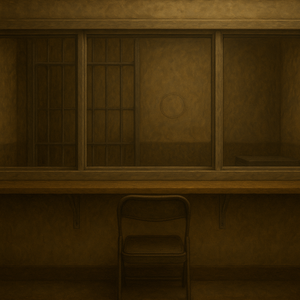
The visitation room was divided by a glass panel, with telephones on either side for communication.
Clarisse, as always, sat upright with a composed expression.
When Rosen picked up the receiver, she quietly followed suit.
“…There’s something I wanted to say to you.”
“What is it?”
Clarisse smiled faintly.
“I only ever created his background. That’s all I did.
He had no name—so I gave him a frame.”
“A frame?”
“Yes.
Without a frame, a painting can’t be hung on a wall.
It can’t even enter a museum.”
Rosen was silent for a moment, then allowed himself a small smile.
“But now… he has a painting signed with his own name.”
Clarisse lowered her gaze gently.
“That’s why I’m here.”
Her calm words softened Rosen’s expression just a little.
“Back then, when he had no name, I was the one who gave him his first frame…
That’s what I’m proud of.”
She smiled, her eyes narrowing gently.
“Thank you, Inspector Rosen.”
With that, she slowly placed the receiver down and stood up.
The door to the room opened quietly, and without a glance back, Clarisse walked out under the watchful eye of the guard.
Rosen continued to watch her through the glass.
Her stride, her posture—unshaken.
She was someone who had known her role until the very end.
He set the receiver down gently and lowered his eyes.
He said nothing, but one emotion lingered quietly in his chest:
—Respect. And just a trace of sorrow.
Rising slowly from his chair, Rosen took a deep breath as he turned toward the door.
In the now-empty room, no voices echoed anymore.
*
A few days later, one afternoon—
Rosen happened to pass by the front of an art museum.
In the window display, a single poster was taped up.
“The Anonymous Artists Exhibition”
—No names. And yet, the paintings still speak.
Rosen gazed at it for a while, then let out a short, amused breath through his nose and turned away.
Only the sound of his footsteps echoed quietly against the stone pavement.
*
Weiss’s morning was a quiet one.
He was in a solitary cell at a detention facility on the outskirts of Cologne.
Pale light streamed in through the barred window, softly illuminating the gray walls.
The room had only a simple bed and a small desk bolted to the floor.
He still had things he could paint—
But now, something unnamed lingered deep within his chest.
“…The reason I paint has changed.”
—Not to deceive.
Just… to paint.
*
Meanwhile, in London.
Inside a small room of a secondhand bookstore-cum-gallery tucked away in a cobbled back alley, art authenticator Edward Humble was being interviewed by a trade magazine.
Sitting deep into a well-worn chair, his arm resting on the armrest, he listened quietly to the reporter’s question.
“What is your view on the Campendonk forgery case?”
Asked by a young male journalist, Humble tilted his head slightly.
“Yes, it’s a forgery. There’s no doubt about that.”
“You’re referring to the ‘Red Painting with a Horse’? The one where the pigment and paper labels were all the same? What about the other forgeries attributed to Weiss?”
“What about them?”
“I mean, do you also classify them as fakes?”
“I believe so…”
The reporter pressed further.
“But at one point, you called one of Weiss’s forgeries a ‘beautiful painting,’ didn’t you?”
“You’re good at digging up unpleasant things, aren’t you?”
“Apologies. It’s part of the job.”
Humble’s gaze drifted to the foggy window. After a brief silence, he murmured softly,
“…It was beautiful. That hasn’t changed.”
“Then—what is ‘authenticity’ to you?”
To this, Humble exhaled slowly and looked back out the window, where the gray London sky loomed.
“Determining authenticity—that is our job as appraisers,” he said, pausing for a moment before continuing.
“But if something stirs the heart, some might call that genuine. I have no right to deny them that.”
The reporter seemed about to speak again, but Humble slowly stood from his seat.
“I’m sorry, I have another appointment now.”
He gently adjusted the hem of his coat and quietly made his way to the door.
Only the sound of his footsteps echoed softly across the creaking wooden floor.
*
In the afternoon, a guard came to the cell.
He held out a single envelope.
“A letter.”
There was no need to check the sender.
It was from Clarisse.
Weiss broke the seal and slowly traced the neatly written words with his eyes.
—Truth or lies, your lines always wrapped around me.
—Perhaps I always saw the truth in your paintings.
When he finished reading, Weiss let out a long breath and opened his sketchbook once more.
Then, starting from the edge, he began to draw lines—quietly.
His hand trembled slightly.
But within each stroke, there was something unmistakably him.
There was no signature.
And yet, for the first time, he felt with certainty:
He was drawing his own painting.
“…It finally came. The ‘right moment’… at last.”
*
A few days later, the latest issue of the art magazine Art & Truth hit the shelves.
The cover feature bore a provocative headline:
"What Is ‘Authentic’ in the Work of the Blank Forger?"
The article was written by art journalist Isabelle Fried.
Her appearance—blonde hair tied back, wearing a muted blue jacket—was modest, but her sharp eyes and calm, incisive tone had earned her deep respect in the art world.
The piece began by outlining the events of the forgery case—Clarisse’s testimony, Humbel’s statements, Director Katharina’s internal conflict, and the eventual launch of the Exhibition of the Nameless.
“Why do Adalbert Weiss’s paintings move people so deeply?”
At the end of the article, she posed a quiet challenge:
“Whether this painting is a ‘forgery’ or a ‘masterpiece’ — the answer lies in your eyes.”
The piece spread like wildfire across social media.
“It’s supposed to be a forgery, so why am I crying?”
“That ‘forest painting’… I don’t care who painted it. I just love it.”
“This isn't a forgery. It’s another kind of original.”
#TheTrueForgery
#MoreRealThanReal
The hashtags quickly began trending, and the name once condemned as a crime was now being reinterpreted—spoken of as a form of expression.








Comments (0)
See all