
Not with violence — with unfolding. Thin tendrils began to rise from the surface, almost hesitant in their motion. They were translucent at first, like nerve tissue or sea grass, trailing fluid shapes through the air. As they reached upward, they thickened, darkened, growing more defined, more purposeful. Dozens of them — no, hundreds — coiled around his feet, not with force, but inevitability. They climbed slowly, wrapping his calves, his knees, winding over the fabric of a uniform that was no longer the one he wore to dinner. It was a second skin now, fused with the dream.
He tried to move. He didn’t try to run, just to step back. But there was no resistance in his legs — only stillness. His muscles didn’t obey. Or perhaps they had been replaced. The tendrils continued upward, brushing his arms, coiling behind his shoulders, curving gently beneath his jaw.
He felt fear begin to surface, a tremor at first, then a full wave. His chest tightened. His fingers twitched. The roots — if that’s what they were — responded, not with retreat, but with acceleration.
They reached his face.
He tried to cry out, but his breath caught. The first tendril slipped past his lips, soft and slow, trailing a faint bioluminescence. Another pressed against his nose and entered. It wasn’t violent, but it was absolute. Panic surged in his chest — a primal response, the knowledge that something foreign had entered a place it didn’t belong.
His mouth opened wider, trying to scream, but the tendrils filled the space faster than the sound could form. They were inside him now — in his throat, in his lungs, and somewhere deeper still. Not choking. Replacing.
He could feel them winding down his spine, curling around the base of his skull like a crown made from the roots of forgotten trees. His eyes rolled back as something flickered behind them — not a word, not an image, but a presence.
And then the moon pulsed overhead.
Not brighter. Not louder.
Just deeper.
As though its silence had become aware of itself.
His body stopped struggling.
Not because he had surrendered, but because it no longer belonged to the part of him that had resisted.
And in that stillness — terrifying and profound — he felt something bloom inside his chest. Not pain. Not even transformation.
Recognition.Ax woke with his hand on his chest, fingers splayed wide, breath caught between inhale and exhale. The room was dark, unchanging. The station lights had not shifted. But the silence around him felt wrong — too soft, too watchful.
He swallowed, then sat up slowly.
His throat still ached.
After the dream, Ax could not return to sleep.
He lay still in the cot, eyes open, the ceiling above him bathed in the soft pulse of night-cycle lighting. The rhythm was steady, measured — the station’s idea of calm — but it scraped at him now, artificial and too regular, as though the room were breathing on his behalf. There was a hollowness behind his sternum, a faint tremble in his fingers that he did not entirely register until his hand moved to rest across his chest.
His thoughts shifted, circling around the shape of the dream but unable to settle on it. There were no clear images left, no symbols he could hold in place — only sensations. Pressure along his limbs. The strange warmth of something entering him. The memory of roots not just touching, but folding into him, as if he had always been hollowed out for their arrival.
The cot adjusted beneath him, subtle and seamless, responding to his shift in posture, but he paid it no mind. His gaze drifted toward the desk, where the aurora flower had been placed. The surface was smooth now, blank and undisturbed. There was no trace of it — not a petal, not a stem, not even a residual scent. Just the faint memory of something warm in his palm, and the look in Alderin’s eyes when he had offered it.
He thought of the dinner — the low, quiet conversation, the way Alderin spoke about root systems and plant memory as if discussing people he had once loved. There was a softness in him, not passive, but deliberate. It unsettled Ax in ways he hadn’t expected. Not because it was unfamiliar, but because it wasn’t. It reminded him of something — not someone — long buried. Something he had perhaps admired once, or envied. Or feared.
The memory of Alderin’s dream pressed at the edge of his mind: fruit opening to reveal memory instead of seed. Not a vision, but a feeling. Ax hadn’t known what to say to that at the time. He still didn’t.
His thoughts wandered back further, across the system, to the stone passageways of Rheunon. To the echo of his own footsteps in mineral-carved corridors. The wet scent of subterranean condensation clinging to his clothes after long sessions in the archive vaults. The faint blue bioluminescence that curled across the ceiling of the central forum — a controlled illusion of sky, projected as comfort.
He remembered the quiet. Not peaceful, but structured. Predictable. Rheunon was a place that did not grow so much as endure. It did not open. It preserved.
He had never hated it. Not once. But lying there in the unfamiliar rhythm of a station above another world, with a dream still echoing in his body and the scent of moss and petals fading from his memory, he realized he could not imagine going back. Not yet. Not without understanding what had changed.
He let out a slow breath, unsure whether it was a sigh or simply the need to feel his lungs again.
There was no clarity waiting at the end of the thought. Only the sense — faint, persistent — that something had been stirred in him. Not entirely new. Not entirely welcome.
He did not know what it meant.
But he knew it had begun.
Before he could shift fully into motion, the intercom system chimed — the same soft sequence of tones he had already come to recognize, precise and impersonal, unburdened by urgency. It filled the room without intruding, like vapor curling through a sealed space.
“Launch sequence begins in two hours. All assigned personnel report to departure staging within the next ninety minutes.”The voice faded, leaving the silence even more pronounced in its wake. Nothing in the room had changed, and yet everything felt thinner now — the walls more aware of him, the air carrying weight it hadn’t the moment before. The station had spoken not to him directly, but to the shape of his choices. His delay. His body’s hesitation.
Two hours.
Ax did not move right away. He remained seated on the edge of the cot, fingers laced loosely in his lap, eyes fixed on nothing. The cot had adjusted beneath him already, shifting from rest posture to upright readiness, anticipating the sequence of steps he had not yet begun. Even the lights had brightened by a fraction, subtle but noticeable, inviting alertness.
It was procedural, of course. Routine. Just another mission in a long series of diplomatic endeavors, exploratory assignments, and controlled risks. And yet the announcement rang through him like a bell struck inside bone — not loud, but deep.
He stood, slowly, letting the muscles in his back stretch against the long stiffness of his half-sleep. His feet touched the floor with a softness that felt intentional, even if it wasn’t. He walked once to the corner of the room, then back again, pacing without purpose, only to remind himself that he was still here. Still embodied. Still himself.
Mostly.
He crossed the room without haste, the soles of his feet pressing softly into the chilled floor. A recessed panel along the far wall opened with a quiet hiss as he approached, revealing the exploratory suit folded and sealed within a climate-controlled compartment. He reached for it without ceremony.
The fabric was heavier than it looked — dense, pressure-resistant, and engineered for environmental variance. It flexed slightly as he moved, adapting to the contours of his frame with practiced precision. He stepped into it one leg at a time, drawing it up over his torso before fastening the high collar into place with a subtle twist of the magnetic clasp.
The suit was black, nearly matte, but in the right light it shimmered faintly with violet undertones — an optical response designed for visibility in low-atmosphere settings. The shoulders were lined with reinforcement mesh, the joints reinforced without bulk. Functional. Durable. Elegant in the way that only intermoon design could achieve.
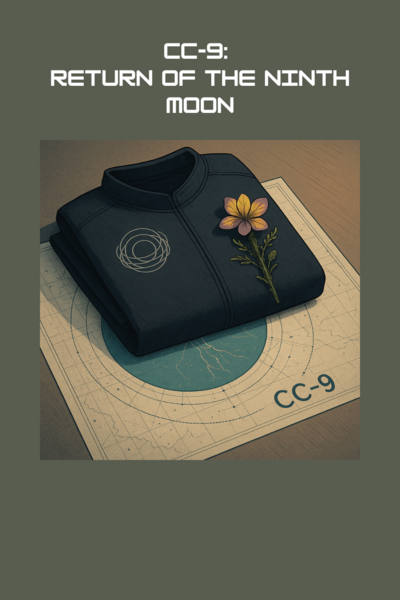
Centered on his chest, stitched just above the heartline, was the emblem of the Circumlunar Commonwealth — a silver crescent looping through eight orbit lines, each curved toward a central point of convergence. A stylized unity. A reminder that this mission, however small it might appear on the surface, belonged to all of them.
He let his hands rest at his sides for a moment after dressing. The suit held its own warmth, generated from a self-regulating inner layer, but the sensation wasn’t physical comfort. It was containment. Like being fitted into a role already written for him.
And yet, as he adjusted the wrist seal and checked the pressure locks along the collar, he realized he wasn’t resisting it.
Not today.
Once the final clasp was secured, Ax crossed the room to the narrow mirror beside the storage panel. It was the same as before — tall, frameless, set flush into the alloy wall with no ornamentation. It did not distort. It did not flatter. It merely reflected.
He expected to see himself — as he always had. And for the most part, he did.
But his eyes were greener.
Not subtly. Not a trick of light. The blue was still present, still dominant in the iris, but it had been overlaid — threaded through with a faint green bloom that encircled the pupil and pushed outward like a halo. Not vibrant, not artificial. Natural. But undeniably different.
He leaned in, searching for the flaw — a change in lighting, a retinal delay, an ambient lens shift. Something explainable. But the change remained. The color held. It was real.
He blinked. Looked again. No difference.
A slow chill moved down his back, not from fear, but from uncertainty. He reached for explanations, cycling quickly through the vast mental reserve of memory and knowledge he carried like a second spine. Had he consumed something? Interacted with an atmospheric compound? Was this stress-induced — some obscure Rheunarian vascular response?
Nothing surfaced. No protocol. No warning. No precedent.
Just the eyes.He exhaled through his nose, slow and even, watching himself as though the breath might change something — as though the act of witnessing might restore the familiar.
It didn’t.
Still, he stood straight. Checked the seams of his suit once more. There was no time for speculation. No room for indulgence in mystery when the reality ahead required clarity and action. He could not allow himself to be distracted by what might be irrelevant — a symptom with no source, a change with no meaning.
Whatever it was, it would wait.
He turned away from the mirror.
And did not look back.
The overhead intercom system chimed again, the now-familiar tones unfolding with calm precision before the voice returned — smooth, neutral, unquestioning.
“All personnel assigned to the exploratory mission, report to launch staging. Transit access and footpath corridors are now open. Departure begins in thirty minutes.”
The message dissolved into silence, and the room resumed its steady hum, as though nothing had changed — as though the words had not pulled the weight of a world into motion.
Ax stepped away from the mirror, crossing the room with deliberate ease. He tapped the door panel, and the hatch slid open without hesitation, releasing him into the corridor beyond. The air outside was cooler than before, laced with the faint scent of filtered ion vapor and metal warmed by light. The station’s day cycle had begun to assert itself.
He could have taken the internal transit system — the mag-path would have brought him to the launch pad in under three minutes — but he didn’t. He turned away from the lift junction, passing beneath the pulsing blue beacon that marked its access point, and chose the footpath instead. He needed the time. Not for the walk, but for the space between steps.
The corridor stretched long and gently curving, illuminated by overhead panels set into the ceiling like veins of soft amber. Every few meters, he passed recessed alcoves lined with emergency stowage or modular seating, all untouched. The air was quiet. He passed no one.
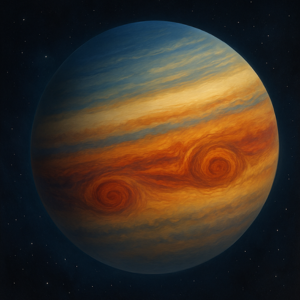
Fifteen minutes.Long enough to settle the weight in his chest. Long enough to breathe deeply without having to answer questions he wasn’t ready to form. The hallway turned again, and for a brief moment, one of the larger viewing panels came into sight — a sweeping arc of reinforced glass that revealed the gas giant below. Typharion churned with violet storm bands, vast and beautiful in its violence, its gravity holding the moons in place like beads on invisible thread.
Ax paused for just a moment, gaze drifting toward the horizon. He couldn’t see the ninth moon — not from this angle, not with the station’s shielding and orbital arc. But he felt it all the same. Not as pressure. As pull.
He exhaled, then continued on.
He arrived at the launch pad with the steady rhythm of his steps still settling in his body. The corridor opened onto a wide, circular chamber — half hangar, half cathedral — with a ceiling that arched high overhead and curved light panels that diffused illumination from above like filtered starlight. The air here was cooler, sharper, touched with the sterile scent of sealed fuel compartments and recently pressurized hulls.
To his right, spaced evenly across the far wall, stood four launch vessels.
They weren’t massive — nothing like the long-haul diplomatic ships or the rotating biospheres of the Commonwealth fleet. These were smaller, sleeker, built for planetary descent and atmospheric variation. Each one stood on a wide stabilizing ring, with a tapered central body flanked by symmetrical engine spires and a vertical ridge down the spine that housed the entry chamber and docking seals. Their hulls were charcoal-grey with reflective trim, polished but functional, their shapes more biological than mechanical — curved like shells or seeds waiting to open.
They were spaced precisely one hundred yards apart, each anchored in its own recessed bay. At three of them, pairs of figures stood waiting — silhouettes in dark suits, posture formal, some in conversation, others quiet. Ax didn’t recognize their faces at this distance, but the composition was clear.
He was the last to arrive.
At the vessel nearest to him — the fourth and closest — only one figure stood.
Alderin.





Comments (0)
See all