
"To be honest, I hesitated about the exhibition,"
The curator of the “Anonymous Artists Exhibition” smiled into the camera during a television interview.
"But when I stood in front of that painting... I didn’t need a reason. I just thought, ‘This deserves to be shown.’"
*
The morning light streamed quietly over the desk, filtered through iron bars.
A guard approached with a newspaper in hand, flipping through the pages as he spoke.
"...Let’s see, ‘Forgery sold at high price now on display’? Your painting’s in there too?"
He gave a snort and held the article out toward Weiss.
Weiss glanced over the article, then lowered his gaze.
His silence carried a shadow—whether of confusion or resignation, it was hard to say.
The article covered an exhibition held in Berlin’s Graz Square.
Nowhere was a single artist’s name mentioned.
──“Anonymous Artists Exhibition.”
The works on display had once circulated as forgeries, their creators unmasked.
They were not authentic.
But they radiated something more than that—something no label could quite contain.
*
“...Is this that one?”
On the morning of the opening day, a visitor stood still in front of a painting.
“I heard it was a forgery... but this is really something.”
The brushstrokes, as if reaching deep into the chest, quietly pulled the viewer in.
In a corner of the gallery, the lead curator continued speaking in a media interview:
“We received written permission from both the artist and involved parties for the exhibition. Additionally, the Cologne Criminal Police granted a special exemption, recognizing this as a ‘site for social reflection.’”
“The authorities did that...?”
“Yes. Not just with the artist’s consent—”
*
White walls and an iron-framed bed.
In that sterile, lifeless space, Clarisse quietly sat down.
With a metallic clang, the door shut behind her, and silence returned once more.
“So... this is my ‘home’ for a while, then,” she murmured.
The guard spoke.
“Three-year sentence, right? If you keep your record clean, it might be shorter.”
“I see... Then I’ll be out a little sooner than him.”
What flickered in her eyes was a vision—
a glimpse of something beyond,
a future no one else had yet seen.
*
The “Exhibition of Anonymous Artists” sparked a major reaction across social media.
“Who painted this?”
“A forgery? No—this is creation.”
“The phrase ‘a forgery that transcended the original’ fits perfectly.”
The hashtag #TheTrueForgery began trending, and photos of the exhibited works spread rapidly online.
There were also plenty of critical voices:
“Don’t glorify crime.”
“A forgery is still a forgery.”
But beneath those posts, one quiet comment kept appearing:
“And yet... have you ever seen a ‘forgery’ that moved your heart like this?”
*
In one corner of the exhibition hall hung a single sketch.
Beneath it was a small caption:
“A forgery is not the act of tracing the real—
but the creation that fills in the blanks left undrawn.”
Many visitors paused in front of those words,
each sensing something unspoken in the silence.
The preparations and operations of the exhibition were supported by materials entrusted before Clarisse's surrender—
and by Inspector Rosen himself.
That morning, Clarisse had handed Rosen several paintings with verified provenance, detailed financial records, and memorandums from involved parties—
all sealed with a letter.
“I am heading toward the end.
But the paintings… they should be a beginning.”
Rosen took the documents and paid a visit to the director of a prominent art gallery.
The man’s name was Erik Meyer, director of the Bern Gallery of Art—
a curator known for his lifelong inquiry into the boundary between authenticity and artistic value.
He and Clarisse had once served on the judging panel of a major art exhibition.
Through that encounter, he had developed a deep respect for her eye for authenticity and aesthetic sensitivity.
It was this connection that Clarisse had entrusted to Rosen.
“Crimes must be atoned for.
But art… must be judged by a different standard.”
Meyer agreed to cooperate.
Part of Clarisse’s remaining funds was anonymously funneled into an “Art Revival Fund,”
which became the financial backbone for the exhibition and its associated projects.
Money once earned through forgery
was now paving the way for the future of aspiring artists in pursuit of what is real.
*
Night had fallen over Graz Square.
The lights of the Exhibition of the Nameless still glowed faintly,
though the bustle of the daytime now felt distant—
the venue slowly cooling into silence.
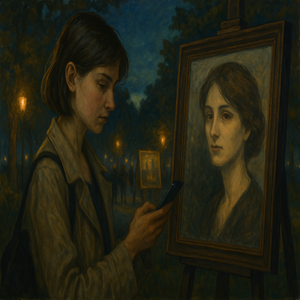
In that quiet, a young woman stood before a painting.
Clutching a sketchbook to her chest,
a bag bearing the logo of an art university slung over her shoulder,
she stood still.
Taking out her smartphone,
she gently snapped a photo of the artwork.
It was the forged piece Weiss had painted in Montpellier—
a portrait of Émilie Charmy,
her calm profile oddly reminiscent of Clarisse.
The woman stared at the screen in silence,
as if deep in thought.
Then, she opened a messaging app
and began typing something.
Its contents remained unseen.
She tapped send,
slid the phone into her pocket,
and turned toward the exit.
Her footsteps echoed softly against the cobblestones,
the shadow of quiet resolve swaying behind her.
Whether it was hope, or something else—
no one yet knew.







Comments (0)
See all