
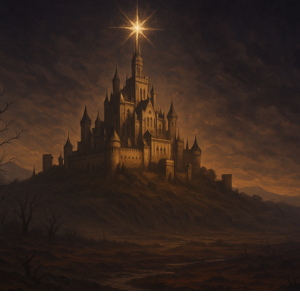
The chamber doors groaned open on ancient hinges, and one by one, the Council of Scholars entered. Robed in soft greys and whites, they moved like drifting smoke—quiet, aged, and unimpressed. Each bore a pendant of the Light: some shaped like stars, others runes, all gleaming faintly in the crystalline glow of the high windows. The chamber itself sat beneath the Tower of Illumination, where the city’s great crystal hovered, its glow filtered down through circular stained glass like the light of a frozen sun.
King Malrik sat at the head of the crescent table, hunched yet regal, hands gripping the arms of his chair. His crown sat heavy on his brow. Behind him stood Cassimir, composed as ever, eyes unreadable.
“You have summoned us, Your Majesty,” said Prophet Marell, the eldest among them. His voice rasped like brittle parchment. “We pray this gathering is of importance.”
“It is,” Malrik replied, and for a moment, there was silence.
He stood slowly, the crown shifting slightly as if reluctant to move with him. “Last night, I saw the world end.”
Several prophets raised their brows. Others merely sighed.
“The beast again,” muttered Eyal, one of Malrik’s scholars, under his breath.
Malrik’s hands trembled at his sides. “Larger this time. Not a creature. A god. A walking wound in the shape of mountains. Its skin was the sky. Its breath… its breath turned towers to ash before they could fall.”
Some of the prophets scribbled quietly on parchment. Others exchanged tired glances.
“I saw the eastern gate collapse in a single heartbeat. I saw knights—our knights—crushed like snapped twigs. And then the crystal, our crystal—”
He gestured upward. “—it shattered. Not with fire. Not with impact. It screamed, like a dying bird. And then it vanished. Just gone. The light extinguished. Like it never was.”
A tense silence followed. Then Prophet Sael offered carefully, “Visions are often metaphor, Your Majesty. The beast may represent war, sickness… perhaps even fear itself.”
“Then fear has claws now,” Malrik snapped. “It bit me.”
Murmurs.
“Your Majesty,” Marell said, more cautiously now, “these images you speak of… they do not appear in any known scroll or rune. Not even in the ancient vaults of Aelmarith.”
Cassimir stepped forward, voice smooth. “Perhaps that is the problem, not the king’s mind. Perhaps the vaults are simply outdated.”
“Or perhaps he is tired,” Eyal said, rising. “These… waking dreams—”
“Do not patronize me,” Malrik growled. “I know what a dream feels like. This was worse. It looked at me. It knew my name. And when I blinked, it was gone. That is not madness. That is warning.”
Another prophet spoke: “Then what would you have us do?”
Malrik’s face darkened. “Sound the bells in every high temple. Draw back all of our scattered forces within our walls. Alert the other cities. The great crystals—every one that floats above our towers—watch them. If they dim, even for a moment, we must be ready.”
“Ready how?” Sael asked. “What would you prepare for? An earthquake? An invasion? A god?”
“Yes,” Malrik said, his voice cracking. “All of it.”
The prophets began to speak at once—suggestions wrapped in ceremony, hesitations masquerading as wisdom. Draft a missive. Form an advisory subcouncil. Consult the southern seers. Delay.
Cassimir, strangely, said nothing. He watched them all—king and council—with a stillness that felt too deliberate.
Malrik listened. Then, slowly, he sat back down. He looked to the table, then to each face in turn.
“You will do nothing,” he said quietly. “You will wait, and rationalize, and die in robes that smell of old incense.”
No one replied.
“Out,” Malrik whispered. “Get. Out.”
The council stood as one and drifted out in silence. Only Cassimir remained.
High above, behind embroidered drapes filling the stone archway of the gallery, four figures lingered in the gloom. The echo of their father’s voice still vibrated through the floor, but none of them spoke—yet.
Maelis sat cross-legged with her arms wrapped around her knees, her delicate fingers weaving a dried flower into the hem of her sleeve. She didn’t look down at the throne. She didn’t need to. “He’s worse than last time,” she murmured. “Last year he wept in private. This time, he nearly screamed at them.”
Theron leaned against a pillar in the corner, half-shadowed. “He’s unraveling in public now,” he said. His voice was cool, matter-of-fact. “Soon he’ll be a ghost in his own throne room.”
“He already is,” Sylwen replied, perched near the archway like a raven on a ledge. Her legs crossed, her hands idly polishing the black gemstone of her ring. “The moment he said the crystal screamed, half the council tuned out. The other half just wrote it down to appear interested.”
Oriven stood beside the balustrade, arms crossed, watching their father with a quiet scowl. His broad frame barely shifted, but there was a hardness in his jaw, like a soldier expecting battle. “It’s not power he’s losing,” he said. “It’s fear. They’ve stopped fearing him. That’s when kingdoms fall.”
“You think he’s imagining it?” Maelis asked softly.
“Does it matter?” Sylwen said. “Real or not, the fear is real. And fear spreads like sickness.”
Theron finally looked down into the chamber, his eyes distant. “He said the crystal shattered… but it’s still there. Still glowing.”
A voice sliced through their quiet.
“You make fine vipers, all of you. Whispering above the body before it’s cold.”
Vaedros stood in the archway, his silhouette rigid, hands clasped behind his back like a commander awaiting confession. His hair was tied back in a silver clasp, his boots polished to a fault. Everything about him looked recently adjusted, as though he prepared for this exact confrontation.
Oriven didn’t turn. “Spare the performance, brother. You’ve been waiting for him to die longer than any of us.”
Vaedros stepped forward. “I wait for duty, not death. I don’t hide in corners like a coward hoping fate makes the decision for me.”
“No,” Sylwen said with a faint smirk. “You just iron your cuffs while the world burns.”
Vaedros ignored her. “You all think you’re clever. But when the city crumbles and the throne falls, it won’t be cleverness that keeps our people alive. It will be strength. Leadership. Something none of you have shown.”
“And you have?” Maelis asked, standing slowly. Her voice was gentle, but her gaze sharp. “All you’ve done is prepare for the crown like it’s inevitable. As if father’s death is just a date you haven’t circled yet.”
Vaedros’s jaw tensed. “Someone must be ready.”
“Funny,” Theron murmured, finally stepping into the light. “I thought kings were chosen. Not staged.”
“Don’t lecture me on legacy,” Vaedros snapped. “You spend your days hiding in libraries and shadows. What do you know of leading?”
“More than you know of listening,” Maelis said.
Oriven stepped forward now, standing just inches from Vaedros. “You want the crown so badly,” he said quietly, “but you’ve never fought for anything that wasn’t already handed to you. You don’t lead, Vaedros. You position.”
For a moment, it looked as though Vaedros might strike him. But instead, he turned—deliberate, cold.
“When father is gone,” he said, “and the city needs a voice, it will not be yours they follow.”
Sylwen tilted her head. “Then let’s hope you sound more convincing with fire at your gates.”
Silence fell again. The siblings stood, not as a family, but as figures in a storm—each one certain the others were the wind.
From above, the light from the crystal tower filtered down through the gallery window—its blue-white shimmer flickering.
Then… just for a breath.
It pulsed.
And dimmed.


Comments (0)
See all