
The candle flame in Cassimir’s chamber wavered, casting his silhouette across the walls like a second self watching from the shadows.
He stood alone, robes immaculate, hands smooth and still. With one motion, he snuffed the candle, plunging the room into darkness—then turned and opened the door without a sound.
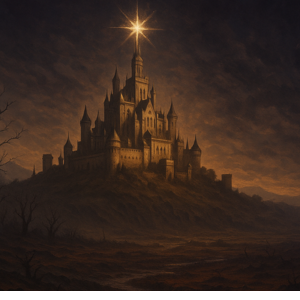
The castle of Vaelorin slept.
Tapestries hung limp in the halls. Silver sconces glowed low with crystal light, but only every fourth was lit, leaving long corridors of gloom in between. Even the guards were sparse now—pulled toward the gates or upper towers, far from where Cassimir moved.
He walked not like a thief, nor like a man in a hurry. His steps were slow, methodical. Silent. A nocturne he had rehearsed a hundred times before.
Downward he went—past the galleries and noble wings, into a lesser-used hallway lined with forgotten busts and faded murals of dead kings. The air here smelled older. Not foul, but unused. Undisturbed.
At a certain door, he paused.
It had no nameplate, no marking. Just dust and old hinges. He did not open it. Instead, he pressed his hand to a section of the stone wall nearby, fingers gliding slowly until they found a shallow groove—a circle etched centuries ago and nearly worn flat.
Click.
Cassimir stepped back and tugged a leaning shelf aside. Glass bottles rattled gently. The shelf, mounted on hidden runners, slid smoothly away to reveal a crack in the wall—an opening where no door should be.
He entered without hesitation.
The air changed immediately.
It was colder. Wetter. Heavier.
This passage had no carvings of saints, no mosaics or painted ceilings. The walls were raw stone, chiseled and uneven, reinforced with beams that looked as though they might fail with a deep enough breath.
His sandals made no sound on the stairs as he descended.
Down, down, past roots that slithered from the ceiling like veins. Past carvings no hand had maintained. Down to where the stone felt less like construction and more like bone.
He passed niches in the walls where old urns sat. Some cracked. Others sealed in wax that had melted and hardened again a dozen times. Cobwebs bridged the corners of the stairs. No dust stirred as he passed—because none had settled.
He paused once.
At a landing, a small basin had been carved into the wall. Empty now, but once filled with oil or blood or something older. He ran two fingers along its edge, then wiped them on his sleeve with the casual detachment of habit.
Then he continued.
At the bottom, the tunnel widened into a cavern.
Not built, but opened. The shape of it was wrong—too wide at the base, too narrow at the top, as though shaped by something pulling upward rather than pushing down. Pale veins of crystal streaked the walls but gave off no light.
Only the ceiling glowed—just barely. A patchwork of moss or lichen glimmered faintly in the high stone, like stars glimpsed through ice. It offered enough light to see, but only if one knew how to look.
And Cassimir knew.
He stepped into the chamber.
Four others were already there.
A farmer—broad, back slightly hunched, hands knotted with callus. A scholar—tall, precise, his robes marked in places with ink stains that had never washed out. A servant—small and wiry, posture too rigid for comfort. And a butcher—his apron gone, but the smell of meat still clung to him.
Each wore a blindfold of black cloth, tied tightly across their eyes.
They stood in silence. Perfect, meditative stillness.
Cassimir moved past them with the composure of a bishop in his own cathedral. He did not speak. He simply took his place, facing the center, adjusting the folds of his sleeves.
The walls around them bore carvings—not like the sacred texts above. These were older. Harsher. Spirals twisted into eyes. Teeth hidden in shapes that might have once been hands. There were rings inside rings, symbols that defied the eye, changing shape if looked at too long.
Time had not worn them down.
It had only softened their edges—like teeth dulled not from age, but from frequent use.
High above, pressed flat against a jagged ledge of broken stone and shadow, Sylwen watched.
She had followed Cassimir from his chambers with the caution of a thief and the patience of a predator. The way he walked—unhurried, reverent—had only confirmed her suspicions. She had long known Cassimir was playing a deeper game.
But this? This was no game.
This was a ritual.
She adjusted her cloak against the wall, eyes scanning the chamber below. The blindfolded figures didn’t frighten her. Not really. She saw what they were—tools. Willing ones, perhaps, but tools all the same.
What intrigued her was Cassimir. The way he carried himself. The way the others deferred to him without needing to see him. The way his voice seemed to own the silence that followed.
There was danger here. Real, ancient, unknowable.
But there was power, too.
And power—true, raw, unrepentant power—was something Sylwen could use.
Her gaze traced the carvings along the walls. They made her vision swim, made her pulse quicken in ways she didn't fully understand, but she looked anyway. Listened anyway.
Let the others flinch and fall away. Let her brothers posture like noble fools. Let her father rot on his throne.
She was here now, where the real power moved.
Beneath her, the stillness finally broke.
The butcher spoke first—his voice deep and gravelled, more breath than sound.
“He coughs blood now, doesn’t he? I heard the chambermaids whispering. They think it’s old age.”
The scholar gave a soft chuckle. “They think everything is old age. As if time alone could rot a man from the inside. No… this is something more deliberate. Our patience pays.”
The servant shifted his weight, cloth boots scuffing faintly. “They still flock to the temples. Hoping for healing. Hoping for light.”
The farmer snorted. “Let them. The brighter they cling to it, the harder the fall. There’s something poetic in it—watching them pray to glass towers that already flicker.”
A silence passed between them.
Then the butcher spoke again. “Five more last week. A nobleman’s son. Two scribes. A dockworker. And one of the prophets, believe it or not.”
“They always come easier when they’ve lost something,” the servant said. “Grief opens the door. All we have to do is guide them through it.”
“And what do they think we offer?” the farmer asked mockingly. “Redemption? Peace? The truth?”
“No,” the scholar replied. “They think we offer shelter. From the storm. From the darkness they can already feel pressing in.”
He tilted his blindfolded head upward slightly, as though addressing a god that wasn’t there. “Let them believe what they must.”
The farmer exhaled slowly. “And when do we stop pretending we’re building a kingdom?”
“When the old one falls,” Cassimir said, his voice finally entering the space. Smooth. Authoritative. “And it will.”
They turned toward him—not by sight, but by instinct. Even blind, they knew when he spoke.
“The king’s breath rattles louder with each week. His mind weakens with every vision. He sees flames now. A beast in the sky. These things he cannot explain.”
“Does he suspect you?” the butcher asked.
“He trusts me,” Cassimir said. “Even now. He leans on me because he must. The others bicker like hungry crows, but I give him silence—and he mistakes it for loyalty.”
The servant chuckled softly. “And what of the people? They still think the Light will save them?”
Cassimir’s lips curled. “They want to believe the world ends gently. That light will simply… dim. That all stories end with peace. But this one ends in teeth.”
Another silence.
Sylwen’s fingers tightened against the stone. Her breathing shallow, heart ticking in her chest like a war drum buried beneath snow.
This wasn’t treason. This wasn’t rebellion.
This was rot. Willful, knowing rot.
The scholar broke the silence. “The dream returns to me more clearly each time. I see the sky split—not red, not fire, but black. Thick. Like blood turned to smoke. And it falls across the towers. Across the fields. And when it touches people, they don’t scream.”
“No,” the farmer agreed. “They sink.”
The servant murmured, “It welcomes them.”
A weight pressed down in the cavern. The lichen dimmed just slightly, and though no wind blew, the flame on Cassimir’s pendant flickered.
“It’s not death,” Cassimir whispered. “It’s what comes after the death of light.”
“An unmaking,” the butcher said.
“A return,” the servant added.
Cassimir raised his hands, palms upward, as if receiving something unseen. “A memory older than the world, returned to us.”
Sylwen couldn’t look away. Her mouth was dry. A part of her wanted to run—but another part, deeper, more frightened, knew she must understand what she had seen. And more than that, what was coming.
The scholar’s voice was soft now, almost prayerful. “Let the city celebrate its holy light. Let the towers shine. Let the king speak of healing and rebirth. Let the people cheer.”
As the cultists whispered of the king's failing breath, of recruitment, of the people’s blind hope—Sylwen didn’t feel fear. She felt confirmation. The game she had long suspected was being played on a deeper board, and now she could see the shape of it.
They spoke of overthrowing.
But their words—“the death of light,” “a return,” “the sky that sinks”—hinted at something greater than politics.
A soft thrill crawled up her spine.
Not fear. Ambition.
She smirked faintly in the dark.
If the kingdom was truly doomed… then why not place her bets on the winning side?
Not as a servant. Not as a believer.
But as something more dangerous.
A knife among the shadows.
She didn’t know what they served, or what Cassimir truly desired—but she would learn.






Comments (0)
See all