
About six months after his incarceration, Weiss sat quietly in a small prison workshop, brush in hand.
His strokes no longer carried the tension they once did, nor the exaggerated flair that sought to please others.
Now, each line came as naturally as breathing.
“Your lines have gotten softer lately,”
murmured an older inmate sitting beside him.
Weiss gave a small laugh and shrugged.
“Maybe I’ve finally returned to myself.”
In those words lay a quiet conviction—
the dissonance he had long felt with his father’s brushstrokes,
and the hard-won realization of what his own line truly was,
after years spent as a forger.
Beside his sketch lay a folded newspaper clipping.
“Anonymous Artists Exhibition Expands Across the Country — A Question Behind ‘The Forgery That Surpassed the Original’”
Neither Clarisse’s name nor Weiss’s appeared in the article.
But Weiss knew without doubt—
one of the paintings on display was unmistakably his.
*
In a corner of Berlin, preparations were underway for a new installment of the Anonymous Artists Exhibition.
“Anonymous Artists Exhibition Part II — Beyond the Lines”
Gallery director Eric Meyer stood still before one particular painting, watching as his young staff bustled about with the setup.
“Precisely because there’s no name attached, people try to see the painting itself. I hope this time will be no different.”
The painting was by Weiss.
Its gentle lines carried a quiet resolve — a sign of healing, of intention returning.
Meyer hung it on the wall, seeing in it a glimmer of hope.
*
After returning to Berlin, Rosen completed a report.
“This was not merely a forgery case.
It was a record of confronting the questions: What is art? What does it mean to believe in someone?”
The report concluded with those words, making it a rare submission within the department — an investigative record accompanied by personal reflections.
His superior read it silently, then exhaled softly and said,
“...You’ve changed.”
“In a good way?” Rosen asked.
The superior simply replied, “Who’s to say?” — but his expression had softened, ever so slightly.
*
Three years later — the day of Clarisse’s release had finally arrived.
The early morning sky was a clear expanse of blue. Leaves swayed gently in the trees, and the faint chirping of birds could be heard.
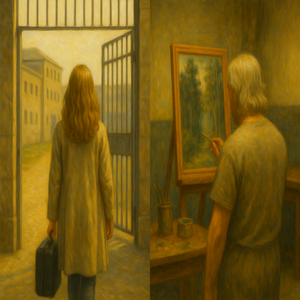
The heavy iron gate creaked open slowly, and Clarisse stepped alone through the prison’s main entrance.
No one had come to greet her, but she accepted that as if it were only natural.
With a quiet breeze brushing through her hair, she began to walk, pulling a small black suitcase behind her.
There was no hesitation or urgency in her steps.
Her destination: a modest apartment on the outskirts of Berlin, arranged by Eric Meyer.
It was minimally furnished — a wooden desk and chair, white walls, and a distant view of the river through the window.
Clarisse opened her suitcase and began carefully unpacking her things.
Among them, just one photograph — a forgery of “The Forest and the Crowd” painted by Weiss.
“This was our creation.”
She placed the photo upright in the corner of the desk and exhaled deeply.
*
The Next Morning.
Clarisse awoke quietly.
She brewed a cup of coffee and opened her laptop.
On the homepage of the search engine, an unfamiliar headline caught her eye:
— “Clarisse Weiss Released from Prison” —
“This makes the news…?”
She scoffed lightly and let out a small sigh.
But it was the related articles below that drew her attention:
— “Not a Crime, but a Conviction: Voices Spread Across Social Media” —
Clicking on it, a video played of young people on the street holding up copies of paintings.
“I can’t believe this was ever called a forgery.”
“It’s not about the name — it’s about how it makes you feel.”
“This moved me more than any so-called original.”
Staring at the screen, Clarisse felt a warm stirring deep in her chest.
*
A few days later, the intercom buzzed.
Standing at the door was Rosen.
“You look well,” he said.
“…If I look well, then I must be,” Clarisse replied.
She invited him in and made coffee.
Her hands moved just as they always had.
Rosen sat by the window, gazing out at the river.
“I’ve started using social media lately,” he said.
Clarisse blinked in surprise.
“You did?”
“Surprised?
But it turns out, the desire to express something—it’s the same for us too.”
He stared into his cup and continued.
“Vice’s paintings are getting good reactions.
Because they’re ‘anonymous,’ people try to look beyond the lines, to find the heart behind them.
Your ‘staging’ plays a part in that too.”
Clarisse lowered her gaze.
“…We erased our names.
But all along, we hoped the art would reach someone.”
“Well, it did,” Rosen said.
“And now… it’s your turn.”
He stood and offered a final remark as he reached the door.
“Social media isn’t so bad.
Being able to speak your truth without revealing your identity… suits people like us with something to hide.”
Clarisse laughed before she could stop herself.
“I’ll give it a try.”
*
That night, Clarisse sat in front of her laptop, staring silently at the screen.
—Should she speak up, or choose silence?
Eventually, her fingers began to move, slowly.
“I lied and deceived many people.
But I always wanted the art to be ‘true.’
We believed in what the lines could say—not the names behind them.
We still believe that.
If the word ‘forgery’ can’t be erased, then I want to believe in something that surpasses it.
Even without a name, if there’s a heart within the painting, then it’s not a lie—at least, that’s what I believe.”
—Post.
“…140 characters. I used them all,” Clarisse smiled softly.
“One more… is allowed, isn’t it?”
Then she typed another line:
“To everyone who quietly watched—thank you.
Your voices became my light.”
*
The next morning.
Clarisse brewed her usual cup of coffee and opened her laptop.
—Notification: You have 1 new DM.
It was a heartfelt message from a young woman.
[@marina_draws]
The profile icon was a bouquet of flowers, softly painted in watercolor. In the background, a discreet logo of an art university was nestled into the design.
“Dear Clarisse,
I’ve read your post many times.
We don’t feel that we were ‘deceived.’ On the contrary, we were deeply moved by your choice—to protect something you believed in.
Forgery? Authentic?
Those words matter less than what your art gave us.
The emotion in each line, the memories living in the colors, and the feeling that we were witnessing ‘someone’s life’—
That, I believe, is the truest thing of all.
Right now, my friends and I at the university are discussing what we can do to help Mr. Weiss gain release.
We’re thinking of starting a crowdfunding campaign, but we’re unsure if we’re allowed to act on our own…
Still, we feel strongly that we must do something.
Those paintings were hope itself.
Please—let us help.”
Clarisse stared at the screen.
She brought the cup to her lips, but the coffee had already gone cold.
Outside the window, the wind gently stirred the leaves on the trees.
She read the message again.
And then, softly, she smiled.
It was a smile no one else saw, but in that moment, something quietly unraveled within her.
Then, she calmly closed the laptop and finished the cooled coffee.





Comments (0)
See all