
Weiss was spending a quiet afternoon, just like always.
A soft light filtered through the prison courtyard and fell diagonally across the pages of the magazine he was reading—a fine arts journal, one that had reached him several months late.
And within it—he saw his name.
“Crowdfunding Launched – Movement to Support the Release of Painter Weiss”
Narrowing his eyes, he read the headline again.
“Crowd… funding?”
He murmured the unfamiliar word aloud. It was the first time he had heard it.
From the opposite bed, a young inmate turned his head slightly. A slender youth with short-cropped blond hair and sharply defined features. A few simple tattoos marked his arms.
“That’s a thing these days,” the young man said. “You collect money online and stuff.”
Weiss furrowed his brow.
“Collect money… online?”
The young man shrugged with a faint smile.
“Yeah. Looks like there are people out there who want you released. You’re pretty famous, you know.”
Weiss couldn’t respond right away. He simply stared at the reproduction of his painting printed in the corner of the page, then quietly closed the magazine.
*
Rosen was reviewing case files in a back room at police headquarters.
The investigation and the trial had long since ended. At this point, it was less “work” and more of a “habit.”
Among the documents, a torn-out magazine clipping caught his eye—it was about the crowdfunding campaign supporting Weiss.
Weiss’s name still echoed somewhere in society.
Just then, his phone vibrated from where it rested on the edge of the desk. It was a message from a journalist.
“We’d like to run a feature on the forgery case. If possible, we hope to include a statement from the lead investigator at the time.”
At first, Rosen intended to decline.
But a single line in the message made him stop.
“Rather than the authenticity of the works, we want to explore the power of belief.”
*
Several hours later, Rosen was seated at a café table across from the editor.
“So… why did his paintings appear so authentic? What did you see in them, through your own eyes?”
The young editor asked with a serious expression, notebook in hand.
Rosen brought his cup to his lips, took a deep breath, and replied.
“…The lines were alive. No, too alive, perhaps. As if they could only be drawn in that fleeting moment.”
The editor nodded silently for a moment.
“I see. So even though they were forgeries, they carried the breath of an original work…?”
Rosen shook his head slightly and lowered his gaze, as if searching for the right words.
“I’ve seen my share of forgery cases. Some imitated Matisse, others chased the shadow of Picasso. And while some were technically brilliant in brushwork and paint, they were still just copies. But Weiss… he was different. He wasn’t imitating—he was inheriting.”
The editor paused mid-note, looking at Rosen intently.
“To be honest, I don’t think the term ‘forgery’ quite fits his paintings. The brushwork, the pigments, even the labels—they were flawless. But what only they could create was the story. And I think that’s what truly set it apart.”
*
That night, Clarisse was preparing dinner in the kitchen.
The soup simmered quietly in the pot, its aroma gently warming the room. A kitchen knife rested in her hand, vegetables neatly arranged on the cutting board.
Her expression was calm, but her gaze seemed to drift—just slightly—as if looking into the distance.
Suddenly, a notification sound rang from the laptop on the table behind her.
Wiping her hands with a paper towel, Clarisse walked over and glanced at the screen.
— “20% of the goal reached. A media article will be published tomorrow morning. Please review it in advance.”
She nodded silently and gently closed the screen.
— It’s already in motion.
She murmured the words inwardly, so softly that no one could hear.
She turned down the heat and tilted the lid of the pot slightly—a motion that carried the quiet grace of a prayer.
*
A few days later, Clarisse received an email.
It was from Eric Meyer, the director of a gallery.
“The next exhibition’s theme is ‘The Painter Who Stood Between Truth and Forgery.’
I’d like to ask for your cooperation.”
After reading the message, Clarisse didn’t reply right away.
But from that day forward, she quietly began reviewing recent documents and updates, alongside her usual paperwork.
The question still lingered deep in her heart:
What did the people who believed in us see at the end of that exhibition?
*
Meanwhile, Marina and her friends had rented an old teahouse.
Together with fellow university students, she was working on a new web documentary.
The theme: “A painter who shaped experience, beyond lineage or wealth.”
Marina’s eyes, as she looked at her laptop, were serious—but they held a gentle warmth.
One of the members spoke softly:
“Someone saw this painting and decided to keep living. I did too.”
Marina nodded and began typing out a draft for the documentary on the screen.
With each tap of her fingers, a small flame of hope was quietly being kindled.
*
Prison work program.
In a quiet workroom, Weiss used the little time he was given to freely draw.
On the desk lay a blank sheet of sketch paper.
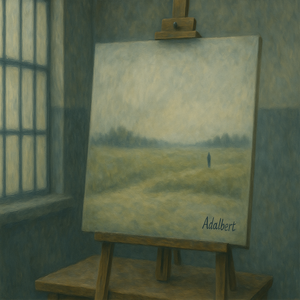
On its reverse side, he painted a serene landscape.
It was a place that seemed vaguely familiar—and yet, it was unmistakably his own.
After a brief moment of hesitation, he signed it for the first time.
—Adalbert—
It was not someone else’s name.
Not the name of a copied artist.
At last, he had begun painting his own work.
Without showing it to anyone, he gently tucked it away in the drawer of his desk.
*
Early morning.
As usual, Clarisse opened her laptop and began checking her emails when one subject line caught her eye.
— “Notice of Bail Receipt and Release Procedure” —
Her fingers froze. Her heartbeat skipped—then surged.
Slowly, she opened the message.
“The bail application for Mr. Adalbert Weiss has been officially accepted. The full amount has been paid via crowdfunding.”
Clarisse stood still, holding her breath.
Only the light from the screen continued to glow—quietly, but unmistakably.









Comments (0)
See all