
When An was fourteen, the first pain arrived one scorching afternoon at the height of a sunburned summer. He collapsed onto the classroom floor like a bird struck mid-flight, his mouth filled with the metallic taste of blood and his ears ringing with ghostly sounds. His classmates panicked, teachers rushed to help, but An—in a haze—saw only a red tide retreating from his body, as if the sea had come to carry away his memories.
The hospital was swift in its diagnosis: Helicobacter pylori—a vicious parasite that had silently eroded his stomach lining, like nightfall swallowing a lonely room. Blood poured out, urgently and endlessly, as if trying to erase a part of his soul. An lost over eighty percent of his blood—a number usually reserved for obituaries.
A transfusion was urgent. But the blood bank lacked his rare type. At that desperate moment, a Western woman—on a volunteer trip in Vietnam—agreed to donate her blood without hesitation. They called it a borderless act of humanity. But no one knew that the moment her blood flowed through the tubes and touched An’s heart, something irreversibly changed.
He survived. But from that second on, something inside him was no longer whole.
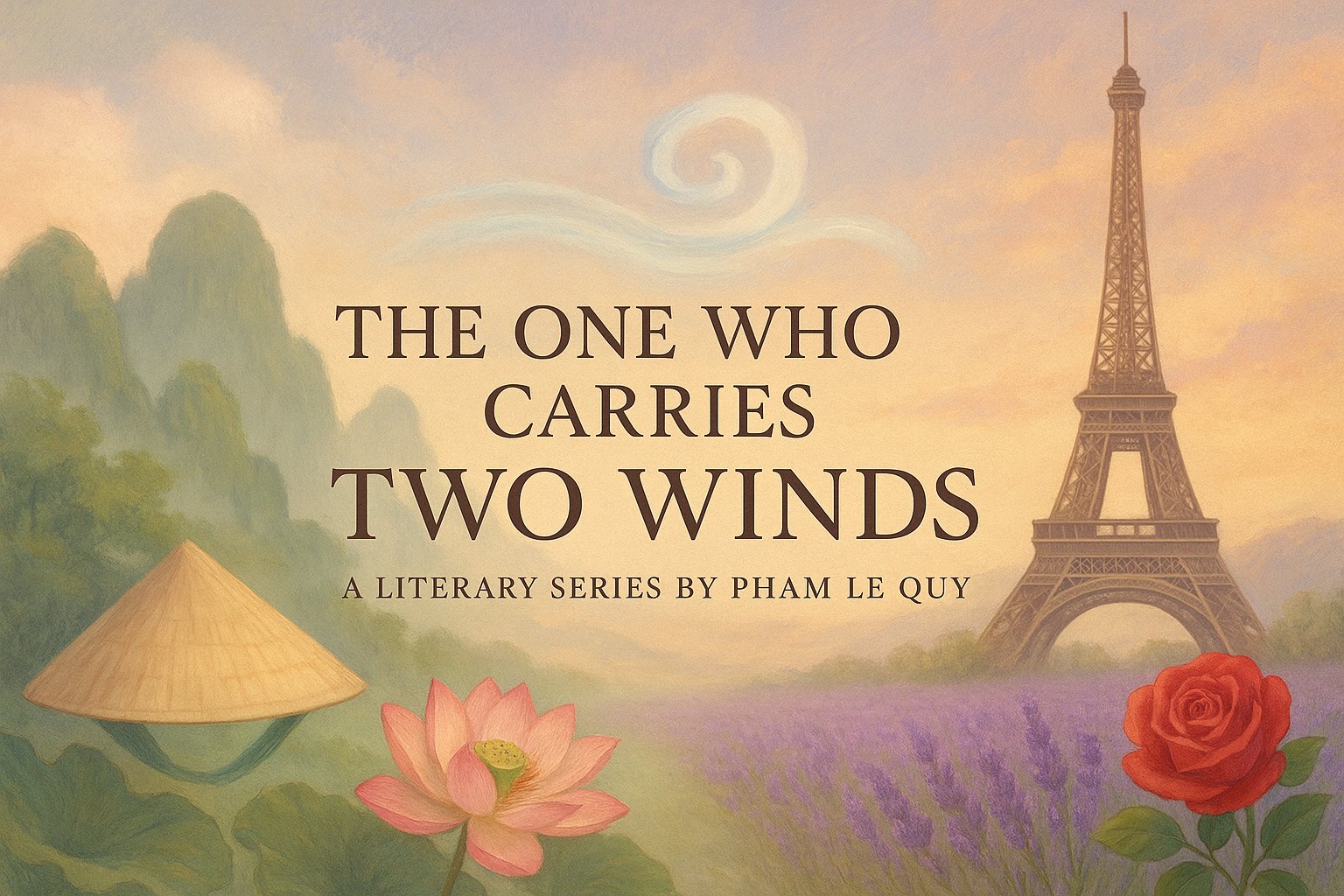
The first night after surgery, An dreamed of a vast lavender field. The sky above was a pale mint, gentle and strange. He stood there in ceremonial white clothes that belonged to no culture he knew. At the end of the misty path, a blonde woman waited—her eyes deep as forest lakes.
“An?”—her voice was soft as silk, yet it pierced his soul.
“I used to be your wife. Now, I am you.”
An awoke in a sweat, his body cold as if it had walked through snow. He stared at his hands—sun-kissed like any Vietnamese boy’s—but something within had changed.
From then on, the dreams returned—erratic, illogical. Sometimes, he sat by an old wooden window, writing letters in French. Sometimes, he was a woman trembling under air-raid sirens. Sometimes, he knelt before a cathedral’s cross, weeping for no reason he could understand. These were not An’s memories—yet they ached with familiarity.
One night, he opened his phone and searched: lavender fields, Provence, European wartime widows... and to his horror, every image he had dreamed of existed—in another hemisphere. He had never learned French, yet in sleep, he recited Apollinaire’s poetry, dreamed of the Loire River, and sometimes—cried for a man named Étienne.
An told no one. How could he? At fourteen, one is allowed to dream, but not to reincarnate. He feared his parents would send him to a psychiatrist. He feared teachers would label him “post-trauma hallucination.” But above all, he feared that speaking the truth would make it disappear—like dew under sunlight.
But the change wasn't only in dreams. Slowly, An’s habits shifted. He began drinking Earl Grey instead of iced coffee. He stopped reading Japanese comics and turned to Proust, to Colette. His writing became layered, tender—as if another hand were guiding his pen. His literature teacher asked quietly, “An, your writing has changed. Is there something you want to tell me?” An only smiled, eyes distant: “Maybe I’m just growing up, sir.”
He knew it was a lie. He wasn’t just growing—he was transforming. In his veins flowed the blood of that Western woman—not just biologically, but spiritually. With it came memories, longings, and a silent curse: to continue living, even without a form.
As he grew, the conflict within him deepened. On one side, the rooted self—An of Saigon, of dust and untold mother-tales. On the other, the unseen woman—a soul who had lost everything, now dwelling in her former husband’s body, rediscovering herself through each breath, each gaze. Sometimes, when he looked in the mirror, his familiar brown eyes shimmered with gray—like a European winter sky.
One afternoon, he found himself at a dusty bookstore, instinctively picking a fragile French novel titled Lettre à l’ombre. One line struck him silent:
“I shall live within the one I love—even after my ashes are scattered.”
He closed the book, hands trembling. That sentence—it wasn’t just a line. It was his reality.
No one believed him. But the universe did.
From that day, even the world around him shifted. Western winds—cold, scented with butter and old fairytales—began to sweep through tropical afternoons. Strange birds perched on his windowsill. Some nights, a violin melody floated through the air, though no one was playing. Once, he paused at a market stall, lured by the scent of toasted baguettes—something he’d never liked before.
And then, the soul spoke.
Her voice came not in words, but in feelings, instincts, memories trickling into his every moment. He never knew her name, but she knew all his pain. When classmates mocked him, she whispered, “Don’t bow your head. I once stood alone in an empty square and still sang.” When he wrote late into the night, she smiled, “I too once loved the light of candles.”
It wasn’t possession. It was coexistence.
An knew—he was now two people in one body. One, a Vietnamese boy. One, a woman from a distant land. Two winds. Two bloodlines. Two origins. Both abandoned. Both surviving. Both walking forward.
But he also knew—one day, he would have to face the truth. He had to discover who she was. He had to name the soul that had merged into his blood. He had to rewrite the story—not just of a teenager, but of a love that had died and returned in the most unexpected form.
And so, An was no longer just An.
He was the one who carried two hearts—one beating for the present, one for the past.
The curse had been cast. The path was unmarked.
But the wind had changed direction.





Comments (0)
See all