
On the streets of Saigon, An felt like a misaligned hue in a black-and-white palette. No one said anything outright, but glances never lied. A quick look was enough for her to understand she wasn’t welcome. A prolonged “hmm” from a vendor, a fleeting gaze followed by avoidance, a subconscious frown—all were ways people refused to acknowledge someone who didn’t belong to any “standard shade.”
The Vietnamese didn’t hate her. But they didn’t know how to love her either. Because she was… a third.
The number three—in local culture—is a bad omen. Something incomplete, awkward, neither round nor square. Neither beginning nor end. The third knock in ghost stories. The third child—the extra.
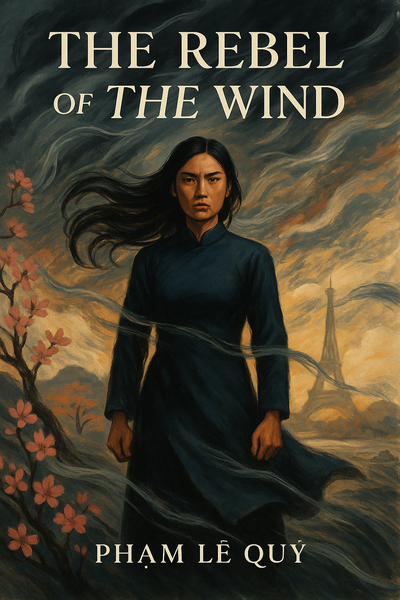
An carried three bloodlines—French, Chinese, and Vietnamese. But in others’ eyes, she carried none in particular. The French part was suspected to be a faded layer of lipstick. The Chinese lineage, a wrinkle on history’s brow. And Vietnam—the homeland she lived in—was the mirror that reflected most clearly her own out-of-placeness.
Once, on a rare date, a Vietnamese man—educated, polite, good-looking—looked at her through the steam of his coffee and asked:
“So... what are you?”
An replied, “I’m me.”
He chuckled softly. “I mean... what kind of mix?”
“French, Chinese, Vietnamese.”
The answer dropped like a stone into a still pond. He fell silent for a long time.
“Three bloodlines? Wow. That’s... something. But... I guess you’re not planning to marry a Vietnamese guy, are you?”
The question—half-joke, half-judgment—was clear. An simply nodded, as if confirming the obvious: this society didn’t need another species that couldn’t be named.
She had grown used to these silent divisions: Vietnamese men preferred Vietnamese women—pure, traditional, well-bred. They valued the “virtuous daughter,” prized “obedience, grace, speech, and morality.” And she, though never rebellious, never overstepped, was automatically seen as a “mixed girl”—a symbol of Westernization, a representative of “Western women”: flirtatious, wild, lacking restraint.
How absurd, An thought, that morality could be judged by blood type.
To Vietnamese men, she was unmarriageable. To Vietnamese women, she was not a friend to be trusted.
She was not despised for any wrongdoing—but for her lack of purity. In a society obsessed with “racial purity” yet constantly mimicking the West, her tri-blooded heritage became a paradox—a cultural virus.
Once, a group of Vietnamese girls whispered mockingly behind her in a bar:
“Is that a guy? Looks more like a gay dude. Three bloodlines and not a drop of masculinity.”
An heard them. But she wasn’t angry—because they weren’t wrong. She didn’t conform to what they wanted, didn’t fit their mold. She was soft in thought, gentle in action, and at times, even questioned her own gender—not because she was lost, but because society had made her constantly ask, “Am I man enough to be a man?”
And even when she looked Westward—toward the land of her French blood—she didn’t feel welcomed there either. White men looked at her with a mixture of curiosity and pity.
“Sorry, but you look more Asian than European.”
A sentence as light as wind, but sharp enough to cut skin.
To them, she wasn’t a gentle French-Vietnamese lady—but an Asian woman whose Western blood wasn’t “concentrated” enough to be considered one of them. Her choice—to live in Vietnam, to embrace her two-thirds Eastern heritage—was seen as a form of self-degradation, a betrayal of “superior” culture.
So the West dismissed her as second-class. Vietnam disdained her for “impure blood.” China remained silent—as history often does with nameless children.
She remembered that night. The night Linh and Nguyên—two people she thought were friends—injected her with that drug meant to erase everything.
“To let you start over,” Linh had said.
But no one can start over if their roots have been stolen.
An tried to find a reason. She asked herself a hundred times, “Why me? Why three bloodlines? Why not just one or two—like people are used to?” But eventually she realized: no answer would ever be reasonable. Life is just a game of chance, and she had drawn the losing card—the number 3.
And in the end, the only one who understood her... was herself.
No one saw her fear when stepping into a crowd. No one heard her heart breaking, piece by piece, from being rejected not for her mistakes—but for her genetic structure. No one read the invisible label on her forehead—one society had etched: “Belongs to no one.”
But amidst it all, An began to learn how to look in the mirror without hating herself.
She didn’t choose her blood. But she could choose how to live.
If society labeled her as mixed—she would be the most beautiful, the strongest of them all, redefining what it meant to be “pure.” If people called her “abnormal” for being different—she would become a symbol for those who had once been labeled so, and still lived with dignity, with love, with humanity.
On the rooftop, under the Saigon night, An looked at the golden lights glowing from the buildings. She closed her eyes. And in that moment, she felt three heartbeats—three bloodlines pulsing at once.
France – freedom.
China – depth.
Vietnam – resilience.
She didn’t need to choose. Because she was all of them. She was herself.
And that was the one thing no one could ever take away.





Comments (0)
See all