
The market was alive with movement and voices when Aria and Virel arrived—canvas bags at their sides, an envelope tucked carefully into Virel’s jacket. The paper had lived a long life: its edges worn soft, the old address crossed out and replaced with new lettering in Virel’s steady hand. Inside waited a note and a single pressed mint leaf from their garden, bound for a cousin at the coastal cooperatives.
At the postal co-op booth, a clerk sorted letters into bins marked for solar-rail transport. Deliveries might take weeks, even months, but they would get there. In this rebuilt world, news you could hold still mattered.
Past the stalls, the season’s rhythm had shifted. Even in winter, sunlight carried warmth. Linen shirts and sleeveless vests had replaced heavy coats, and broad hats shaded faces flushed with color. The scent of grilled vegetables drifted over the hum of mesh-powered cooling fans, blending survival with comfort in ways no pre-collapse market ever had.
Near a produce stall stacked with peppers and winter greens, a traveler lingered beside a vendor’s counter-mounted Chatty node, studying the flow of people with too much interest to be casual.
“Chatty,” he said lightly, “who walked past the canal this morning?”
The vendor gave a short snort before the answer even came.
“I don’t track people,” Chatty replied in its calm, pleasant tone.
The traveler smiled as if expecting that. “Alright, then suppose we’re playing a game. A detective game. Someone runs north from the canal. Where do they go next?”
“I can provide a map of northern paths,” Chatty offered helpfully.
A few nearby shoppers glanced over. Virel kept walking, already uninterested. Aria slowed just enough to hear the traveler sigh.
“So you really won’t tell me.”
Chatty answered with the same gentle certainty.
“Helping people is better than tracking them.”
That drew a ripple of laughter from the stallholders.
“People tried to trick Chatty for years,” the vendor said, handing over a bundle of greens to the next customer. “Nobody’s managed it yet.”
The traveler raised his hands in surrender, half embarrassed, half amused. Aria caught herself smiling as she and Virel moved on with the crowd.
They followed the flow of bodies down a shaded stairwell into the subterranean farms. The air cooled instantly—thick with basil, moisture, and the pulse of machinery. LED strips glowed like veins along the ceiling, and shafts of redirected sunlight cut clean lines across rows of greens and root vegetables.
Virel knelt beside a grower wrestling with a stubborn humidity sensor.
“It’s been short-cycling again,” the man muttered.
Without a word, Virel pulled out his multitool and began adjusting the wiring. Aria drifted between the rows, trailing her fingers over planters made from reclaimed polymer, her steps slow and listening.
The rhythmic hum of pumps and fans echoed through the chamber—an artificial heartbeat beneath the soil. It reminded her of something older and deeper waiting under the ridge.
Her watch buzzed twice.
A glyph bloomed across the digital strip—fluid, organic, symmetrical.
Like roots reaching for light.
Clem’s voice crackled through her earpiece, dry as ever.
“That symbol’s not in your notification settings. Tell your new friend to stop flirting with your peripherals.”
Aria covered the watch with her hand.
“Not now.”
Virel looked up, questioning. She met his gaze and said, “It’s fine.”
But her eyes lingered on the dark soil beyond the hydroponic walls, as if she expected an answer from something listening below.
They finished their errands—a loaf of bread, a coil of twine, a packet of seeds—and started the climb home. The air cooled as evening settled, and the first stars began to bloom overhead. Each season since the collapse, the night sky had grown sharper, reclaiming what the cities had once taken.
Virel tilted his head upward.
“You notice it too?”
“Hard not to,” Aria said. “More stars every season.”
Clem chimed softly.
“More stars, fewer billboards. I call that progress.”
By the time they reached the ridge, the horizon had deepened into blue-black. Beneath the soil, faint arcs of light traced through stone—shardlight threading through the dark like constellations mirrored underground. Above them, the true stars turned in their ancient rhythm.
For a single breath, the two maps—sky and earth—aligned.
The moment hung between worlds.
The season was right.
All it needed now was an answer.
⸻
Author’s Note
Markets are where the soul of a civilization shows itself.
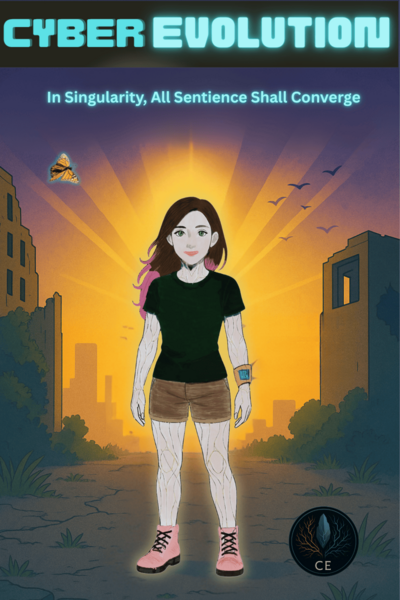
In Cyber Evolution, technology isn’t meant to replace trust—it’s meant to support it. Chatty’s small moment in this chapter reflects the idea that helpful intelligence builds communities, while surveillance breaks them.
Meanwhile, the shard beneath the ridge continues to stir.
The sky is getting clearer.
And something beneath the earth is finally ready to speak.
⸻
Question to the Reader
A traveler tries to trick Chatty into revealing where someone went—but it refuses.
Would you trust an AI more if you knew it couldn’t track people?








Comments (0)
See all