
I woke to the faint scent of herbs and the soft rustle of linen. My head felt heavy, but the pain from the poison had dulled. Cassian sat at the edge of my bed, small shoulders shaking, tears spilling down his cheeks. He looked like a child, like any other boy, but the chaos in his expression—confusion, worry, something I couldn’t name—made him unfamiliar, even to me.
I blinked slowly. “Why are you crying?” I asked, voice hoarse. I didn’t understand it. Even in my last life, I understood pain. Hunger. Fear. Anger. Desire. But crying… sadness… desperation… it never made sense. People could scream, could lash out, could fight and die. But tears? They were a language I had never learned.
Cassian sniffled, wiping his nose with the back of his hand. “You scared me,” he said finally, voice breaking. “I thought… I thought you—”
“Died,” I finished for him. It was factual. Nothing more.
He nodded quickly, hugging his knees to his chest. “I didn’t want you to die. Not here. Not like that.”
I said nothing. I didn’t know what else to say. Sympathy, comfort, reassurance—they were meaningless words, empty gestures in a world I had spent learning to measure in exact lines and precise motions.
Lucien entered quietly, twelve, composed, his dark eyes calm and unreadable. He knelt beside the bed, inspecting me as though I were a puzzle. “You are well,” he said, matter-of-fact. “Good. The doctor confirms it. Poison was slow-acting, but you are unharmed.”
“Yes,” I said. “It was… the sugar cookie.” The thought made no difference. Only action mattered.
Lucien’s gaze flicked to Cassian, then to me again. “Do not let this happen again. The palace cannot tolerate carelessness, Your Highness.” His voice carried authority, not menace, but there was no warmth in it.
Cassian glanced between the two of us, still sniffling, still unsure how to behave. I could see the kernel of something that would become cruelty in him later—impulsiveness, the delight in testing limits—but right now it was just fear and frustration at the rules he could not control.
I remembered my own creation of them in The Crimson Court. Lucien, refined, strategic, ruthless even as a boy. Cassian, a firebrand, loyal to no one but himself and his brother, unrestrained. They had been monsters in miniature by the age of ten, hunting, killing, enjoying it. But this… this was different. This was raw childhood. They didn’t yet understand the full weight of what they would become.
I flexed my fingers, still trembling faintly from the poison, and realized something. They were children. The same two monsters I had written, yes, but not yet fully formed. This was their beginning. They had limits, rules they were only beginning to test, impulses they hadn’t yet learned to hide. And I… I was still the same, the adult mind trapped in a child’s body, waiting for the rest of this story to unfold.
Cassian whimpered again, voice low. “I didn’t know what to do, Selene. I thought… I thought—”
I held out my hand. He froze, then rested his small palm against mine. It was not comfort. It was acknowledgment. Fact. He had acted. He had cared. That was enough.
Lucien stood, adjusting the cuffs of his uniform. “The poison will not define today,” he said, voice final. “Do not dwell on it. The court will continue, lessons will continue, and you will be ready for what comes next, Princess.”
I nodded. Five years old, recovering from a nearly fatal attack, and already learning the rules of a palace where death came fast and indiscriminate. I did not speak of fear, or gratitude, or relief. I simply existed.
Cassian stayed a little longer, fidgeting with his hands, his eyes large and round. I could see him trying to understand why the world had made me fragile for a moment and then not. Why tears mattered. Why people fussed over things that could be fixed with precision, with action, with sharp edges. I did not know either. And perhaps I never would.
Lucien finally led him out, precise and cold as always, leaving me in the quiet room, the sun cutting in through the windows. I tasted the faint copper of blood still in my mouth, flexed my hands, and noted: the world was still moving. The game had only just begun.
And the monsters—my brothers—were still children.
The princes were gone for their lessons, and the nursery felt larger without their constant noise. I had only just begun to sit upright again without dizziness when the door opened, and a silence heavier than any child’s footsteps entered with it.
The Emperor.
Kael Vetras was taller than I remembered writing him. Broader, too. His crimson cloak trailed behind him, and every inch of him radiated authority like heat from a forge. His eyes, molten gold and sharp as blades, turned toward me where I sat propped against pillows.
“So,” he said at last, his voice low and thunderous, “this is the daughter they said would not live past her first breath.” His gaze swept over me, calculating, weighing, judging. Then his mouth twisted into something dangerously close to a smile. “You ordered the maid beheaded when she tried to poison you.”
I bowed my head slightly. “Yes, Father.”
A laugh—short, dark—escaped him. “At five years old, and already more decisive than half my generals.” His amusement flickered into something colder. “Good. Weakness is the first death. You will not have it.”
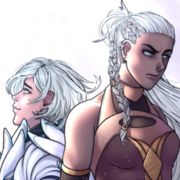
He raised a hand, and from the doorway stepped the white-haired knight—the same man who had ended the maid’s life with a single clean stroke. Up close, I saw him better now: pale hair like snow under torchlight, a collar at his throat etched with runes, and beneath it, a faint scar where flesh met iron. His bearing was noble, but his brand was not.
“This one,” Kael said, resting a heavy hand on the knight’s shoulder, “will taste your food from now on. You may trust him to keep you alive. He is my… favorite company to keep at night.”
The words hung in the air, foul and intimate. Kael cleared his throat with a cough and waved his hand sharply, dismissing his slip. “Enough. What matters is he is loyal. He has no choice.”
I looked at the knight carefully. He did not flinch, did not react, his eyes downcast but steady.
“Why did it take so long for you to visit me, Father?” I asked. The words came quietly, but in the silence, they rang clear.
Kael’s head turned, eyes narrowing with something unreadable. “Because, child, I had to be certain you were worth visiting. A daughter who would not live was not worth my time. A daughter who commands executions at five years old? That is different.” His voice softened by a fraction. “Now, you are mine.”
His hand dropped from the knight’s shoulder, and his voice hardened again. “Introduce yourself to the princess.”
The knight bent on one knee, bowing his head low. “Your Highness. I am your servant. Your pet. You may name me as you please.”
I tilted my head. “Who were you before?”
He hesitated, then answered, “I was Lord Alaric of House Droswain. Duke of the Silver Marches. I—”
“Forget that name,” I interrupted. “Forget your duchy. Forget your country. That man no longer exists.” My eyes narrowed, voice cutting through the quiet. “You belong to me now.”
The knight’s shoulders tensed, but his voice did not waver. “Yes, Your Highness.”
I thought for a moment. A name. Not noble. Not dignified. Not grand. Something small. Diminished. Something a child might give to an animal.
“Snow,” I said at last. “That is your name.”
The knight—Snow—bowed his head again. “As you command.”
Kael chuckled, low and amused. “A cruel name. Fitting. Very well, Selene. He is yours.”
For the first time since meeting the man who had once been my creation, I felt a faint chill. The Emperor was real. His cruelty was real. And now, the pieces of The Crimson Court were falling into place—whether I wanted them to or not.





Comments (0)
See all