
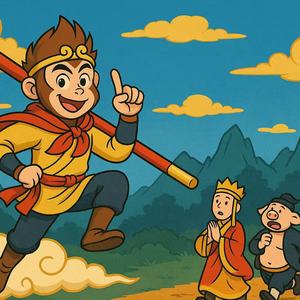
After being crowned the Handsome Monkey King, he really led the monkeys to live a very happy life. Spring meant picking flowers and tasting honey. Summer brought juicy peaches and watermelons. Autumn was all about chestnuts and acorns. And in winter, they dug up mountain yams and golden roots. Year after year, they ate well, slept soundly, and basically lived like gods. A few centuries passed in the blink of an eye.
One day, while throwing a fruit-wine party with his monkeys, the Handsome Monkey King suddenly choked on a sip. His eyes welled up with tears. The monkeys panicked and asked “Your Majesty, what’s wrong? Is the wine too strong?”
He sighed. “Think about it. We eat, we drink, we play. Life looks great now, sure. But what happens when we get old? When we get sick? Eventually, won’t Yama (King of Hell) drag us all away? What’s the point of a few hundred years if it all ends in death?”
That hit the whole monkey gang hard. Turns out, it’s not just humans who fear death, monkeys get existential crises too.
At that moment, a long-armed monkey with bright eyes stepped forward mysteriously and said, “Your Majesty, you finally got it. But death isn’t the only ending. Have you ever hear of Buddhas? Immortals? Deities? They aren’t under the jurisdiction of the Hell. They live longer than mountains, outlast the stars.”
The Handsome Monkey King’s eyes lit up. “Where can I find them? I want to learn from the best!”
The long-armed monkey pointed beyond the mountains. “Deep in the wilds, hidden valleys, and ancient forests. It’s not easy, but it’s not impossible.”
The next morning, the monkeys held a full-blown farewell party. They laid out wild fruits, mountain roots, sweet herbs—an entire stone table’s worth of forest delicacies. It was basically a retirement banquet, except instead of retiring, the Handsome Monkey King was off to chase eternal life.
After the feast, the Handsome Monkey King waved goodbye, stepped onto a bamboo raft loaded with snacks, and sailed off toward the human world. His destination was the Southern Continent. His mission was to find a master who could teach him the secret of immortality.
For days the southeast wind carried him across the ocean, until finally he reached shore. The human world was noisy, busy, and full of fishermen, bird-trappers, and salt peddlers. Compared with Mount Huaguo, it was even more lively.
Wukong couldn’t resist having a little fun. He jumped out, roared like a beast, scared a few people off, and stole a fisherman’s clothes. Dressed in human rags, he blended in surprisingly well. He started learning how to talk like people, greet like people, and behave like… well, a very hairy, slightly suspicious-looking man.
But even though he wandered the world for eight or nine years, all he saw were greedy merchants, power-hungry officials, and ordinary folks chasing fame and fortune. No immortals. No sages. Not even a wannabe wizard.
Out of options, he headed west across another ocean. Another bamboo raft, another stretch of open sea. He eventually landed in the mysterious land of the Eastern Continent.
This place was different. Wukong pushed into the forests and mountains, meeting wild beasts, snatching fruit from eagles, and searching high and low. Finally, deep in the mountains, he stumbled into a valley so serene it looked like a painting—green pines, bamboo groves, rare flowers, fresh air, and crystal-clear springs. The place smelled like immortality.
As he marveled at the view, a song drifted from the woods:
“Chopping wood and selling wine,
Laughing through life just fine.
No fame, no fight, no strife,
Just sitting and talking about the Dao…”
Wukong’s ears perked up. Those lyrics didn’t sound ordinary. “That has to be a clue!” he muttered, and followed the voice.
Soon, he saw a man—an old woodcutter in a straw hat and rough robes, sandals on his feet, carrying a load of firewood. He was humming as he chopped.
Wukong rushed forward and dropped to his knees. “Master Immortal! Please take me as your student!”
The old man jumped. “What? I’m just a woodcutter! No immortal here!”
“But you were just singing about ‘the Dao’ and ‘the Yellow Court Classic’—that’s Taoist stuff, right?”
The old man laughed. “Oh, that? I learned the song from the immortal next door. I’m no sage. I just sing it for fun when I get bored.”
Wukong’s jaw dropped. “You live next to a real immortal and you’ve never asked to be his student?”
The woodcutter sighed. “My family’s poor. I’ve got an elderly mother at home waiting for food. Who’s got time for enlightenment?”
Wukong nodded solemnly. “A filial son. Respect.”
He asked for directions. The old man pointed. “Keep going south along that trail for about seven or eight miles, you’ll find Mount Lingtai. Inside was a place called Cave of Slanting Moon and Three Stars. A great master named Master Bodhi lives there. He’s taken on many students. He might just take you too.”
Wukong was over the moon. He tried to convince the woodcutter to come with him, but the old man just chuckled. “You monkeys have no manners! I’ve got dinner to make!” And off he went, firewood bouncing on his shoulder.
So Wukong continued alone, climbing mountains, crossing rivers, and just as described, found himself in front of a fairyland cave residence—misty clouds, ancient trees, strange scents, and flocks of animals. It was like a real-life immortal utopia.
He was about to knock when he hesitated. Was that too rude? Instead, he climbed a nearby tree, munched on pine nuts, and waited.
Before long, the cave doors creaked open. Out stepped a young boy—clean robes, graceful air, glowing skin. This wasn’t your average forest kid. This was definitely a disciple of the Dao.
“Who’s making all that racket?” the boy called out.
Wukong jumped down and bowed deeply. “Immortal attendant, I’ve come seeking the Way. I meant no offense!”
The boy looked him up and down, then grinned. “So it is you! My master was mid-lecture when he suddenly said, ‘Go open the door. A seeker has arrived.’ I guess he meant you.”
Wukong beamed. “Yes! That’s me!”
He straightened his clothes, stood tall, and followed the boy inside.
The cave was otherworldly, ornate towers, flowing incense, tranquil silence. They passed through several grand halls until they reached the main temple.
There, seated high on a teaching platform, was Master Bodhi himself. He was serene, dignified, surrounded by over thirty young disciples, all standing respectfully.
Wukong wasted no time. He dropped to his knees and bowed hard, thumping his forehead to the floor. “Master! I’ve come to learn the great Way!”
Master Bodhi opened his eyes and spoke with a calm, deliberate voice. “Where are you from? What’s your name? First, introduce yourself; then we’ll talk about discipleship.”
Without missing a beat, Wukong replied, “I am from the Water Curtain Wave of Mount Huaguo which is in the Kingdom of Aolai of the Eastern Continent!”
As soon as the Monkey King finished introducing himself, Master Bodhi’s expression darkened.
“Nonsense!” he thundered. “Lies and foolishness! Toss him out! He’s not worthy of learning the Way!”
Startled, the Monkey King dropped to his knees and knocked his head on the ground. “Master, I swear it’s all true! Every word! Not a single lie!”
Master Bodhi raised an eyebrow. “You’re telling me you came from the Eastern Continent? That’s across two oceans and half the human world. And you just… showed up here?”
The monkey nodded furiously. “I built a raft out of bamboo and sailed across storms and waves. I’ve been seeking the Way for over ten years!”
Master Bodhi’s face softened. “Hmph. Not bad. Not bad at all.” Then he asked, “What’s your surname?”
The monkey scratched his head. “I don’t have one. People yell at me, I don’t get mad. Hit me, I don’t hit back. I just smile and move on. You could say I’ve got no temper—no fire in me.”
Master Bodhi chuckled. “I meant your family name, not your personality.”
“Oh,” said the monkey. “Well, I’ve got no parents. I was born from a stone. No surname to inherit.”
That got Master Bodhi’s attention. “From a stone?” he asked, intrigued.
“Yep!” said the monkey proudly. “A giant immortal rock on top of the Mount Huaguo. One day—pop!—split open, and out I came!”
Master Bodhi gave him a long look. This one’s no ordinary creature, he thought. He’s got potential.
“Walk a few steps,” he said.
The monkey bounced around with flair, leaping, skipping, and showing off like a natural acrobat.
Master Bodhi laughed. “You move like a squirrel hopped up on pine nuts. Let’s see… ‘squirrel’ in your tongue is húsūn, right? Take away the ‘beast’ radical and you get ‘gǔyuè’—ancient moon. But that sounds gloomy. We’ll tweak it. Let’s call you Sun. That’ll be your surname.”
The monkey lit up. “Sun! I love it! I have a surname now!”
“Now for your name,” Master Bodhi said. “In our sect, disciples follow a twelve-character lineage: Guang, Da, Zhi, Hui, Zhen, Ru, Xing, Hai, Ying, Wu, Yuan, Jue. You’re the tenth. You get ‘Wu’.”
The monkey leaned in, eyes gleaming. “What’s my full name then?”
Master Bodhi smiled. “Let’s go with Sun Wukong—‘Awakened to Emptiness’. Sound good?”
“Good? It’s amazing!” the monkey beamed. “From this day forth, I am Sun Wukong!”
Master Bodhi nodded, then called a disciple. “Show him the ropes. Teach him our customs and chores.”
And so, Sun Wukong settled in at the school. He trained with the other students, reciting scriptures, meditating, and doing plenty of grunt work: sweeping leaves, chopping wood, hauling water, you name it. Days blurred into years—six or seven of them, in fact.
Then one day, Master Bodhi ascended the lecture platform. All disciples gathered beneath the flowering trees. Lotus blossoms bloomed underfoot. The air shimmered with incense and magic. Master Bodhi spoke of the Dao, of truth, of peace, of transcendence. His voice rang like thunder, deep and hypnotic.
Wukong, seated cross-legged with the others, grew so excited he couldn’t sit still. Before he knew it, he was clapping, laughing, dancing in place.
“SUN WUKONG!” Master Bodhi snapped. “This is a lecture hall, not a monkey circus!”
Wukong stood up and bowed, grinning sheepishly. “Forgive me, Master. I just got a little carried away.”
Master Bodhi gave him a stern look, then asked, “How long have you been here?”
Wukong scratched his head. “Not sure. But I’ve eaten the ripe peaches on the tree behind the mountain seven times now.”
“Seven years, then,” Master Bodhi mused. “So tell me, what do you want to learn?”
“Whatever you’re willing to teach, Master,” said Wukong respectfully. “I’m just eager to learn something real.”
Master Bodhi nodded. “There are 360 paths in the Dao. Let’s see… Want to learn divination and fortune-telling?”
“Will it make me immortal?” Wukong asked.
“No.”
“Then nope.”
Master Bodhi tried again. “How about meditation, sutra study, healing arts?”
“Will that grant me eternal life?”
“Like a wooden beam inside a wall—seems solid, but it rots over time.”
“No thanks.”
“Stillness and purity? Fasting, silence, isolation?”
“Will I live forever?”
“Like a clay brick in the rain—it’ll crumble.”
“Next.”
“Alchemy? Herbal medicine? Body tuning?”
“Immortality?”
“Like the moon in water—pretty, but untouchable.”
Wukong crossed his arms. “Hard pass.”
Master Bodhi snapped. He leapt off the platform, snatched his teaching stick, and WHACK WHACK WHACK! thumped Wukong on the head.
“You hairy rascal! This one’s no good, that one’s not enough—what DO you want to learn?!”
Without another word, he stormed off behind the curtain and slammed the inner door shut.



Comments (0)
See all