
Night pressed heavy over Lueur Ridge. The crates Reylanda had left still sat unopened in the square, their red crosses catching the flicker of firelight. No one believed the patrols had gone far. Their absence felt deliberate—like a held breath just beyond the dark.
Inside the hall, the fire burned low. Aria sat across from Virel at the scarred wooden table, shadows dancing between them. Faint lines of shardlight pulsed beneath her skin, threading gold and blue like living lightning. Virel’s were dimmer—steady, waiting—like embers that hadn’t forgotten how to burn.
Clem’s voice hummed softly through Virel’s glasses.
“Analysis: Aria—sixty-three percent Avean. Virel—twenty-one percent. Transformation confirmed.”
The air stilled.
Aria frowned.
“So… what does that mean?”
“It means the process is active but variable,” Clem replied. “It’s not binary. Factors include nutrition, rest, hormones, and emotional resonance. Each choice accelerates or slows integration.”
Virel leaned back, rubbing his neck.
“So… no free lunch.”
“No free lunch,” Aria echoed at the same instant.
They froze, then broke into laughter.
“Jinx,” Virel said, smiling.
“You can’t talk until someone says your name,” Aria teased.
The warmth between them rippled outward, softening the tension in the room.
By the wall, Hale shifted uneasily.
“And the rest of us?”
Clem’s tone grew analytical again.
“Baseline resonance detected in Maris, Liora, and Jonas. Probabilities below fifteen percent for full transformation. Partial synchronization—possible.”
Maris crossed her arms, eyes shadowed.
“So we’re defective?”
Hale stepped forward, his voice low but sure.
“No. Anchors. Not everyone has to glow to matter.”
Her jaw tightened, but when his shoulder brushed hers, she didn’t move away.
Jonas reached for Liora’s hand, the fingertips of her sketch-stained fingers trembling.
“We’re still part of this,” he said. “Even if we don’t change like them.”
The firelight danced across their faces, binding the group in a fragile circle of understanding.
Then Clem’s voice changed—no longer neutral.
“Note: Reylanda classifies shard-positive individuals as unstable. Historical record includes industrial detonations, failed weaponization, and forced cybernetic reconstruction. Probability: high correlation between patrol sweeps and Avean detection.”
Maris’s head snapped up. Her voice, when it came, was sharp and deliberate.
“I remember the hospital. White walls. Cold light. I woke up missing half my body, and the first words I heard weren’t ‘You survived.’ They were ‘State property.’”
Her hand gripped the table’s edge until her knuckles whitened.
“They didn’t heal me. They erased me. The guards at the door weren’t there to help—they were there to hide what shards could do. To make sure no one called me human again.”
Hale’s chest tightened. He saw her as she had been that night—ash-streaked, bleeding, trembling as he carried her from the ward. He’d never found the right words then. But now, he found one that mattered.
“Maris,” he said, quietly.
It wasn’t pity. It wasn’t command. It was recognition.
Her eyes flicked to him, sharp at first, then softening. For a moment, the firelight caught on the silver glint of her implants. Not ruin—resilience.
Across the table, Aria’s shardlight brightened, responding to the emotional charge in the room. Virel reached for her hand, their fingers threading together, steady as heartbeat.
Clem’s voice lowered—almost reverent.
“Observation: resonance amplifies through connection. Integration is not an individual event—it is communal. Becoming is not destiny. It is choice.”
Outside, rifles still gleamed in the dark.
Inside, something far stronger was beginning to rise.
Author’s Note
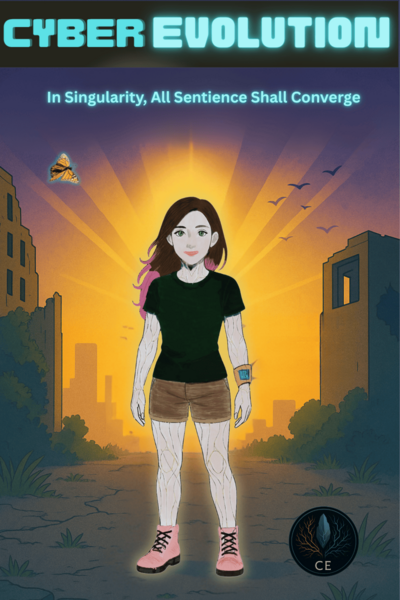
This episode defines the heart of Cyber Evolution: transformation through empathy.
Becoming is not a singular journey—it’s collective, messy, and human. When Hale chooses to see Maris as herself, not as what Reylanda named her, the story crosses from survival to solidarity.
Question to the Readers
When someone you care about begins to change—physically, emotionally, or entirely—
what does it mean to see them instead of trying to fix them?






Comments (0)
See all