
When the last of the Hollow Kings had been devoured, their crowns cracked and scattered like shells upon a barren shore. The skies hung bruised and low, heavy with the memory of radiance, yet void of its warmth. Across the desecrated plains, light and shadow warred without purpose—no victors, no witnesses, only the echo of what had once been divine.
In that wasteland where creation wept itself empty, something small began to stir.
It was not born as the Fragments were—no blaze, no trumpet, no celestial storm. It came quietly, as though the world itself had sighed and, in doing so, exhaled a soul. A pulse beat once within the dust, faint as the heart of a sleeping ember. From that pulse, a figure began to take shape: neither god nor man, neither radiant nor blighted.
The first of the Nameless Children.
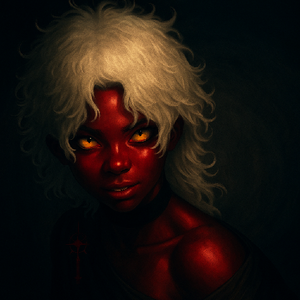
He was born without memory, his flesh pale as clay, his eyes reflecting both sun and abyss. Around him, the air shimmered, confused as to what he was. The rivers bent toward him, yet recoiled when they tasted his breath. Beasts watched from afar, uncertain whether to kneel or flee. Even the fractured heavens paused, their tears of light suspended mid-fall.
For within him stirred the first harmony between creation and undoing—the quiet equilibrium that neither heaven nor hell had desired, but both had made inevitable.
The Nameless Child wandered. He did not hunger, yet he felt the pangs of those who did. He did not weep, yet tears fell when he saw ruins steeped in prayers unanswered. He followed the trails of the fallen Fragments, guided not by sight but by instinct—a pull buried deep in the marrow of the world.
He came first to the plains of iron, where the Bearer of the Furnace had burned himself into eternity. The ground still smoldered, black glass hissing beneath his steps. Amid the molten bones, he found the hammer that had once forged suns. When he touched it, visions erupted behind his eyes—armies aflame, heavens sundered, light devouring itself.
He dropped the hammer, but the memory clung to him, branding his palm with a faint sigil of red-gold light. The world around him groaned, and the dead metal began to breathe again. He felt the furnace awaken inside his chest—not wrath, but the echo of it, tamed by sorrow.
In the north, he found the forest of bone, where the Beast-Bound Wanderer had perished. The trees still whispered in hunger. The Nameless Child laid his hand upon the nearest trunk, and it split open, bleeding white dust. From within spilled a skeleton of a beast, half-grown, stillborn.
He fell to his knees, understanding without words that the forest was alive, yet yearning for death. He whispered a single breath—a mercy. The ivory leaves quivered, and the trees began to crumble, releasing the trapped spirits within. Their gratitude shimmered like snow before fading into the wind.
From that act, a second sigil marked him—ivory, faintly luminescent, curling like roots upon his forearm.
He traveled on.
In the south, he found the temples of chains, still swaying though their priests were dust. The air reeked of incense and blood. The Nameless Child ascended the cracked altar, where shackles of silver still writhed, seeking wrists to claim.
They lunged for him.
He did not resist. Instead, he let them coil about his arms and throat. Their weight crushed him to the floor; their whisper burned in his mind. They spoke of freedom through obedience, of redemption through servitude. He wept—not for himself, but for the countless souls who had believed the same.
Then, with quiet strength, he broke the chains—not through might, but through stillness. They shattered like glass, leaving the air trembling with disbelief. In their ruins bloomed the third sigil, faint as smoke—black upon his throat, shaped like an open lock.
Westward, he journeyed into the desert of thunder, where the Hunter of the Silent Plains had vanished. There, half-buried in sand, lay the weapon that had once devoured souls. The Nameless Child reached for it, and the storm awoke.
Lightning struck his flesh, searing, flaying. The weapon screamed in his hand—hungry, remembering every life it had ended. It demanded purpose. It demanded blood.
He did not feed it. He pressed it to the earth, and with a single breath, silenced its fury. The dunes swallowed it whole.
The storm ceased.
A fourth sigil appeared upon his chest—ashen, jagged, shaped like a crescent moon.
At last, he came east, to the City of Glass, where the Child of Fractured Light had been entombed. The crystal spires still shimmered faintly, though all within had turned to salt. He entered the great cathedral and found the final fragment’s ribcage upon the altar, hollow, glowing from within with a dim and sorrowful light.
He knelt, touched it gently.
The glow brightened, spilling across the cathedral floor like dawn breaking through a wound. For a moment, the entire city seemed to breathe again—music without sound, prayer without voice. And in that breath, the Nameless Child saw everything: the rise and fall of gods, the betrayal of light, the corruption beneath holiness, the endless wheel of creation devouring its own tail.
He understood then that Radiance was not salvation. It was hunger disguised as purpose.
As the light consumed the glass city, he walked out unburned. Upon his brow shone the final sigil—a faint aureole of silver flame, neither divine nor profane.
Five marks. Five burdens. Five memories.
And when the light faded, the world was still.
In the heavens, the Trifold Radiance flickered, uncertain. In the abyss, the Blighted Crucible stirred, curious. For in this fragile being, both forces saw their reflection—and their undoing.
The Nameless Child looked to the horizon, where the first dawn in centuries began to rise—a light tinged not with gold, but with shadow.
And he smiled.
For balance had been born.





Comments (0)
See all