
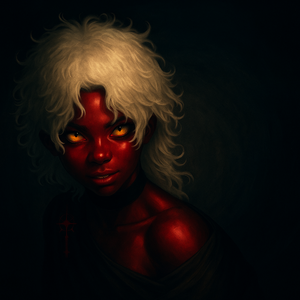
There came upon the waking earth a man without mercy, whose wrath was older than mountains and whose silence was older still. None knew his name, for he had forgotten it long ago—perhaps when the first temple fell, perhaps when his blood first sizzled upon molten stone. The world called him many things: Slayer, Warden, Executioner. Yet beneath all these masks burned the same truth—he was a fragment of Radiance that had turned to fire.
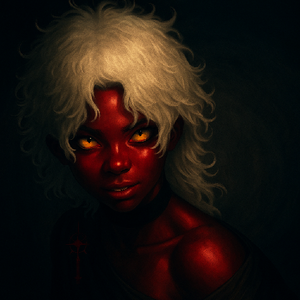
He walked where infernos lingered, and Hell itself recoiled. He had no faith, no hope, no voice, yet the sound of his breath was like the thunder of gods locked in combat. When the skies tore open and things with too many mouths poured from the wounds of creation, the Crimson Warden did not pray. He loaded his weapon with the marrow of demons and tore through them as one might reap wheat.
He had once been human, or something near enough. Once, he had loved. There had been a tower—high, white, and filled with hymns. There had been a woman who sang by candlelight, whose eyes reflected dawn. But she was gone now, devoured by that same Radiance he once served. Her light had burned too fiercely, and he—unable to endure her purity—had drawn his blade against heaven itself.
Thus, he became wrath made flesh.
He moved across the broken lands, through citadels long turned to ash, through cathedrals where angels lay impaled upon their own spears. His armor was etched in the sigils of forgotten crusades. His hands were blackened by celestial blood. Wherever he went, the soil curdled and the air split, for the heavens feared his return as much as Hell feared his judgment.
When he slept—which was rare—he dreamt of the Choir of the First Dawn, of the day when all creation sang as one. But even that song now screamed in his skull, warped into something monstrous. The Radiance within him still flickered, but it was twisted, bruised, tainted by vengeance. It spoke to him sometimes, in a voice that was both tender and cruel:
> “You were made to protect the flame, not to burn it.”
And he would answer, through blood and steel:
> “Then why did the flame consume all I loved?”
In his heart, the fragment yearned for wholeness—but he could not bear what that meant. To be whole was to forgive. To forgive was to relinquish rage. And without rage, he was nothing.
So he fought on, deeper into the heart of ruin, seeking the Abyss where gods were unmade. There, he would carve open the womb of damnation and strike at its source.
When he found it, it was not what he expected. There, beneath the world’s crust, was a vast mirror of blackened glass—so wide it caught the reflection of eternity. Upon its surface were carved ten thousand faces, each one screaming, each one wearing his own. He struck it with his blade, but the blade shattered. He struck it with his fists, and his armor cracked. He struck it with his will, and his soul splintered further.
From within that mirror, something laughed—a sound like the sigh of dying stars. It was the echo of Radiance itself, mocking its wayward son.
And as he fell to his knees, covered in his own fire, the Crimson Warden realized the truth he could never bear to name:
He was not meant to destroy Hell.
He was meant to guard it.
The flames rose around him, folding like wings. His eyes—once human—became twin suns of vengeance, forever watching the gates. And thus, the Warden became his own prison, his fury eternal, his soul a torch for a paradise long lost.
In the chronicles of the unseen, the scribes wrote that the second fragment failed—not from weakness, but from strength untempered by sorrow.
Where Radiance demanded harmony, he offered only noise.
Where the divine sought mercy, he gave ruin.
And the heavens mourned him not, for they feared what he had become:
A god without worship, a flame without end.






Comments (0)
See all