
He was born not in light, but in its aftermath.
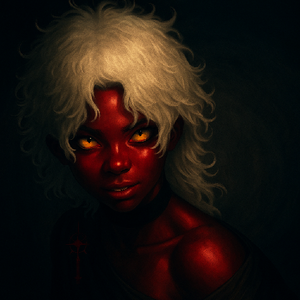
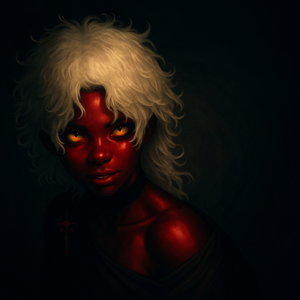
Where the heavens once sang, he crawled from the silence that followed, soaked in the blood of those who had mistaken divinity for authority. He bore the mark of chains upon his wrists—chains that no longer bound his flesh, but haunted the memory of it. His eyes were pale storms, his breath heavy with the ghosts of slaughtered gods.
They said he had once been a soldier in the armies of dawn—a protector, a guardian of the first fires. But he had turned his blade upon his masters when he saw what the light demanded: sacrifice upon sacrifice, obedience without understanding. So he rose against the throne and tore it down with mortal hands, his rebellion echoing across eternity.
In his rage, he consumed their power.
In his grief, he devoured their silence.
And so was born the third fragment of Radiance—the one who feasted upon the divine.
The world remembers him as the God-Eater, though no scripture dares to speak his true name. His every breath was war. His every step, the collapse of another faith. He carried a weapon forged from the ribs of a slain titan, and with it he broke the chains of heaven and hell alike.
But victory is its own prison.
For every god he slew, a shadow of that god took root within him. Their voices—cold, divine, and venomous—nestled into his veins, whispering their guilt, their desire, their hunger. He had sought to free himself from the tyranny of Radiance, yet now he bore its echoes within his own heart.
He wandered the ash plains for ages uncounted, followed by specters that bore his face. They called to him from the edges of memory: the wife he had loved and slain, the child he could not save, the brother he betrayed. They were not ghosts of the dead, but reflections of the living Radiance he had severed. Each pleaded for him to remember what he once was—a guardian, not a butcher.
But remembrance was agony.
And so he walked on, blade dragging through the bones of the earth, his shadow long and red.
One day, he came upon a temple that still stood amidst ruin—a temple of mirrors, ancient and cold. Its doors whispered open as he approached, and within, the air smelled of rain that had never fallen. Upon the altar stood no idol, no scripture, no offering—only a child carved from crystal, its eyes closed, its heart flickering faintly with Radiance.
He knelt before it, unsure why.
Perhaps to destroy it.
Perhaps to worship it.
The child spoke—not in words, but in a tremor that passed through the marrow of all creation.
> “You who have slain the gods… why do you still hunger?”
He answered not with voice, but with sorrow.
He had never wanted their power, only their peace. But the gods had left him no peace, only blood.
The child’s crystal heart shattered, and from its fragments came a light that touched him—not as fire, but as forgiveness. And that, he could not endure. For forgiveness demanded surrender, and surrender meant facing all that he had broken.
He raised his weapon high and brought it down upon the altar. The light screamed. The temple collapsed. And the world trembled with him.
When the dust settled, he was gone. Only his blade remained, buried in the stone, humming with the faint, unbearable sound of weeping Radiance.
The heavens wrote his failure in silence. The earth remembered his footsteps as wounds.
He was not damned—he was forgotten.
And that, perhaps, was the cruelest mercy of all.
For the third fragment’s sin was not rage, nor pride, but grief so vast it devoured even the gods themselves.
He had become what Radiance feared most—
The proof that holiness could die.






Comments (0)
See all