
In the age when memory still bled and the heavens had not yet turned to stone, there was born a child who carried no cry, no sound, no word. The midwives feared him, for he was too quiet even in pain. His mother wept, thinking him stillborn, until his eyes opened—eyes that mirrored the dawn, not in warmth, but in clarity so sharp it cut the soul that met it.
He would grow to be known only as the Silent One. No name followed him, for names are the shackles of destiny, and destiny had already marked him. The bards called him hero, though he never claimed the title. He was born into prophecy—the kind carved in the marrow of dying gods, promising that one day a wordless soul would rise to mend the world’s fracture.
Yet the prophecy lied.
He was raised among ruins—villages swallowed by roots, temples turned to hollow bones. Wherever he walked, the ghosts of Radiance lingered, whispering half-truths, songs that bled with longing. They told him he was chosen, and he believed them, because silence breeds obedience. With a wooden blade and a heart too kind for war, he began the path they set before him.
He slew beasts of blight and darkness, each kill a prayer to a god he could not hear. He freed kingdoms drowned in twilight, lifted curses that had forgotten their origin. He carried light into every hollow, and for a time, the world remembered hope.
But Radiance is not mercy—it is hunger disguised as purpose.
With each victory, he felt his voice dying further inside him. The light praised him, but its praise was poison. For every monster he struck down, a fragment of his own soul was bound to the blade. And the blade grew heavier—not in weight, but in sorrow. Its hum turned from harmony to mourning. Its glow dimmed from gold to ash.
He tried once to speak—to tell the heavens that he was tired, that he wished to rest, to be free of his endless return. But no sound came. The light had stolen his voice, sealing it as tribute. His silence was its covenant.
And so, when the gods called again—when the Radiant war banners rose for yet another age of slaughter—he obeyed. Because that was what heroes did. They obeyed.
He fought across centuries, dying and returning, his body reborn from the remnants of old legends. Each incarnation wore a different face, yet the same sorrow. The same silence. The same hunger for release.
Until, at last, he found her.
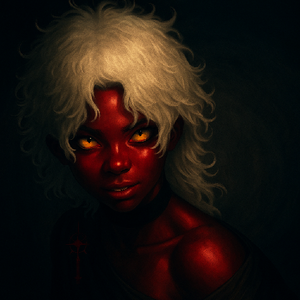
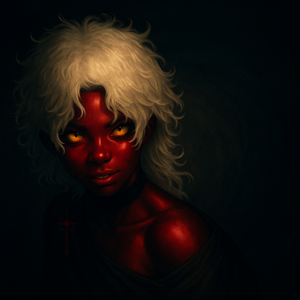
In the depths of a shattered sanctuary, beneath roots older than the sun, he met a woman carved of dusk and dawn, her hair woven with shadows, her eyes like the last breath of evening. She called him by a name he did not remember. She said, “You’ve come home.”
And something in him broke.
He dropped the sword. It screamed as it hit the ground, as though the world itself protested his refusal. But he turned away. He took her hand. For the first time in a thousand lives, he chose something not written in Radiance.
That choice shattered everything.
The sky turned black. The rivers bled backward. The gods howled, for prophecy had failed—and in its failure, the world began to remember freedom.
The Silent One and the woman of dusk vanished together into the unlight. No grave marks their resting place. Only a ruin remains, and a sword buried to the hilt in the heart of the world, still humming with the memory of a voice it never heard.
Sometimes, when the wind passes over that desolate plain, it carries with it a whisper—not sound, but intent.
> “Not all silence is peace.”
And so ended the fifth fragment of Radiance—the hero who saved the world so many times he forgot why it needed saving.
The one whose silence outlasted the gods.




Comments (0)
See all