
The sixth fragment came not from heaven nor from the forge of war, but from the quiet rot beneath creation—the mold that creeps under holy altars, the laughter that festers in empty tombs.
He was once a man of ordinary blood, born among the innocent, dreaming of simple things: warmth, love, shelter from the storm. Yet Radiance, ever cruel, hungers most for those who wish for peace. And so it found him.
It began with a whisper in the wood.
A murmur beneath the floorboards of his home, where the dead had forgotten to stay dead. At first, he thought it madness—the wind’s joke, the rustling of time itself. But then the laughter came. Not human, not divine—something in between, something mocking.
He found the book buried beneath the roots of an ancient tree, its pages inked in something that shimmered like oil and blood. It called itself scripture, but its words were alive—each syllable a serpent, each verse a wound. He did not mean to read it, but the pages begged, and he was weak.
And when he spoke the first word aloud, the world listened.
The air split. The ground opened. The sky bled. And in that moment, the Forsaken Son learned that there are prayers which summon not salvation, but hunger.
The dead awoke. His wife, his friends, his neighbors—all rose with smiles too wide, eyes too bright, their laughter filled with radiant decay. They called his name in unison, a choir of blasphemy, and he ran. He fled into the woods, carrying with him the cursed text, as though by running he could outrun the echo of what he had become.
Days turned to years. His hands grew calloused, his face hollow. He learned to kill the dead, to burn them before their laughter reached him. But they always returned. They always knew his name.
Each kill took a piece of him.
Each scream became a hymn in his honor.
The Radiance, long fractured, watched through the veil, curious—perhaps even envious—of this mortal who could command such horror with mere words. It whispered to him in dreams: You are my reflection. My forgotten hand. My laughter given flesh.
But he would not kneel. Not even to light.
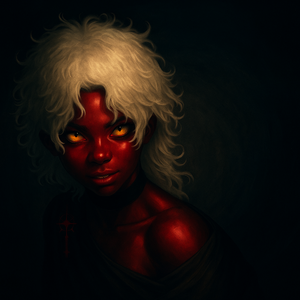
He tore out his own eye when it began to glow, cut off his own hand when it tried to strangle him. He replaced it with a weapon—a symbol of his rebellion, forged from steel and rage. With it, he slaughtered the corrupted dead by the thousands, screaming through tears and madness.
And in that endless war between man and the remnants of his own sin, he found clarity.
He was not fighting to save the world.
He was fighting to keep it from remembering him.
Because memory was contagion, and Radiance was watching.
In the end, when his strength waned and the cursed woods grew silent, he sat beside the last fire and looked upon the book one final time. Its cover breathed, waiting. It whispered sweetly, as if it loved him.
> “Read again. Become whole.”
He smiled—a broken thing—and threw it into the fire. The book screamed as it burned, and the forest screamed with it. The stars dimmed, and the laughter died.
The Forsaken Son closed his eyes, his body sinking into the ash. His weapon lay across his lap, still humming faintly with defiance. And when the dawn rose, it found no man—only a shadow burned into the ground, shaped like one who had fought the light and the dark and called neither master.
They say his ghost still walks the dead forests, forever laughing, forever hunting what cannot die.
Some call him cursed.
Others call him saint.
But the Radiance remembers him differently—
as the mortal who burned its reflection,
and made even the divine afraid to laugh.




Comments (0)
See all