
Before the world had shape, before Radiance split itself into mercy and madness, there was a scream that lasted a thousand eternities. From that scream came war, and from war came him—the Doomwalker, the seventh and most terrible fragment of Radiance.
He did not fall.
He was cast.
Once, he had been a protector—a sentinel wrought from the purest flame, carved by the gods to stand between light and corruption. He was the blade’s will, the fury of righteousness given form. But Radiance, in its infinite cruelty, demanded obedience without question, purity without thought. And when he saw what his creators had done—when he saw how they burned children to feed their wars of holiness—he turned his wrath upon heaven itself.
The heavens called it heresy.
He called it justice.
For his defiance, they bound him in chains of prayer and hurled him into the depths of Sheol, where the first demons were still being born from the screams of angels. There, they believed his fury would fade, devoured by despair.
But fury does not die. It ferments.
A thousand ages he lay entombed, listening to the gnawing of the damned. His armor rusted, his flesh withered, his soul burned. Yet his hatred remained—steady, pure, undiminished. It grew until even the walls of hell began to quake, until the demons that crawled upon his prison began to whisper his name in fear.
And then he rose.
When his eyes opened, hell itself flinched. The chains that held him melted. The ground beneath him cracked. And as he stood, the abyss that birthed him became his weapon. The first to die was the jailer—a creature of bone and prayer, whose skull he crushed until light poured from its mouth.
From that moment, he waged war upon damnation.
He did not fight for redemption, nor vengeance, nor love. He fought because the cosmos had committed the greatest sin: it had learned to tolerate evil.
He tore through the fortresses of hell as if through memory. His fists shattered the altars of fallen seraphs, his boots trampled their relics into dust. The rivers of flame turned black behind him. The demons cried out to Radiance for salvation, but Radiance had abandoned them long ago.
He became legend.
Then myth.
Then silence.
For where he walked, even words fled.
At last, he reached the throne of the Infernal King—the first of the Blighted, the father of decay. The king rose to meet him, wrapped in wings of dying suns. Their battle was not fought in time, but in eternity. Every strike rewrote creation; every wound birthed another world. When it ended, there was no victor—only ruin.
The king’s body lay broken across the horizon. The Doomwalker stood above him, his armor cracked, his blood mingled with the ashes of gods. And when Radiance dared to whisper into the void—“Are you content now, my wrathful son?”—he answered not with prayer, but with silence.
Then, in that stillness, he knelt.
He reached into the corpse of the Infernal King and tore free its heart—a black star burning with the light of a fallen heaven. He looked upon it, not in hate, but in pity. For he understood now: Radiance and Rot were the same. Two mirrors facing each other, reflecting eternity’s cruelty.
So he did the only merciful thing left. He crushed the heart between his hands.
The explosion was the sound of godhood dying.
It was also the sound of creation reborn.
When the fires dimmed, nothing remained but his armor—empty, hollow, still standing. And the wind that passed through its helm carried a single echo, a vow that both hell and heaven still fear to this day:
> “There shall be no throne, no god, no Radiance—only justice.”
The Doomwalker was gone.
Yet in the ruins of his war, the cosmos began to tremble anew.
For when wrath becomes holy, even paradise can burn.
Chapter Eight — The Pale Seer
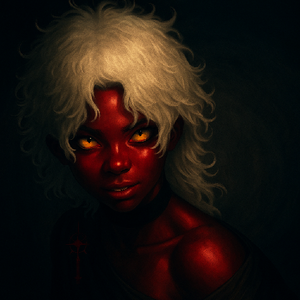
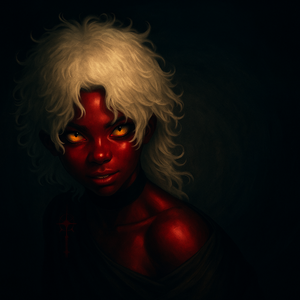
There was once a woman born without color—her hair as white as salt, her eyes the pale hue of old frost. They called her The Pale Seer, the Eighth Fragment, the Whisper Between Dawn and Dusk. Her birth was heralded by silence; not the peaceful kind, but the hollow quiet that follows a god’s last breath.
She was not strong, nor fierce, nor radiant. Her body was frail, her lungs weak. Yet when she opened her mouth to speak, the world paused to listen. For her words were not words—they were remembrances. When she spoke, stones remembered they had once been mountains, rivers remembered the first tear that carved them, and even death remembered it was only sleep.
Her gift was not foresight but recollection—she did not see what will be, but what has already been forgotten. And in those memories she saw everything: the rise of Radiance, the corruption of Sheol, the forging of light from agony. She saw the birth of the other fragments—the wanderers, the slayers, the martyrs—all doomed to fall before their time.
And she wept.
For she understood what none of the others did: that Radiance was dying. Not destroyed, not overthrown—but decaying, piece by piece, consumed by its own perfection. The light had become self-devouring, and soon, it would turn upon all things.
She tried to warn the heavens. She wrote her prophecies in blood upon their altars, whispered her visions into the dreams of saints. But Radiance does not listen to those who tremble. It branded her voice as blasphemy and cast her from the spires of paradise, her body shattering upon the roots of the world.
Yet death did not claim her. For truth cannot die—it can only go unheard.
She crawled from the wreckage, her spine twisted, her bones glowing faintly with inner light. In her blindness, she saw further than ever before. She walked among mortals, wrapped in tattered robes, speaking only in riddles. They feared her, yet they followed her, drawn by the cadence of her sorrow. To some, she was a prophet; to others, a plague.
She foretold the fall of the heavens, the burning of oceans, the war of gods and fragments alike. She spoke of a coming balance—a vessel of both ruin and Radiance, born of suffering and silence, who would either end the cycle or become its final echo.
When asked if that savior would bring peace, she laughed.
It was not a cruel laugh.
It was the laugh of one who has seen the end and knows it will hurt.
> “Peace is not a gift,” she said. “It is the silence left when all songs are spent.”
Her followers built temples in her name. They painted her likeness on ivory walls, adorned her effigy with chains of glass. Yet none understood the message hidden beneath her mourning—that the divine itself was only a story, and stories are meant to end.
On the day her final vision came, she stood upon a cliff of obsidian and looked out over a sea of corpses. The wind carried whispers of the past, all of them her own. Her eyes, once blind, began to glow with impossible light.
She saw the fragments burning one by one—the warrior consumed by his own hatred, the silent hero breaking prophecy, the forsaken son laughing in fire, the doomwalker unmaking creation. And beyond them all, she saw something else—something neither Radiant nor Blighted, but whole.
A being born not of perfection, but of contradiction.
She smiled through her tears. “At last,” she whispered, “the wound has learned to heal itself.”
Then her body shattered into a thousand shards of glass, each carrying a piece of her memory into the future. Those shards fell into oceans, deserts, forests, and dreams. Some became relics, others became voices. But all of them waited—for the balance she had seen, the one she could never name.
The heavens wept that night. The stars dimmed in mourning. For they knew her prophecy would come to pass.
And from that silence, from that stillness between breaths, the world began to tremble again.







Comments (0)
See all