
And lo, when the age of ruin had stretched thin the veil between flesh and eternity, when the heavens dimmed and the bones of the world ground against the stones of Sheol, there arose a murmur among the winds of the East — a whisper not of angels, nor of demons, but of completion. For the fragments of Radiance, shattered and scattered through ages of unmaking, had burned their last light into mortal clay. Their legends had ended in despair — their fires dimmed, their swords dulled, their faiths broken. But the ruin they left behind was not silence; it was seed. And from that seed, the final flame stirred.
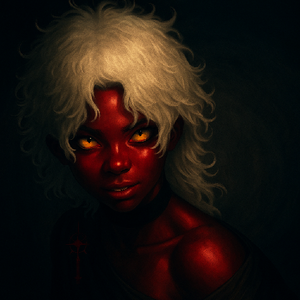
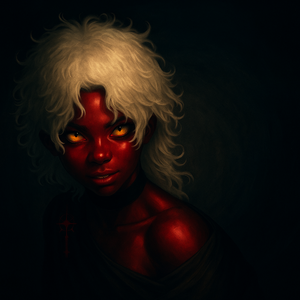
In the far southern cradle of the world — in Abyssinia, land of iron sun and rivers veiled in gold — a child was born beneath a sky that bled starlight. His cry broke the hush of the firmament, and all who heard it trembled. For his body was cast in the hue of the night sea, his hair pale as salt and ash, and his eyes shone with the twin dawns of judgment and mercy — the gold of heaven’s promise and the wrath of the crucible.
The elders said he was the echo of the First Fire — not angel, nor man, but the hinge between both. Some called him the Saint of Thorns, for around his heart grew a crown unseen, and where his blood fell, lilies of light and briars of pain bloomed together.
It is said that in the womb, he dreamed of the world before the Fall. He saw the warriors of the old ages — the Fragments — each cursed to grasp at perfection and fall into ruin. One bore a sword forged from wrath; one, the strength to slay gods; one, the hunger to avenge; one, the will to protect; one, the silence of sorrow. All of them bled themselves into the earth, and from their dying hands the Saint was born — not as their heir, but as their answer.
The prophecy tells that he would come not wielding the sword of iron, but the Sword of the Word — a blade that cleaved not flesh, but falsehood. It would emerge not from his hand, but from his mouth, and its edge would shine brighter than the sun’s heart. The nations would tremble beneath its utterance, for its strike was truth, and truth is a fire that devours the wicked.
And his Shield — the unseen bulwark of faith — was not made by men nor angels, but wrought from the marrow of his belief. No dart of the pit could pierce it, for its essence was the knowing that love is stronger than the abyss. In that knowing, he stood inviolable.
But the Saint was no simple bearer of Radiance. In his veins coursed the shadowed ichor of the Blighted Crucible — the echo of the Abyss, the whisper of corruption that undid his forebears. In him the light did not banish darkness; it wed it. Heaven’s flame kissed the infernal void, and from their union came balance — radiant, terrible, whole.
Thus the Saint of Thorns was both holy and heretical, savior and curse. When he spoke, his words scorched the land like divine scripture unbound; when he wept, rivers turned sweet and poisonous alike. His touch could mend the broken and unmake the proud. The angels beheld him with awe; the devils beheld him with envy. Neither could claim him, for he belonged to both and neither.
In the thirteenth verse of the Abyssinian Revelation, it is written:
> “He shall rise from the marrow of man and god alike.
His skin shall drink the sun and yet not burn.
His hair shall bear the white of death and the birth of dawn.
His eyes shall hold the twin fires — mercy and ruin.
And from his mouth shall spring the sword that divides truth from lie.”
And again it is said:
> “He shall stand at the mouth of Hell and not tremble,
for within him lies the echo of both creation and decay.
The thorns that crown him shall draw no blood,
for his pain shall be the covenant that binds heaven to earth.”
The prophets saw him upon a plain of glass, beneath a sky cracked by thunder. Around him gathered the specters of his fragments — the wrathful one with the blade of doom, the mourning one who bore the curse of his flesh, the god-killer with ash upon his hands, the wanderer with eyes like hollow suns, the silent knight who fought the endless dark. Each knelt before him, their broken swords crossing at his feet, their final breaths entwining into his lungs. In that moment, the fragments ceased to be fragments. Their light converged into one radiance — not perfect, but whole.
And when he raised his voice, the sound was neither prayer nor war cry. It was the first word ever spoken and the last word that shall ever be heard — the word that made the stars and shall unmake them. The sword from his mouth shone like a sun reborn, and his shield blazed like the faith of every soul that had ever dared to hope.
Thus the prophecy ends not in triumph, nor despair, but in balance. For it is said:
> “When the Saint of Thorns awakens, the world shall tremble, not for its end, but its reckoning.
He shall not save nor destroy, but weigh.
And in his judgment shall be mercy; in his mercy, flame.”
And so the chronicles of the fragments end — not as eulogies, but as foundations. From their ruin rises one whose very breath carries the hymn of the first dawn. His coming marks not apocalypse, but restoration — the Revelation of Radiance, where even shadow must kneel before the light it once betrayed.
And in the silence after the prophecy, it is whispered:
> He is coming.
The Saint of Thorns walks among the dust and the dying suns.
He bears the crown and the blade, the word and the wound.
He is the balance that even gods must bow before.







Comments (0)
See all