
I don’t remember the first piece I ever composed. My mother swears it was nothing more than noise, a child hammering at keys until the neighbors begged for silence. But I remember the first piece that mattered.
It wasn’t written for a stage. Not for recognition, not for my name to be printed on a program. It wasn’t even meant for an audience.
It was written because I met Kaoru.
---
The first time I saw him, he wasn’t dazzling. He wasn’t the loudest in the room, wasn’t someone who commanded attention with charm or words. No—he was quiet, almost trying to fold himself into the corner by his own painting. His shoulders drawn in, his eyes downcast, as if the canvas in front of him could shield him from the world.
People walked past. Their eyes skimmed his work and then moved on, searching for something brighter, louder, easier. I almost did the same. Almost.
But then—something pulled me back.
His canvas stopped me. It wasn’t shouting, it wasn’t brilliant in the obvious way. It breathed. It carried silence in the way music carries sound. It wasn’t absence, it was weight. An ache pressed into every brushstroke, like something unspoken waiting for someone brave enough to hear it.
And when I finally looked at him—really looked—I thought:
If silence could take shape, it would look like him.
That was the first time I wanted to write for someone, not just something.
---
He wasn’t easy. Kaoru never made things easy. He had walls built from years of doubt, years of being overlooked, of losing pieces of himself and pretending it didn’t hurt. He bristled at my chatter. He rolled his eyes when I insisted on sticking around.
But he didn’t push me away. Not completely.
He let me sit there. Let me play while he sketched. Let my noise fill the air while his silence painted it. We were two contradictions—line and melody, brush and piano. At first, I thought I was teaching him to open up. I thought I was the one bringing light. But the truth is… he changed me.
He taught me that silence is music, too. That the rests matter as much as the notes. That sometimes the things unsaid—the pauses, the gaps—speak louder than sound ever could.
---
The night he told me he was losing his vision, I felt my chest collapse in on itself. It wasn’t because he was broken. Kaoru has never been broken. It was because the world was cruel enough to steal from him the one thing he thought defined him.
But worse than the diagnosis was the way he looked at me, almost apologetic.
“You don’t deserve someone who’s disappearing,” he said.
His voice cracked on the word disappearing. That sound is carved into me. It tore through me like dissonance that refused to resolve.
I wanted to shake him. I wanted to scream. Not because I was angry at him, but because he couldn’t see what I saw—that his worth wasn’t his sight, or his art, or what he could give. His worth was him.
That morning, I shouted. I didn’t even know I had it in me. The words spilled out raw and desperate, as if silence would kill me if I let it last another second. He needed to hear it: that I had never chosen his sight, his talent, his colors. I had chosen him.
And when the shouting fell into trembling breaths, we finally stopped lying.
Our first kiss was clumsy, almost painful in its urgency. But it wasn’t the start of our love. No—it was simply when we stopped pretending it wasn’t already there.
---
When the darkness came, I was afraid. Not of him—never of him—but of losing the way his eyes lit up when he painted, of losing the Kaoru I thought only existed with colors.
But the more I sat with him, the more I realized: his light had never been in what he saw. It had always been in what he gave.
So I sat at the piano, and I wrote. For the first time in my life, the music came like a flood. No hesitation, no second-guessing, just truth.
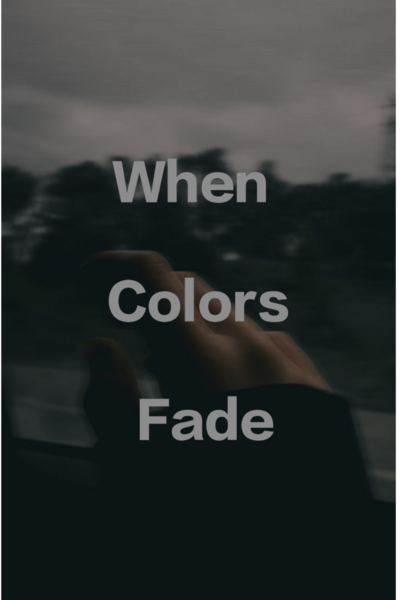
When Colors Fade.
I wrote it for him. To remind him that vision wasn’t the only way to see. That he was painted into every note, every chord, every silence between.
When I played it, he cried. He didn’t need to say anything. His tears told me everything—that he understood, that he believed me, that even if colors faded, he would never fade from me.
---
Years have passed. I’ve watched him rebuild himself with hands that no longer need sight to create. I’ve sat beside him at galleries, watching strangers run their fingers over his textured art, lingering in the worlds he built from memory and touch.
He can’t see their faces, but I can. And I’ve never seen anyone walk away untouched.
Sometimes, in quiet moments, he still whispers, “The colors are gone.” There’s sadness in it, a mourning that never fully leaves. But then he tilts his head toward my humming, or threads his fingers through mine, and I know he remembers: that colors fade, but love doesn’t.
One night, he said, “Maybe colors fade. But you stayed. That’s enough.”
He’ll never know it, but that was the most beautiful thing anyone has ever said to me.
---
So if you ask me what my greatest composition is, it isn’t the awards or the symphonies. It isn’t even When Colors Fade.
It’s this life. Lived beside him.
My music carries him. His silence carries me. And together, we’ve built something neither of us could have alone.
A world where colors don’t need to last—because love does.



Comments (0)
See all