
Rain had erased the lines between rails and road, night and cloud, breath and fog. In the carriage lamps, the world outside was a sheet of moving glass where towns slid by as smudges and orchards became drifts of ink. Most passengers slept the way stones sleep—heavy, without dreams—heads canted, hands folded, trusting the click and hum to deliver them to a morning with newspapers and bread.
He did not sleep. He counted the intervals between bridges, the rhythm of iron over joints—a private metronome that told him the route was true. When the rhythm faltered, the way a heart stutters between beats, he sat up. The windows had lost their reflections. Beyond the glass was only a darkness with texture, as if the train were pushing through velvet hung with dew.
Then the bell. A single, clear note that had no source and no echo. The carriage slowed, and the air changed the way it does before a fever breaks—too cool, too careful. He watched the window for a sign, a station name, anything. The glass yielded a shape instead: a platform lamp shaded like an old parlor fixture, its light round and patient, painting a circle on wet concrete.
The brakes sighed. The train exhaled eleven times. He counted.
The door latch lifted with a soft, obliging click. No one else stirred. The conductor, if there had been one, was absent in the way a thought is absent once you’ve spoken it. He stepped into the corridor and the corridor stepped back from him, empty, polite, expectant. At the end, the vestibule yawned, and the smell of damp stone and machine oil drifted in, braided with something warm like breath that had been recited for years.
He told himself: Only to look. Only to be certain where we are.
The first thing he saw upon stepping down was the sign. It did not carry letters. It carried a number shaped like an O that had forgotten it was a letter. Painted in enamel, the white had the pallor of a hand long kept from sun. Beneath it, small digits on a brass plate gave the time: 2:17. The colon blinked. On. Off. On. Off. The plate did not tick forward.
Rain made a low thrumming under the roof. The roof was old, ribbed like the belly of a whale. Puddles arranged themselves into maps he did not recognize. Benches waited with the patience of undertakers. A timetable under cracked glass listed places he had almost visited: Halver. Bridle. Port of Glass. Each line ended with a word he could not translate, but understood the way one understands the meaning of a lullaby without the language. The word felt like a soft glove drawn over the mouth.
The carriage behind him persisted in its idling, but no carriage door opened and no footstep fell. He turned to look and discovered the cars had become silhouettes without windows, a cut-out train sliding slowly toward a vanishing point. The engine’s eye showed no fire.
“Last stop?” he asked no one.
“Not yet,” said the overhead speaker, though he had not seen a speaker before. The voice was polite and tired and sounded like the way cool porcelain feels against a fevered forehead. It wore many accents stitched together and frayed at the joins. “Do not leave the train,” it added, late, as if remembering a rule after it had been broken.
He put a hand to the metal column. It pulsed once under his palm, as if something living were inside, pressing back with a heartbeat too large for the structure that contained it. The paint there had been polished by the touch of thousands. He imagined the thousands. He tried to remember if he had ever been among them in another story, another life, waiting with a suitcase that smelled of camphor.
Across the tracks stood the opposite platform. It was not a mirror of his own, because it contained a small ticket booth of varnished wood and rippled glass. The shade was drawn. Behind the shade, someone moved. The shape was thinner than a person and taller than a child, the sort of impossible proportion that exists only in memory. The shape raised its head as if to listen.
The rain slowed. The lamps hummed like a throat clearing quietly in a theater. Something far down the line flashed, the narrow flicker of a train that would never arrive—only lurk along the horizon of the tracks the way lightning lurks along the horizon of a plain.
He told himself: Back on board. He put a foot on the step. The step did not object. The carriage did not move closer. Distance had ceased to behave.
A boy walked past him then, barefoot, leaving prints like exclamations. The boy wore a school blazer gone shiny at the elbows. He carried a book flattened by water. He did not look at the man. He looked at the brass plate. “Late,” he said, with no anger. “Always late.”
“Where is this?” the man asked.
“Between,” said the boy. He meant a vestibule with no doors, a hallway that forgot its rooms. “My mother said I should wait where it is warm.” He did not shiver. He did not seem wet.
“Which train are you waiting for?”
“The one that knows my name,” said the boy, and he touched the speaker pole with two fingers, solemn as a pledge. The pole made a sound like a breath drawn against a reed.
The man tried the corridor again. He could walk it, yes, but like a dream corridor, it lengthened as kindness sometimes lengthens, denying the request by fulfilling the form. With every step, the platform’s edge traveled with him, faithful as a leash.
“Passengers are advised,” said the voice from nowhere, “to remain seated until the horizon settles.”
“What if the horizon doesn’t?” he said, laughing because the alternative had too much bone in it to swallow.
“Then you will learn to sit,” said the voice. Its sympathy was terrible.
A woman appeared at the far end, her hair wrapped in a scarf bright as a parrot. She held a paper cup steaming with nothing and wore shoes unsuitable for rain. She, too, glanced at the brass plate and allowed herself the small, unwounded surprise of recognition. “Two-seventeen,” she murmured, “again.”
“You’ve been here,” he said.
She smiled in that distant way one smiles when accepting an apology never spoken. “Since the night the river rose,” she said. “Or the night I missed my stop. Or both. Some nights it is the same night.”
“What happens if we wait?”
“The lamps remember us,” she said, and she lifted her cup as if to toast the humming light. “Sometimes the announcements get our fathers’ voices right. Once I heard my own name pronounced as if it belonged to a lighthouse. I cried then, in a good way. I will not again.”
“Is there a way out?”
“I do not say no,” she said, “because no is a word that locks. I say: there are trains that pass us, and trains that take us past ourselves.”
The timetable flickered. For an instant, all destinations blanked to a soft, startling word: HOME. The glass fogged from within, wiped by an unseen hand. When the fog cleared, the old names had returned, and the word at the end of each line—the untranslatable lullaby—had lengthened by a letter, as if practicing how to spell itself.
A wind threaded the station, tasting of coal smoke that had never burned. The boy sat, book on knees, and began to turn a page that would not separate from its twin. The woman sipped nothing and sighed. The man took his hand from the column and felt the absence of its pulse like the absence of a watch you have worn for years.
Down the track, the flash returned—longer now, like a glance held, like the thought of a name on the tongue. Rails sang in their sleep. The lamps dimmed, then brightened, then held steady as a surgeon’s hands.
“Approach,” said the voice.
The man stepped back toward his carriage, which had become simply a rectangle of dark, harmless as paper cut to the shape of a door. Inside, his seat waited with every crease he had made on the journey from where. He put his palm to the glass and saw, reflected, not his face but the platform behind him, emptying of people he could still hear breathing. He turned. The bench held only a folded jacket. The jacket held nothing.
“Approach,” the voice said again, and now it spoke like a memory of summer shade. The brass plate blinked once and went out. The sign above the platform did not change. It had never changed. The O watched him kindly.
A tremor ran through the rails, as if something enormous far away had merely considered moving. The darkness beyond the lamps thickened, thinned, then put on the pretense of a shape—engine, windows, the promise of doors. It did not stop. It slid along a track just adjacent to the one that mattered, the way a thought slides adjacent to the thought you wanted. He felt, with a feeling too intimate to refuse, that this train knew his name but had decided to pronounce it later.
He climbed back aboard because the body has ancient laws. The door closed without a latch. The carriage shifted its weight like a horse resettling. The corridor narrowed until it was simply the aisle he remembered. He sat. The lamps of the station peered in through the glass as if curious, as if willing to be believed.
When the train moved, it did so with the kindness of a tide pushing a toy boat. He watched the platform recede by not receding. It remained beside him for a long while, walking the same speed, windows for windows, lamp for lamp, as if to keep him company until he admitted something he could not name. Then, at last, it let go. The darkness returned to being only darkness. The glass returned his face to him, paler, a little older in the mouth.
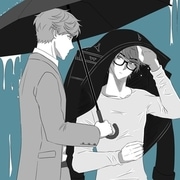
He checked his watch. The second hand swept without hour or minute to obey. The carriage clock, above the door, blinked: 2:17. He looked for the boy. He looked for the woman’s bright scarf. He found only an umbrella dripping on the rack and a ticket stub pinned beneath its ferrule. On the stub, in a conductor’s tidy hand, a single circle had been stamped where the destination should be. Not a zero. Not a letter. An opening.
He kept the stub. Later, he would tell people about a small station that stood between things. He would say he had stepped onto its platform and that the rain had sounded like pages turned by a careful librarian. He would say the lamps hummed his name without speaking it, and that a sign shaped like an answer had looked over him like a patient moon.
When he finished the telling, those who heard would say, smiling, that it was a fine story for the road, for the bar, for the hour it costs nothing to spend. Then they would travel, and at night, between towns with kind names and towns with cruel ones, they would feel the train slow for no reason and see, for one long blink, a pool of lamp-light on old concrete and a brass plate that did not count.
If they stood, if they thought to look, if they let the door click and the corridor breathe them forward, they might find the platform ready and the air polite and the sign watching with its single, faithful shape. But they would not say it was real. They would say: we dreamed of a place that appears at a particular kindness of night.
And the night, pleased to be called by any name at all, would answer by arriving where it always does.
At 2:17.








Comments (0)
See all