
Olympus, the gods' paradise.
The gods gather and feast on Olympus; all joy and glory begin there.
Hephaestus finally received the status he deserved; he would have his own palace and recognition on Mount Olympus.
Hephaestus, whose heart and soul were forged from flame, steel, and seawater, stood atop Mount Olympus, in the center surrounded by the gods. He straightened his back; his bright red hair was tied in a ponytail, mechanical prosthetics encased in his boots. He was neatly dressed, his disfigured face hidden by a mask, appearing like a handsome, flawless god. Curious gazes looked at Hephaestus, but the god skilled in forging stood expressionless in the middle of the temple hall.
Zeus sat on the throne, staring at Hephaestus.
"Oh..." Zeus breathed a sigh. "So I had another son abandoned by Hera."
The proud, unruly, and irritable king of the gods turned his gaze toward his wife Hera, receiving an awkward look and an evasive face from her.
"My son, welcome back to Mount Olympus." Zeus turned his head and looked at Hephaestus, a slow smile appearing on his face. "Olympus will be your home from now on."
"Welcome, our brother!" said Athena; the graceful goddess of war gave Hephaestus a gentle smile.
Hephaestus bowed to Zeus like a well-mannered god. This etiquette had been taught to him by the sea goddess. Although Hephaestus was raised among humans on the earth, he was not uncultured. He had been reared by Thetis and possessed good manners and abundant knowledge — after all, forging weapons and controlling fire are not skills easily mastered.
Hephaestus would receive the gods' recognition, the glory belonging to a deity, and a palace on Mount Olympus.
But these were not what Hephaestus wanted. He walked around among the gods searching, yet he could not find the deity he was looking for... Aphrodite, the goddess of beauty.
That vexing goddess of beauty was not among the gods, but Hephaestus was not worried. He told himself to stay on Mount Olympus; Aphrodite would return to Olympus sooner or later, for the goddess of love and beauty had nowhere else to go. Although Aphrodite descended from Uranus, she had no noble bloodline or pedigree; apart from Mount Olympus, there was no place that could accommodate her. If that proud, beguiling, and arrogant goddess left the shelter of Olympus, she would be harmed.
Thus Hephaestus accepted the glory and status granted by Zeus. His innate skill in forging and mastery of fire made Hephaestus a member of Mount Olympus—the god of fire and craftsmen who commands flame and smithing.
The fate belonging to Hephaestus opened to this god who returned to Olympus. The gods looked at Hephaestus with varied glances and thoughts, but it was certain that they were pleased by his return; after all, a perfect craftsman was something Olympus had lacked. Hephaestus could forge and serve the gods, which was also why Zeus quickly accepted him.
Zeus gave Hephaestus Aglaea, the youngest of the Charites (Graces), intending to marry her to Hephaestus, but Hephaestus refused Zeus’s match.
“My face is ugly and I am disabled, while this goddess is perfectly beautiful and graceful; she does not match me. Great Zeus, I do not need this marriage—please withdraw your decree.” In the presence of the gods, Hephaestus refused Zeus’s match and removed his mask, revealing his ugly side. Aglaea instinctively covered her mouth so she would not cry out.
Hephaestus listened to the gods’ whispers about his appearance without shame or displeasure; he had long been accustomed to such discussions about his looks.
Hephaestus bowed to Zeus, and Zeus did not force the matter, only saying: “Then let Aglaea live with you as your handmaiden… after all, a man always needs the care of a woman.”
Hephaestus did not refuse further, because he knew that continually refusing Zeus would only anger him; thus he accepted Zeus’s gift.
Hephaestus built a new temple for himself. Although he did not intend to live on Olympus for long, he still constructed a splendid palace and helped repair the residences of other gods on Olympus—for example, he helped restore the temple of Athena, the first goddess who showed him kindness. He was extraordinarily strong, clever, and skillful; with the help of some lesser gods, Olympus was soon renewed.
The new god of fire and craftsmen secured his position and temple on Olympus. From then on, forging sounds continually rang out in Hephaestus’s temple—hammers striking steel and bronze. This seemingly ugly smith god kept forging new weapons and various items. Aglaea, the Charis given to Hephaestus by Zeus, served him. Aglaea understood Zeus’s intent: she should have been Hephaestus’s wife, but he had refused the marriage and accepted her as a handmaiden by his side. Aglaea tended to Hephaestus, bringing him water or weaving new clothes for him while watching the tall god forge day and night.
Half of Hephaestus’s face was covered by a mask, hiding the ugly and frightening side; with it concealed, he no longer appeared terrifying. Hephaestus took the water Aglaea handed him, looked at her deeply, and said softly: “I do not wish to bind you by marriage, because I know my ugliness, and I will not remain on Olympus long. Aglaea, thank you for your care. I will regard you as my daughter and sister. In my temple you are not my serving maid nor my possession. If you wish, you may frolic and run in my palace, and you may sleep and eat—do whatever makes you happy.”
Aglaea's eyes brightened slightly.
The youngest of the Charites looked at Hephaestus with gratitude, a radiant smile on her face: "Thank you, Your Highness."
Hephaestus waited for Aphrodite's return.
How long Aphrodite stayed hidden in the earth was unknown; after about a month, Aphrodite finally returned to Mount Olympus.
The beautiful goddess of love and beauty returned to Mount Olympus glowing with radiance. Protected by Triton for a month, Aphrodite only emerged from Triton's palace after she judged that Zeus's anger had likely subsided.
Floaty Triton, son of Poseidon and Amphitrite, who wields the power of the sea with a fish tail and a human torso, was radiant. He took in Aphrodite when she blew the conch; under a few seemingly flirtatious words from Aphrodite—without even touching her—he foolishly sheltered her for a month. Only after Aphrodite gave him a kiss did Triton finally return her to the land. The poor sea prince received no promises and no tangible rewards; merely Aphrodite's enchanting words had him serve her devotedly.
Aphrodite believed Zeus's wrath had died down. Although she knew her actions were somewhat inexcusable, a month had passed and no deity under Zeus's orders had pursued her; Zeus's lightning had not chased her. So Aphrodite chose to return to Mount Olympus—after just one month, Olympus was completely renewed.
Aphrodite's return prompted the Muses on Mount Olympus to sing her praises; they sang music extolling the lovely goddess. Apollo waited along the road Aphrodite would take back to Olympus, playing his lyre.
Aphrodite felt joy inwardly though it did not show on her face. In a beguiling, beautiful voice she murmured to Apollo, "Apollo, radiant god, far-shooting one, what has happened on Mount Olympus? How is it so renewed?"
Apollo gazed at Aphrodite with affection as he plucked the strings: "Zeus's son, the god of fire and craftsmen Hephaestus, has returned to Mount Olympus, and thus Olympus has been renewed... beautiful Aphrodite, why has your expression changed? Hey! Don't go!"
When Apollo saw Aphrodite's expression change sharply upon hearing the name "Hephaestus," Aphrodite, unable to spare a few teasing words with Apollo, strode forward without hesitation.
Hephaestus... the ugly god who was once toyed with by Aphrodite on the island of Lemnos... is actually Zeus's son?
The beautiful and beguiling goddess's expression shifted slightly; he began to run, his pale ankles faintly visible beneath the fabric, like a flock of white doves taking flight.
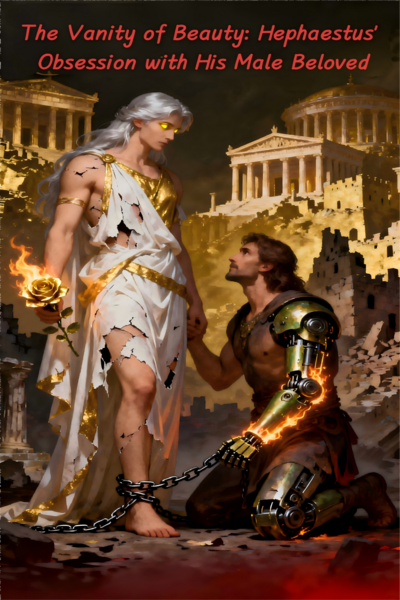
Aphrodite's crimson lips pressed tightly together; lips once as vivid as pigeon blood now stretched taut. Eager to return to her temple to question her handmaidens about what had happened in the past days, the beautiful and beguiling goddess had only just entered her temple garden when she halted—beside one of the temple's columns near the gate, leaning against the pillar, stood the newly returned Prince Hephaestus, wearing a chiton that revealed a strong chest, a colored metal prosthetic limb, and an intact, handsome face.
“Aphrodite!”
Leaning against the column, Hephaestus saw the hurried goddess. He strode up to Aphrodite and tightly grasped her wrist.
"Quickly remove the curse you've placed on me!"
Hephaestus's voice was grave. Looking at Aphrodite's somewhat bewildered face, he asked, "What spell did you cast on my heart? Why can I not stop thinking about you?"








Comments (0)
See all