
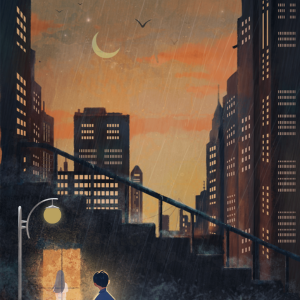
The air inside the university library always felt heavier after noon — the kind of quiet that hummed rather than spoke, where every turn of a page seemed louder than it should. Rows of wooden tables glowed softly beneath the high lamps, and the rain outside brushed faintly against the tall windows, wrapping the world in a hush.
He was already there when she walked in — seated near the far window, where the filtered light fell in gentle stripes across the table. Two open notebooks, a pen rolling idly under his fingers, and a cup of black coffee slowly cooling beside him.
The professor had assigned the project two days ago. It wasn’t the topic that caught her attention; it was the pairing. She hadn’t expected to be matched with him. In truth, she hadn’t expected to be paired with anyone at all.
They had agreed, through a short exchange after class, to meet in the library on Friday. Neutral ground. Quiet enough to think. Formal enough to keep distance.
She spotted him almost immediately, but for a moment, she hesitated. The table beside him was surrounded by stillness — not cold, just steady, like it belonged to someone who didn’t need noise to fill the space around them.
When he looked up and caught her eye, he smiled — not broadly, just the kind of polite curve that said you can sit here, it’s fine.
She walked over, her steps measured.
“Sorry, I’m late,” she said quietly, setting her notes down.
“You’re not,” he replied. “I got here early.”
And just like that, the first barrier broke — thin, almost invisible, but there.
They began with the outline first. She was precise, deliberate, her handwriting slanted neatly across the page. He noticed she didn’t waste words — every sentence was a decision, not a filler.
But despite herself, she couldn’t help noticing him. He was different from the others — quieter, calmer, as if the silence of the library suited him.
She hadn’t remembered his name at first — they’d been paired by chance — but it came back to her now, written neatly beside hers on the project sheet: Lucen.
The name fit him. Soft but certain, like the steady glow of light that never needed to announce itself. His hair was slightly tousled, not from carelessness but from comfort. His eyes, when focused on the text, held a quiet steadiness, like someone who didn’t need to rush to understand.
She shook off the thought. What did it matter? He was just another boy. That was all.
Still, as they worked, she found herself noticing small things — how he paused before writing, how his pen tapped softly when he was thinking, how he didn’t try to fill the silence with meaningless chatter. He didn’t need to.
And oddly, that made it easier for her to stay.
It unsettled her — this noticing. Because she never noticed. Not about boys. Not about anyone beyond her small, safe circle.
He had expected her to be distant, and she was. Her eyes rarely left the page, her words clipped, her tone polite but restrained. But what struck him wasn’t the wall itself — it was why she built it.
She spoke only when necessary, her voice calm and low. Everything she said was about the work — definitions, ideas, sources — never once slipping into casual talk. It wasn’t rudeness. It was control.
And then it hit him — she didn’t talk to boys, not beyond what was needed.
It should’ve dissuaded him. It didn’t.
Because the more she stayed guarded, the more he wanted to understand what she protected.
He admired her precision — her notes aligned perfectly, her handwriting small and symmetrical, her references highlighted in soft pastel. Every movement was intentional. She rarely looked at him, but when she did, it was brief — sharp, assessing, as though deciding whether he might disturb the fragile order she built around herself.
He didn’t push. Instead, he matched her pace. When she spoke, he listened. When she paused, he stayed silent. He wanted her to feel safe in the quiet — not cornered by it.
At one point, both reached for the same reference book. Their eyes rose and met at the same time.
She froze, pulling back almost instantly.
“Sorry,” she murmured.
“It’s alright,” he said softly. His tone carried warmth, not amusement.
She didn’t look up again, though he noticed the faint flush at the edge of her cheek.
Time passed differently after that — slower, softer. The space between them stopped feeling heavy. Words flowed only when needed, yet the silence felt complete, like a conversation made of stillness.
When they finally closed their notebooks, the library lights had dimmed, the evening melting into dusk.
She rose first, sliding her notes neatly into her bag. “We should meet again,” she said, voice even. “Same place, same time next week?”
He nodded. “Sure.”
For a heartbeat, she looked at him — really looked — as if seeing him properly for the first time. Then, just as quickly, she turned away.
Her steps were brisk, her figure swallowed by the tall shelves until she disappeared completely.
He stayed behind for a while, staring at the empty chair across from him. The faint warmth of her presence lingered in the quiet air — the scent of old books, the echo of a soft “Sorry.”
For her, it was a project.
For him, it was the first thread of something he wasn’t ready to name.









Comments (0)
See all