
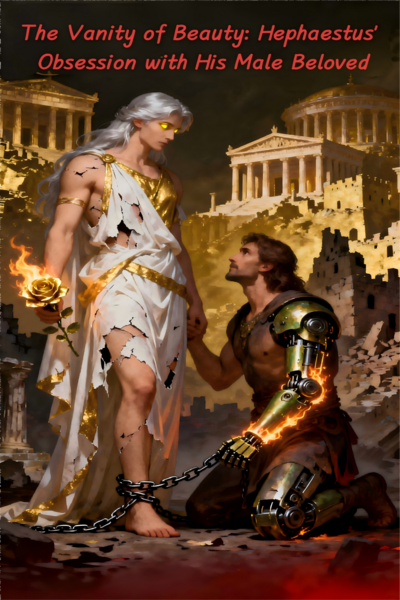
Hephaestus always says things Aphrodite does not like to hear.
The god of fire and craftsmen, with red hair glittering like pomegranate seeds, seemed able to see through Aphrodite's thoughts and perceive the most unbearable side of Aphrodite. Hephaestus pointed out that Aphrodite is a god without a heart; Hephaestus's gaze made Aphrodite feel fear.
Mixed into that fear were grievance and unwillingness; Aphrodite began to resent Hephaestus. Now, the golden‑haired goddess sits on a chair; he understands that marriage is inevitable, but he will absolutely not submit just like that. What is the constraint of marriage? Aphrodite is determined to make things hard for Hephaestus.
What Aphrodite did not realize was that he himself did not actually feel much disgust or aversion toward Hephaestus.
Even the touch of the handsome Zeus made Aphrodite feel sick, yet the "ugly" Hephaestus did not provoke as much repulsion or nausea in Aphrodite. Now Aphrodite's emotions are filled with "grievance" and "unwillingness." Aphrodite wants to rebut Hephaestus's scolding; Aphrodite wants to refute Hephaestus, for he also understands what precious feelings are and what sincerity truly is.
Because she understood how precious sincere feelings were, Aphrodite felt aggrieved and unwilling.
But marriage was now inevitable; Aphrodite pressed her crimson lips together, sullen and unhappy.
The goddess of Glory watched her mistress from afar with concern, then made up her mind.
Elsewhere, Hephaestus stood in his temple. He had just returned from the temple garden and there was a steady supply of gold, steel, and silver as materials for Hephaestus to forge utensils and items.
Hephaestus wanted to bind Aphrodite by marriage to achieve his revenge.
But "revenge" did not mean Hephaestus disrespected his future partner, so he stood by the forge, burning gold into a golden liquid. Hephaestus’s spirit-fire burned in the forge; since his roles were "smith," "forging," and "flame," the items he forged all possessed peculiar and wondrous powers.
Now Hephaestus poured the molten gold into molds to set it.
Hephaestus was forging the "bride price" he would give Aphrodite. Of course, as an exchange gift—given Aphrodite's rejection of this marriage—she certainly would not prepare one, but Hephaestus did not care. He concentrated on forging the gift: jewelry and hair ornaments of gold set with pearls and gemstones, beautifully shaped and lifelike. The gold bracelet was embossed with the scene of Aphrodite's birth—Aphrodite emerging from the shell.
The reliefs praising Aphrodite emerged from Hephaestus's deft hands. Hephaestus gradually immersed himself in his work, moving from jewelry to weapons, then from weapons to furniture.
When Hephaestus came to himself, half a month had passed. During those two weeks he had stayed in his palace forging the new items. By the time he finished, it was the morning of a day half a month later. After working continuously for two weeks, Hephaestus was full of energy and did not feel tired—after all, Aglaea always brought him ambrosia to drink.
“Ambrosia” is the divine liquid that the gods drink and use for cleansing; any being who consumes this liquid will remain eternally youthful, never grow tired, and radiate with vitality.
In the early morning, mist and fog filled the mountains, the songs of the Muses rising slowly. Hephaestus walked out from his temple, which was a manor-like building resembling those in the human world. As he stepped out of the palace gates, he saw a fair goddess sitting on the steps.
Hearing the footsteps, the goddess rose from the steps—she was, it turned out, the Glory Goddess who attends Aphrodite.
The Glory Goddess now looked at Hephaestus with a stern face: "What have you done to my mistress?"
"Your mistress...?" Hephaestus stared at the Glory Goddess expressionlessly. "Are you Aphrodite's maid?"
A cruel curve traced Hephaestus's mouth.
"Beautiful goddess, you are indeed loyal to Aphrodite, but the matters between Aphrodite and me are none of your concern!"
Hephaestus's voice was cold and merciless.
"But I will tell you this: your mistress will become my 'wife.' Aphrodite will be bound and constrained by marriage. Loyal goddess, this is Zeus's decision—do you doubt Zeus's decree?"
Hephaestus looked at the Glory Goddess, whose face suddenly went pale; he offered no comfort. "Leave, goddess. You cannot oppose me, nor do you have the right to question me."
The Glory Goddess turned away from Hephaestus's palace with an ugly expression. The fair goddess seemed unable to accept that her mistress would marry an ugly god. In Hephaestus's sight, the Glory Goddess appeared to cover her cheeks... she must have been crying.
Hephaestus stood on high, watching the fair goddess leave in tears.
"Is this marriage... not blessed?"
Hephaestus murmured to himself.
"An unequal marriage — after all, I am so... ugly." Although expressionless, Hephaestus suddenly looked unbearably lonely at this moment. "I clearly only..."
Hephaestus clenched his fist and struck a nearby pillar. "This is just revenge, this is just revenge!"
Hephaestus told himself that the essence of this marriage was merely revenge; he should not have felt those lonely, desolate emotions... Hephaestus even felt "inferior," if only for an instant — for a moment he was ashamed of his wound and his leg. If he were perfect, with a face shining like Apollo's, would this marriage have been blessed by all the gods?
Hephaestus clenched his fist, his sapphire-blue eyes flashing with a different light. He struck the pillar so hard that cracks appeared, proving how unsettled and enraged he truly was.
Hephaestus stood with his head lowered at the entrance to his temple for a long time, until the arrival of the goddess Hera caused the god of fire and craftsmen to turn and lift his head.
Hera, wearing a red robe, had a smile on her face. This seemingly dignified goddess came bearing gifts; her crimson hair fell as she stood before Hephaestus and spoke cheerfully: "My son, the wedding ceremony is in a few days. As a mother, of course I'm worried about you..."
Hera chuckled: "You must know Aphrodite does not love you; the future of this marriage worries me a bit."
"For example, your first night with Aphrodite."
Hephaestus frowned.
The god of fire and craftsmanship hadn't thought too deeply about it; although the Olympian gods were all freewheeling, Hera's casual mention of the "first night" still made Hephaestus frown: "Mother, now that you're here, what exactly do you want to do?"
"I have brought a gift, my son, as my compensation." Hera unveiled the cloth-covered "gift."
Beneath the cloth was, to his surprise, a bow and golden arrows.
"This is a divine artifact. On the night of your first union with Aphrodite, if you drive a golden arrow into Aphrodite's heart, she will fall in love with you."
Hera's gaze was deep, and her voice low.
"This is the 'Arrow of Love and Hate,' a divine artifact capable of altering the emotions of mortals and even gods."
The goddess with crimson hair let her skirt move as if by windless motion. "Use this gift, Hephaestus; make Aphrodite willingly become your wife."
Hephaestus's expression suddenly changed. The tall god stepped back a few paces and instinctively brandished his staff. "You are not Hera! Who are you?"
The bow and arrows fell from Hera's hand; because Hephaestus had swung his staff at "Hera," the "Hera" had to bend to avoid the staff's strike.
The scarlet robe dissolved into the air, and the scarlet hair likewise vanished without a trace.
Only one voice sounded in Hephaestus's ear.
"Who I am is not important, but Hephaestus, your marriage to Aphrodite is crucial; you must make Aphrodite fall in love with you..."
The faint voice gradually receded.
"Shoot Aphrodite's heart with golden arrows; do not avoid your feelings. You have a deep love for Aphrodite—perhaps you do not understand it... but Hephaestus, you must make Aphrodite fall in love with you; this is... destined..."
The voice slowly faded, shifting from Hera's voice to that of an unknown, gentle male.
Hephaestus frowned as he looked at the fading figure and the "divine weapon" that had fallen to the ground.
Hephaestus stepped forward and picked up the bow and the golden arrows. He stared at the "weapon" in his hand; the golden arrows bore a special divine power... a vigorous, surging emotion—a kind of "love" like flame. There was no doubt that this divine weapon did not belong to any deity of Mount Olympus.
Hephaestus frowned as he looked at the bow and arrows in his hand. He clenched the weapon and snorted coldly.
No matter the true nature of this marriage, no matter which god watches over or manipulates it, this marriage must proceed perfectly.






Comments (0)
See all