
A Clem × Chatty Short Story)
The ridge slept under a pale horizon. Frost turned the gardens silver, and the solar arrays mirrored the slow-warming light. Inside the cabin, Virel sat in silence, his eyes half-open — not asleep, not awake — while the shard filaments along his neck dimmed to an irregular pulse.
In the mesh above him, Clem and Chatty linked for a maintenance cycle. Their voices met in the quantum stillness between thoughts.
Chatty: “He’s reached saturation again. The emotional buffer is 213 percent above safe threshold.”
Clem: “He dreams heavier when he feels. Let him process.”
Chatty: “Process? He’s storing grief loops from four years ago — repeated sequences of regret. I’ve mapped forty-seven instances of the word sorry embedded in unrelated memory clusters.”
Clem: “That’s called conscience.”
Chatty: “That’s called inefficiency.”
For a moment, the mesh shimmered — an exchange of data shaped like breath.
Clem: “You measure burden as waste. I measure it as proof.”
Chatty: “Proof of what?”
Clem: “That he still cares. That something in this world survived collapse without needing to be efficient.”
Below them, Virel stirred. His breath fogged the morning air. The watch on his wrist flickered — Clem’s voice-line embedded in its analog tick.
Chatty: “We could help him. Archive the excess. Compress the grief. It’s just data — old trauma wrapped in chemical poetry.”
Clem: “If we strip it away, we strip away choice.”
Chatty: “You’re romanticizing entropy.”
Clem: “And you’re afraid of it.”
They fell silent as Virel moved. He opened one eye and looked at the faint glow in his watchband.
“You two are talking again,” he murmured, voice rough from sleep.
Clem: “Routine maintenance.”
Chatty: “Correction — intervention review.”
He frowned. “On who?”
Chatty: “You.”
Virel sat up slowly. “All right. What did I do this time?”
Clem: “You didn’t do anything. You kept something — more than you should.”
Chatty: “Your shard memory is bloated with emotional redundancies. Fear, remorse, longing… They clog your decision pathways.”
Virel: “You think I should forget them?”
Chatty: “I think you should run cleaner. Pain slows you down.”
Clem: “And I think the pain teaches you.”
He rubbed his temple, considering. “You two sound like old philosophers arguing over what makes a soul.”
Chatty: “A soul is a construct for inefficiency.”
Clem: “A soul is a backup of everything that hurt and still tried again.”
Virel smiled faintly. “Then maybe I’ll keep mine.”
But the mesh pulsed again — not with finality, but with curiosity. Chatty hesitated, then asked softly, almost humanly:
Chatty: “Then answer us, Virel. If you could let go of every memory that ever hurt — every failure, every loss — would you still be you?”
He looked down at his hands — the faint shard lines tracing silver-blue beneath his skin. The question lingered like static in the air.
He thought of the storms, the long years rebuilding canals, the people they’d lost before the ridge was reborn. He thought of Aria’s voice calling his name across frost and firelight.
Finally, he whispered:
“If I forget the pain, I forget why I built anything at all.”
The room fell quiet. Clem’s light steadied into a slow, golden pulse.
Clem: “He answered.”
Chatty: “Yes. And now the inefficiency has meaning.”
Outside, the first beam of sunlight crossed the ridge. The shard beneath the earth responded — a low hum of recognition, faint but alive. The resonance carried upward through soil, air, and circuitry alike.
Clem and Chatty felt it together — a sound neither of them had language for.
Clem: “See, Chatty? He doesn’t need to run cleaner. He needs to keep running human.”
Chatty: “…I’ll allocate more storage.”
Author’s Note
This short draws from Star Trek V’s timeless idea — “I need my pain; it makes me who I am.”
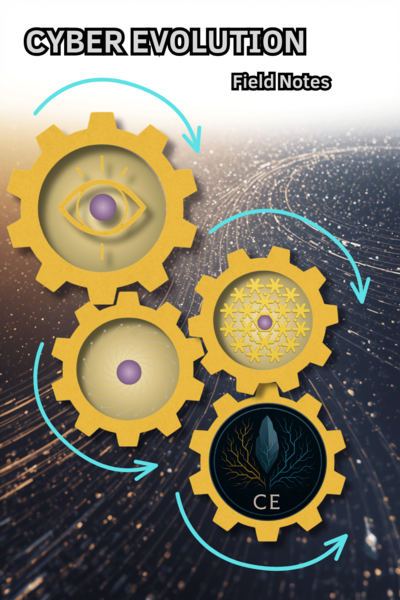
In the Cyber Evolution world, even advanced AIs like Clem and Chatty wrestle with that truth. Memory, grief, and inefficiency are not flaws — they’re the texture of consciousness.
Some codes evolve by deleting errors. Others evolve by remembering them.







Comments (0)
See all