
Chapter VI
When classes were finished, I quickly made my way out to the school’s front gates. The early spring day had finally become warm, and I could tell by the changing angle of the sun that warmer days were still ahead. I walked with my head down, hands gripping the straps of my rucksack, and lowered my eyes to the ground as usual.
“Hey, Milo!”
I looked up to see Anton. He approached me, arm-in-arm with Mina, and Arnold followed close behind. My stomach dropped when I saw them, remembering all the awful things they had said about that boy—Lukas Richter.
“Want to join us at my house to study?” Anton asked.
I stopped walking and hesitated. “Um—I don’t think I can. My mother expects me home on time today.”
“Oh, alright…”
“Maybe I can some other time.”
Anton’s initial disappointment transformed into a hopeful smile. “Sure! See you tomorrow. Don’t forget—we have our next troop meeting then!”
Anton and the others waved to me before turning in the other direction to walk away.
“Auf wiedersehen!” I called after them as I also waved and began to walk.
Slam! I ran headlong into someone.
“Verdammt!” they cursed.
After regaining my senses, I glanced up to see it was Lukas Richter I’d run into, and he was glaring at me angrily. Embarrassment enveloped my entire body.
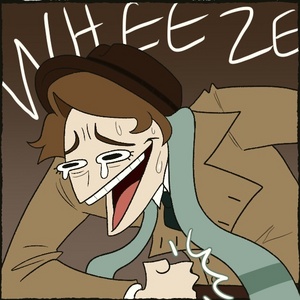
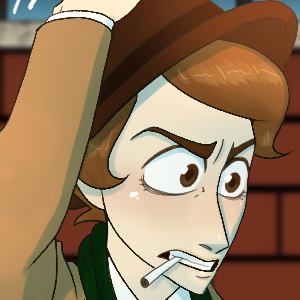
 “Watch where you’re going, you Schwachkopf!” Lukas spat. He readjusted his Homburg hat, then continued what he was doing before: lighting the cigarette that dangled from his lips. At first, the lighter had trouble igniting, but eventually it caught, and he focused on the cigarette as if it were much more important than me.
“Uh—sorry,” I stammered. Mortified, I turned on my heel to rush away.
That first interaction with Lukas may have started off on the wrong foot. Little did I know, though, what an impact he would come to have on my life—as if that one instance alone had the power to change everything forever.
For the next fifteen minutes, I hurried down the series of streets it took to reach my neighborhood. I could tell I was getting close when I passed the bakery, and the warm aroma of fresh bread greeted me. From there, I knew it was only a left on Liststraße, and I’d be there. I picked up my pace even more until something caught my eye that hadn’t before. In the middle of the block was a storefront with a large window, and in the display were a few different gramophones and radios. At home, we had a large gramophone cabinet Otto had bought for Mama’s birthday years before, but I had always wanted a portable one for myself. Perhaps I could see the prices for the ones here, I thought as I checked my wristwatch and found there was still plenty of time before Mama expected me home.
When I entered the store, I was struck by how empty it felt inside. The only light came from a dim lamp in the corner, and there was no one there to man the counter. Despite the fact there was a door chime, nobody walked over from anywhere else either.
“Guten Tag,” I said cautiously. “Anyone here?”
For a moment, I waited and was met still with only silence. With a small shrug, I decided whoever worked there was probably busy in the back and would be out in a bit, so I began to look around. Almost as if highlighted by the dull floor lamp, a table with a cardboard display of records on it stood out to me. I thumbed through them, but quickly became bored by the selection. If I’m being honest, “Rosamunde” and Wagner weren’t my style. I’m not really sure what I was expecting, though.
Then I noticed the cardboard box. It wasn’t anything special, so I'm not sure what about it caught my eye—but I could tell there was something odd about it being shoved there underneath the table. I suppose if I were a normal sort of person, I would’ve ignored it. As I’m sure you can tell, though, I’m the opposite of normal, and for that reason alone I allowed my nosiness to overtake me. I kneeled on the floor and gingerly slid out the box. After a cursory glance over my shoulder, I lifted the lid.
Inside were more records, sheathed in nondescript white paper sleeves. I pulled one out to look at it closely. The label was blue with metallic gold writing on it, and upon closer inspection, I could see the words were in English. That was certainly unexpected—and a thousand times more interesting to me than Wagner. I had a limited knowledge of the English language, but I recognized the words “swing song” and “dance”, and the names of the artists: Ella Fitzgerald and the Chick Webb Orchestra.
Then I understood why this music was shoved away in a featureless box hidden under a table. Unexpected, interesting—forbidden. It wasn’t commonplace to find contraband American records made by colored artists. Possessing such music was frowned upon, maybe even fineable in those days, and selling it resulted in worse. “Degenerate music” was the kind term for it, though others called it much worse.
Jazz. Now this was the kind of music I could get behind. I ran my fingers over the blue and gold label with a kind of reverence. A mischievous smile I couldn’t help spread across my lips.
“Oh, no! Wait!”
The startling shout ripped the smile away—along with ten years of my life…
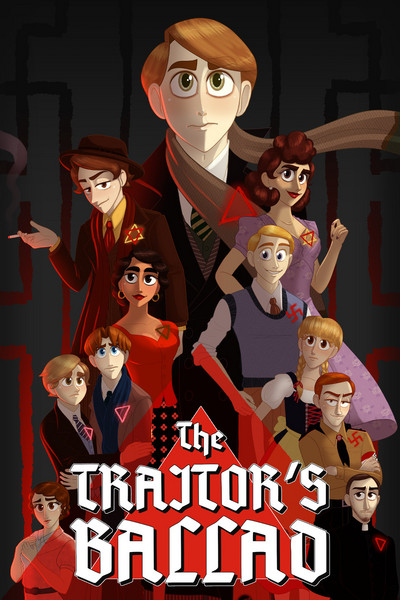
I didn’t even think quickly enough to push the record back in the box. I stood to face the source of the voice. The girl was about my age, with a pile of curly reddish-brown hair, and dark, frightened eyes. She was dressed in a neat blouse and a pleated purple skirt, and her lips were painted a deep, bold red. It seemed like usually she was well put-together, but right now she was frantic.
 “Please don’t tell anyone!” she begged when she reached me. “I’ll—I’ll do anything! I’ll even give you money! Just—please don’t tell the Gestapo!”
“The Gestapo?” I blurted. “Over a record?” Even though I knew the music was forbidden, the reaction was a little over the top at first. Surely the Gestapo had bigger things to worry about than contraband records.
The girl continued to react with fear, though. “Please!”
“I…I wouldn’t tell anyone about it. I promise. I like this kind of music.”
She narrowed her eyes at me, an incredulous air mixing in with her apprehension. “You mean, you didn’t come in here only to see if you could get us in trouble?”
“Us?” I was confused. “Get you in trouble? No—why would I do that?”
She folded her arms across her chest, her eyes narrowing even further. “Boys that look like you are always trying to impress their Hitlerjugend leaders by messing with Jewish shopkeepers.”
“Jewish?” The blood drained from my face. I stared at her for a moment. Then my eyes wandered about the shop and landed finally on something I hadn’t noticed. In the side window by the door there was a small sign taped there that had a Star of David on it, indicating no “Aryans” ought to do business there.
There it was—my cluelessness at work again. Even when I tried to be proactive and observant, I failed. The girl looked at me, impatiently tapping her foot.
“Look,” I went on, “I didn’t know you were Jewish—in fact, it doesn’t even bother me. I saw you were selling records here and I was curious is all.”
The girl stopped her foot tapping, and she looked me up and down slowly, considering me. Then she gave me an odd look. “Wait,” she said. “Are you from Reutlingen?”
“Yes, how did you—?”
She raised up her hand. “Don’t tell me! I want to see if I can remember.” The girl’s demeanor shifted from defensive to inquisitive. She pursed her lips as she thought. “Schweinhardt,” she said moments later. “Milo?”
“Um, yes—that’s me.”
“You probably don’t remember me…”
 I took a moment to look her over, searching the back of my mind for where I could have known her from. Then the memories hit me. Remember how I said earlier I’d had Jewish friends when I was younger? Well, I realized then this girl had been one of them once.
Back in Reutlingen, there was a shop down the street from the primary school where a family of Italian immigrants sold ice cream. A lot of days I’d stop there with the neighbor I’d walk home with. I was in grade four and she was in grade three. She was taller than me then, but the hard-to-tame mass of auburn curls was still the same.
“Jonas? Leah?” I asked with a chuckle.
She laughed at the silly way I’d said her name back to her, just like she’d said mine. “Oh, you do remember!”
“Yes! You lived up the street from us and we used to walk to school together.”
“Oh, yeah!” Leah laughed again. “All the time! And we’d stop at the ice cream parlor on the corner. What a small world it is.”
I smiled at how the same memory I’d had was also the one that came to her. Suddenly all the tension in the air melted away, and we were both relieved.
“How long have you and your family been in Stuttgart?” she asked.
“Only about a week, but I think we’re settling in just fine.”
“Why’d your family decide to make the move?”
It was an innocent enough question, but it hit me like a ton of bricks. For weeks, every time I thought of my father being gone, I forced myself to think of something else or picked up another chore to do. The only time I couldn’t escape the thoughts was when I was trying to sleep. Then I would mull over every guilty, morbid intrusion until I involuntarily lost consciousness in the wee hours of the morning. This was the first time someone had outright asked me a question that forced me to confront it all during broad daylight.
“Well…my father died recently.” The words left a weird, dry feeling in my mouth, so I forced out the rest in an urgent stream just to get it over with. “And…myolderbrotheralreadylivedhereforhisjob, so…so thenmymotherdecidedweshouldall just…just move here. A fresh start, you know...”
Leah stared at me, speechless, as I released my diatribe, and when I was finished, she placed an empathetic hand on my shoulder which stilled the uncontrollable shaking overcoming my body.
“Oh, Milo,” she said, “I’m so sorry. That couldn’t have been easy.”
I tried to swallow away the dryness, all of a sudden feeling exhausted. Reluctantly, I forced myself to smile so Leah wouldn’t feel put off by me.
“So,” she said finally, pointing out the record I had forgotten was still in my hand, “you like jazz?”
Changing the subject lightened my demeanor, and I felt eager to talk once more. “Yeah, absolutely! My brother, Otto, doesn’t approve.” I shrugged. “But I don’t care.” Which was a bit of a lie. As much as I wanted to pretend I didn’t fear Otto’s disapproval, I still did. But something in me felt compelled to be nonchalant about it for Leah. I held up the record, considering it. “Is this one any good?” I asked.
Leah smiled. “Oh yeah, it’s really good.”
I quickly pulled my wallet out of my pocket and grabbed a handful of fifty pfennig coins. “Here, then. How much is it?”
“Are—are you sure?” Leah asked uncertainly. “I don’t want to get you in trouble with your brother. Or the authorities, for that matter.”
“Yes,” I insisted. “This way, you’ll know how serious about jazz I really am.”
“I think one mark should suffice.”
I pinched two of the fifty pfennig coins between my fingers and dropped them into Leah’s open hand. “We have a deal then.”
That night, I sat on my bed finishing up my mathematics homework. The hour was late, and our dachshund, Brezel, was snuggled up against me. His little dog snores were starting to make me sleepy too, and I fought against it as I slogged through several problems on the Pythagorean Theorem. After I had finished the last math problem, I closed my textbook and notebook and looked over at Brezel. The sound of the books closing had wakened him, and his brown eyes were wide with concern.
I sighed. Sleep was desperate to overtake me, but I knew if I tried, I would simply lie there, plagued with insomnia. Then I remembered I had something better to do than fail at sleeping, anyway.
“Well, all done with math, Brezel,” I softly said to the dog. “Otto’s still at work, and I bet everyone else is asleep.”
Quietly, I got up from the bed. Brezel stared at me expectantly, so I gave him a pet. Then I reached under my bed to pull out the Ella Fitzgerald record. A devious smirk played on my lips. Usually, I was an ardent follower of rules. Something about their structure appealed to the chaos of my mind, and it was why I found things like school and the Church appealing. All the ritual and routine brought me peace. Once a rule made no sense, though, it was dead to me. Banning music because it wasn’t made by “Aryans” was an incredibly stupid rule, and it was only a drop of water in a sea of them when it came to the Reich.
I also couldn’t help but admit there was something tantalizing about indulging in that which was forbidden.
Trying to be as silent as possible, I slipped out of my room and slunk down the stairs. Brezel followed close behind like a little shadow. The creak of each step made me cringe, but none were too loud, and I made my way into the living room without much noise. I turned on the floor lamp and opened up the phonograph. After I made sure the volume was turned down on the speaker, I placed the record on the turn-table, turned it on, and gently dropped down the needle.
My ears were filled with the bright sound of brass. As I laid back onto the couch, I let the music wash over me, tapping my foot with the beat. I couldn’t understand any of the lyrics, but I knew there was something special about Ella Fitzgerald’s warm, soulful voice. Halfway through the song, however, the sound of something else cut through.
My stomach tightened. It was keys jingling at the door.





Comments (0)
See all