
The next morning began with the sharp scent of burnt sugar—her first failure in weeks. Mira stared at the tray of ruined tarts, their caramel tops blackened and cracked, and wondered when distraction had started sneaking into her recipes like an uninvited spice.
Outside, trams hissed across the rails, scattering pigeons into the pale sky. The same gray-blue light washed over the café, sliding along empty tables. Carlo was at the morning market, leaving her alone with silence, the hum of the refrigerator, and the slow march of the clock toward eight.
She told herself she wasn’t waiting. She was simply curious if the universe kept its promises.
At eight o’clock, she checked the oven. At eight-oh-five, she wiped the counter again. At eight-ten, she straightened the sugar jars. At eight-eleven—nothing.
For the first time since she began counting, *The Ten-Minute Man* didn’t appear.
Her hand hovered above the counter, uncertain what to do next. The faint thrill from yesterday—the one that had felt like breaking a small rule—now stung like regret.
She sat down at the window seat, cradling a mug of coffee that had gone cold, and opened her notebook.
> “Observation #39 — Absence has a sound. It’s the pause between two bells.”
The door chime startled her. She looked up too fast.
But it wasn’t him—it was Lucy, her roommate, hair in disarray and camera slung across her shoulder like a pet she’d forgotten to feed.
“You look like someone who’s waiting for a plot twist,” Lucy said, collapsing into a chair. “Or a man.”
“I’m waiting for neither,” Mira said, handing her a croissant.
“Then why are you baking like you’re trying to manifest one?” Lucy tore a bite, scattering flakes. “You’re thinking about that late guy again, aren’t you?”
“He’s just a regular.”
“Right. And I only take photos of people I don’t care about,” Lucy teased.
Mira rolled her eyes. “Shouldn’t you be at your studio?”
“Shouldn’t you admit you miss him?”
The banter felt familiar, but not comforting. Mira’s gaze drifted to the empty corner table—the one that had quietly become part of her morning routine.
It was ridiculous, she told herself, to let an empty chair dictate the temperature of her mood.
Still, the air felt colder.
By noon, he still hadn’t come.
She finally surrendered to the restlessness. She hung her apron on its hook, grabbed her coat, and stepped outside.
The city glimmered under a thin sun, damp from last night’s rain.
Vendors shouted near the tram stop; the smell of roasted chestnuts mingled with sea salt.
As she turned the corner, something on a bench caught her eye—a sketchbook, worn and slightly open, pages trembling in the breeze.
Her pulse stuttered.
She didn’t need to check the initials pressed faintly on the inside cover to know it was his.
For a moment she simply stood there, arguing with herself.
Don’t open it.
You promised yourself not to look.
But curiosity, that old traitor, always won.
The first page showed faces from the café—Carlo’s grin, a customer reading the newspaper, the swirl of steam rising from a cup.
Then her hands, caught mid-motion as she kneaded dough.
She turned another page—and froze.
It was her again.
Drawn from behind the counter, her hair slipping from its bun, a lemon tart in one hand. A faint line of graphite light fell across her cheek.
Beneath the sketch, his handwriting read:
> “Ten minutes late. Always worth it.”
She snapped the book shut, as if it had bitten her.
Her pulse thundered.
He had been watching her all along.
That evening, she placed the sketchbook behind the counter, unsure what to do.
Carlo noticed it first.
“Lost and found?” he asked.
“Something like that.”
He peeked at the cover. “Our mysterious artist again?”
Mira didn’t answer. She only glanced at the clock.
8:10 had passed long ago, yet she kept glancing at the door.
Finally, near closing time, the bell rang.
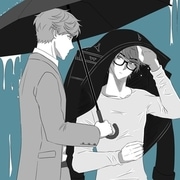
He stepped inside—hair damp, jacket darkened by rain, the familiar sketchbook absent from his hands.
“You forgot this,” she said before he could speak, sliding it across the counter. “At the tram stop.”
He blinked. “You found it.”
“I tried not to look inside,” she lied.
He smiled faintly. “And failed?”
“Maybe.”
“Then you know why I’m always late.”
Mira frowned. “Because you draw?”
“Because I stop to notice.”
He took the sketchbook, fingertips grazing hers—a brief, electric touch louder than the rain.
“Thank you,” he said quietly. “For keeping it safe.”
“It’s what I do,” she replied. “I keep things.”
“Even people?”
She didn’t answer. The question lingered in the air, soft and dangerous.
After he left, Mira wrote one last note in her journal:
> “Observation #40 — The distance between watching and being seen is exactly ten minutes long.”





Comments (0)
See all