
He stepped out of the treeline at first light.
Blue sky hard as glass. Air that bit clean. The mountains ahead, broken and white along the ridge.
He wore a long, weather-stiff cloak over his field kit, hood down to keep the rime off his breath. Under it sat a sealskin anorak with a wolf-ruff that kills crosswind, wool layered tight to the wrist. Bone-slit snow goggles hung on a rawhide cord against his chest
He tested the crust with his heel. Hollow. He set his weight anyway and the crystals knit under his boot. He didn’t watch his feet; he watched the wind lines, the sastrugi edges, the shadow on the lee where frost stuck and told him what the night had done.
He moved the way this place preferred: steady and exact.
A cold wedge, no wider than a doorway, ran a step ahead of him so the gusts split and slid off. Not a show, just easier breathing.
Ravens worked the air over his shoulder. He tipped his chin at them.
“News?” he said.
They gave him the kind of answer ravens like—too much laughter, no details—and drifted toward the flats.
His kit was right. Sealskin anorak with a wolf ruff to take the edge off the wind. Wool underneath. Fingered gloves, big over-mitts he could throw on fast. Bone-slit goggles on a cord. Moosehide boots with felt liners, tall gaiters. Canvas pack riding high so it wouldn’t clap sweat off his back. Knife, line, folding saw, a black kettle, and the oiled maps he’d drawn himself.
Nothing spare. Spare turns into trouble out here.
A creek cut the ridge. Not fully locked. He crouched, glove off, and pressed a palm to the skin of water. Heat left the current in a hush. A pane formed—thin, honest, enough for one careful man. He crossed without breaking stride.
“Behave,” he told the kettle when it rattled. The kettle thought about it and did.
By midmorning he found the old ironwood blazes and followed them west, laying each step down like a palm on paper. No shattered crust. No waste.
***
Smoke threaded the trees at noon. He approached a half-buried hut with a drift fence and a rack of split wood.
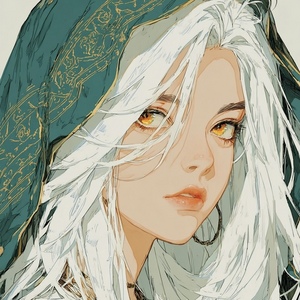
The keeper was a woman with fox-white hair and a jaw built for saying no. She looked him over in three beats; goggles, sled runners, rime on the anorak.
“You’re from north of the ridge,” she said.
“Most days,” he said. “Iver Kade.”
“Fen.” She set a small kettle over a miserly blue flame and poured tea like it cost her. Her eyes found the iron badge in his pocket slit—Registry crest, hairline crack through the sigil.
“Didn’t think you people wore those up here anymore,” she said.
“I forget it’s there until somebody spots it,” Iver said. “You worried?”
“About mages? Not particularly. About people who scare easy? Yes.” She pushed a tin across the table and took the one he set down. Trade square. “You going north or south?”
“Following the ridge.”
“Good answer,” she said, like she’d been hoping for it. “If you cross the long lake, listen first. She’s booming odd this week.”
“Odd how?”
“Like it remembers something.” She grimaced. “Don’t write that. Sounds like a poem.”
“I’ll write ‘odd.’ That’s useful.”
She watched him a moment longer, then nodded at his pocket. “Tuck the badge if you see Registry men. They’re making lists again.”
“I’m good at quiet.”
“Stay that way,” she said.
He left a neat stack of split spruce by her door on the way out. She didn’t mention it. He didn’t, either.
***
He cut a shallow bowl in the lee of a drift and roofed it with blocks. Bedroll in. A palm-sized window iced over the mouth. The sky came through like light through thin cloth.
The stars were bright enough to make a noise. The aurora running green over the ridge. The kettle clicked as it cooled.
The change arrived without warning.
A pressure dip, as if the land had been pulled tight and let go. The snow around him took on a glassy tone he felt behind his teeth. The aurora stalled mid-fold. The wind lost its place. Far off, lake ice boomed once.
He laid still and let his heart settle. Then he sat up, scooped snow, melted it in his hands, and tasted. A faint iron note—coin on the tongue.
He turned in place. Facing south, the tang sharpened a hair. Facing north, it faded.
He set the kettle on just to watch steam. The column rose clean, leaned south, and thinned. No breeze moved in the bowl.
He wrote in his little book: pressure slip; metal on tongue; pull to south. He didn’t write anymore than that.
He pocketed the book and let the day leave him one muscle at a time.
Sleep came in pieces.
***
Two days later, Low country began—stunted spruce, long-chewing cold. A black creek under bottle-glass ice.
Two men standing where the bank pinched in, measuring their chances. Reachfolk by their vowels. Good boots. Parkas patched more than once. The careful eyes of people who have been around.
The older raised a hand. “Morning. Creek’s soft ahead.”
“Not anymore,” Iver said.
He laid his palm to the surface. Frost seeded fast and even. He stepped back so they could see it would take a man.
Their eyes went from his hand to his face to the ice. The younger made a small sign at his chest. Seemed a habit, not a threat.
“You papered?” the older asked, meaning licensed.
Iver showed the iron badge. Registry crest worn smooth, crack through the mark. “Once. South doesn’t check up here.”
“That where you’re pointing?” the younger said, then caught himself. “No offense.”
“None taken,” Iver said. “I’m headed that way.”
“Why?”, the older asked, as if it was odd.
Iver weighed how much to tell a pair of strangers who’d been decent. “Somethin’ in the south,” Iver said. “The clouds froze and the wind died. Water tasted of iron.”
The younger twitched a smile. “Dogs in our camp shut up the same minute. Stove went lazy. House felt… light. I’ve heard your sort notice more.”
“I read snow,” Iver said. “Kettles if they start talking.” He held up the kettle as evidence. “It gossips.”
That earned him a short, real laugh.
They traded clean: a jar of rendered fat and four cartridges for a hardened crossing and the truth about a rotten layer under fresh fall. Evenened the ledger.
Before they split, the older tugged a folded scrap from his pack. “Took this off a ferry post in Low March. Figured you’d read it without getting clever.”
It was a clipped column from the Northern Courier, smudged from pocket-riding:
WEATHERS & MEASURES — PUBLIC NOTICE
Region: Southern Marsh • Bulletin: WM-SM-118 • Issued: 03:40 local • Tier: ⚪ NOTICE (no dispatch; monitor)
Subject: Night Event near Mera (03:12 local, ~42 s)
Barometers dipped 7–9 mb briefly.
Aurora paused; compass drift 3–5° W (recovered).
Lake-ice boom reported; no quake on hill stations.
Flame observation: kerosene lamp emission shifted to blue-white with reduced luminosity during inversion interval; soot deposition ceased then resumed
Guidance (public):
Check chimney draw; avoid thin ice for 24 hrs; report repeat events to your postmaster/ledger-house.
(Seal: Low March Observatory • countersign: Ministry of Arcane Cartography & Lineal Studies)
At the bottom, in pencil: Not weather.
Iver folded the slip to a neat square. “That’s the most sensible nonsense I’ve seen all winter.”
The younger’s gaze stuck to the cracked badge. “South isn’t friendly to your kind right now. Registry’s sniffing. Scholar types too. If you go, go… you know.”
“I know,” Iver said. “If this creek gives you a hiss on the way back, don’t test it. Walk wide.”
They nodded. He set a fresh glaze as a favor and pulled his sled on.
***
By sundown, he’d built a low moving windbreak along his path. The air held a faint iron and a hint of woodsmoke. He checked the steam once more; it leaned the same way.
He had meant to go east in spring and pick at a ruin by the sea people called unlucky. Plans change when the ground says they should.
Somewhere ahead, the low country opened toward Mera. He didn’t know the faces there. He didn’t know who had been caught up in that night. He knew the pull and the work.
Iver Kade went south. The north kept his place.






Comments (0)
See all