
Roric led the way, his violet hair catching the low, angled sunlight filtering through the Blackwood trees. He moved with an efficient, ground-eating stride, a dark, fluid silhouette against the muted greens and browns of the forest edge. Aina followed, her movements so precise and graceful she seemed to float over the uneven terrain. Elias trailed behind, his gait less practiced, navigating the cobblestone path that lined the descent.
Blackwood Keep was strategically situated, crowned atop a hill in the center of the city of Blackhaven. The immediate perimeter was a small forest.
As the trees began to thin, the vast, unexpected panorama of Blackhaven unfolded before them.
Elias paused, breathing in the scent of pine and rich earth. He had known the city only as a distant, abstract concept. For seven years, the Keep had been his entire world, a sprawling sanctuary of stone, silence, and 'academic' pursuit.
At night, he would occasionally gaze at the city from his window in-between planning his demise, curious to know what was taking place over there. Blackhaven was a spectacle of magic: thousands of pinpricks of light—lamps, oil flares, and shielded Flow lanterns—clustered together in the darkness. It never looked like a city, but a low-slung, terrestrial constellation, glittering with cool, untouchable beauty. He never thought to come over though as he didn't feel the need.
Now, in the harsh clarity of the morning sun, the city was a sprawling tapestry of slate roofs and timber frames, the streets below looking like frayed threads tangled among the buildings. A plume of wood smoke rose from a cluster of bakeries near the central square, and the low, constant hum of human activity—shouting, hammering, the rattle of carts—drifted up to them. The smell was the first thing: an unholy blend of burning animal fat from the ubiquitous meat stalls, sour beer, unwashed wool, and a powerful, cloying sweetness from candied fruits and spices traded by a traveling merchant.
Visually, the streets were choked with life. Where the Keep had vast, empty marble floors and silence, the city had cluttered stalls, laundry strung between houses, and bodies—too many bodies—moving with a hurried, unpredictable rhythm.
For Elias, who had only known the measured pace of Keep servants and the precise movements of the servants, the chaotic motion was an overload. A child screamed, a blacksmith's hammer rang out, and a large, ill-tempered hound barked insistently from beneath a wagon. It was loud, messy, and intensely alive.
He watched, fascinated, as a woman in a mud-splattered skirt haggled fiercely over the price of a loaf of coarse bread, her face contorted with genuine frustration. In the Keep, everything was ordered, transactions were settled with a nod or an established debit ledger; here, need was raw, exposed, and visceral.
The trio drew attention immediately.
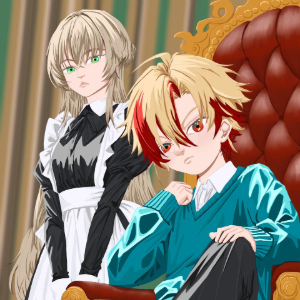
Strangely, it was Aina who truly magnetized the public gaze. Her Mellou heritage made her appearance impossibly striking: platinum-blond hair that seemed spun from moonlight, emerald eyes that absorbed the light, and a posture so innately aristocratic it seemed to defy gravity. She was a walking, breathing paradox—a miniature, unnerving version of Lady Elara Dukker herself. The uniform seemed only to enhance her elegance.
Aina, sensing the attention, instinctively shifted closer to Elias, her protective instincts immediately surfacing, her face remaining cold and emotionless.
As they navigated the tight, crowded passages, the whispers followed them like a hostile wave. The people of Blackhaven were keenly aware of the Dukker family and the hierarchy of the Keep situated above them.
“Is that the young lord?” a woman muttered, quickly covering her mouth with her shawl as the trio passed her stall.
“He is a spitting image of his parents,” another whispered, eyes wide with appraisal, focused on Elias’s own deep gem-like eyes and fair features.
“He looks so cute.”
“And who is the other girl?” a young man asked, his gaze fixed on Aina’s platinum hair.
“My sister works up at the Keep,” a third voice, slightly more authoritative, replied in a hushed tone.
“She says that’s the last-born daughter of Ortis Mellou.”
The name Ortis Mellou caused a ripple of reverence.
“Wait, you mean THE Ortis Mellou? The Hierophant Pragon?”
“No wonder she carries that air around her,” the first voice conceded, sounding slightly intimidated.
But the respect quickly dissolved into resentment.
“I bet she’s nothing special. They’re both just privileged brats who don’t have to work and are handed everything,” a sour, male voice cut in, laced with bitter judgment.
“They don’t even know what a day’s labor looks like.”
“Don’t say that, Barnaby!”
“But it’s the truth. Look at them. They’re tourists in their own land.”
“But why is she in a maid uniform though?” the woman asked, puzzled.
“Is she mocking us?” The one reffered to as Barnaby said.
Elias registered the entire wave of gossip with the detached, analytical part of his mind. He wasn't insulted by the accusations of privilege—they were accurate—but he was profoundly bored by the emotional simplicity of their judgments.
'Envy, ignorance, and misinterpretation of the uniform. A predictable reaction set.' He mused. It was just more noise.
He looked over at Aina. Her features remained perfectly still, but her jaw was subtly clenched, and the knuckles of her hands, held in front of her, were white. She was visibly restraining herself from deploying her cold logic and her considerable Flow to address the "haters." She cast a glance at the one called Barnaby, causing him to shiver under her cold gaze and nodded once. For all her coldness, she retained a fierce loyalty to her brother and the honor of her family name. Otherwise...
Roric, by contrast, was an island of calm. He completely ignored the gossip, offering a polite, almost imperceptible nod of greeting to anyone who dared meet his eye. He was focused, entirely unbothered by the static of the crowd.
They reached a wide, cobbled lane leading toward the gate at the city's western edge—the direction of the wild forests where Roric clearly intended their training to take place. On the corner stood a sturdy, nondescript building of dark stone, marked only by a simple, weathered sign: a stylized silhouette of a coiled serpent pierced by an arrow. The Hunter Bureau.
Roric slowed his pace to match the less efficient stride of the two younger students. He glanced back to ensure they were listening, his purple eyes clear and steady.
“You haven’t been outside the Keep before, have you, Elias?” Roric’s voice, calm and perceptive, broke the silence. The Hunter had stopped, noticing the quiet intensity of Elias’s gaze as he subtly studied his surroundings. Elias turned, composing his features into their usual polite curiosity.
Roric nodded thoughtfully.
“Elara is very protective. Its not really a surprise she never brought her little boy out."
A flicker of heat, sharp and unwelcome, crossed Elias’s mind.
'Little boy.'
The casual infantilization, the assumption that he was fragile, chipped away at his carefully constructed calm. He knew his body was physically weaker than his mind was sharp, but the suggestion of his need for maternal shielding was tiresome. The resentment was brief, however, quickly smothered by the deeper, more pervasive internal emptiness.
'A shame. Danger would be the most interesting thing to encounter.'
"Then again, how is the future ruler of the region going to do his job ife he doesn't know his own people?'' Roric added, soliciting an innocent smile from Elias.
'' Well, theres a first time for everything.'' He replied, pitching his voice with an appropriate amount of eagerness.
“Alright,” Roric said, gesturing to the building and then to the road ahead.
“Before we get outside, we are going to talk about the core elements of the Hunter’s craft. Specifically, the relationship between Hunters and Nodes..”
He stopped completely, allowing the noise of the city to wash over them, emphasizing the practical application of his words.
“Every Hunter, whether working for the Guild in Aethelburg or patrolling the frontiers of Aerthos, operates under two simple assumptions: danger is abundant, and resources are finite. We don't have the infinite, renewable energy . We use what the world gives us. We are going to begin with the basic so lsiten well.”
They began to walk again.
“Tell me, Elias,” Roric challenged gently, “what is a Node?”









Comments (0)
See all